

Bringing employee voices into our AI decision-making
The early phase of enterprise AI can be a little chaotic, and that’s OK. Teams experiment. Ideas are generated across the organization. Momentum builds fast. That energy and enthusiasm matters, but it doesn’t create enterprise value on its own.
In Microsoft Digital, the company’s IT organization, we’ve learned that effectively scaling AI requires a connected operating model that determines what matters, supports execution, strengthens data readiness, improves processes, includes responsible AI practices, and consistently measures outcomes.
That’s why we built a council-based model for our internal AI deployment, which—loosely translated—means we’re using a network of cross-functional leaders to align our priorities, remove roadblocks, and otherwise guide our AI adoption across Microsoft.

“Our AI decisions and direction must be grounded in business strategy. AI councils provide guidance and enablement for our organization, ensuring our investments in AI generate tangible benefits to our business.”
Myron Wan, principal group product manager, Microsoft Digital
Our different AI councils work in concert to help us focus our energy on the AI-enabled scenarios that matter most. The councils function as a connected system, with each council having a distinct role to play:
- Our strategy council keeps us focused on the highest-value scenarios.
- Our enablement council turns direction into reusable practices and scalable execution.
- Our data council strengthens our foundation beneath AI.
- Our continuous improvement council helps our teams improve work before they automate it.
- Our responsible AI and compliance council builds trust, accountability, and review discipline into our delivery.
- Our measurement council helps us close the loop by defining, tracking, and refining the value of our AI investments over time.
Change management is a throughline for all of our councils, because AI transformation only sticks when people understand what’s changing, why it matters, and how they’re expected to adopt it.
This IT playbook will explain the key components you can put in place in your own system of AI councils, allowing you to derive more value from AI investments at your company. It delineates what these different councils should do, drawing on our own experience and context to help you move from experimentation to a more repeatable model for AI enablement.
“Our AI decisions and direction must be grounded in business strategy,” says Myron Wan, principal group product manager in Microsoft Digital. “AI councils provide guidance and enablement for our organization, ensuring our investments in AI generate tangible benefits to our business.”

Inside Track series: AI councils at Microsoft
Learn how employee councils are shaping how we use AI at Microsoft.
Chapter 1: Get AI right with an AI continuous improvement council
If you want AI to create durable value, start with the work itself. In our experience, that means establishing a continuous improvement (CI) council that can look at your business workflows with rigor before teams start layering AI on top.
Our continuous improvement council focuses our efforts on real business problems while driving operational excellence. It provides the following for all our teams building AI solutions:
- Structured problem solving
- Prioritization
- Value realization
- Coaching
- Learning
“Continuous improvement is about process, but it’s also about people,” Wan says. “A guiding hand like the CI council is how you make sure those two components align.”
That discipline matters, because AI can just as easily accelerate the wrong thing as the right one. We’ve adopted a “CI before AI” mindset to keep that from happening.
Before any team at Microsoft automates a process with AI, we want them to analyze where work gets stuck, where waste accumulates, where value is actually created, and how success will be measured after automation. In practice, that has meant using tools and routines like Gemba walks, Kaizen events, bowler cards, and monthly business reviews to expose friction and prioritize opportunities.
Our CI council also helps protect AI from becoming a disconnected innovation stream. Instead of asking which new AI capability looks interesting, teams are encouraged to ask which operational problem is worth solving and what form of AI can help solve it. Here are a few examples from our own experience:
- In our asset management work, the team used continuous improvement to break work into value-add and non-value-add categories before applying AI to registration and data normalization.
- In our designated responsible-individual work, the team reviewed the workflow first, then used that understanding to shape a multifunctional agent that could support summarization, handoff, and reporting.
Key takeaways
Keep process improvement at the center of AI deployment by applying these principles through your council:
- Improve the workflow before you automate it. A continuous improvement council gives teams a way to identify waste, prioritize high-value changes, and avoid automating broken steps.
- Use structured methods to make AI decisions practical. Regular reviews can generate evidence for where AI can help and where it won’t.
- Treat value realization as part of process design. Process work should connect directly to the business result you expect AI to improve.
Learn more
How we did it at Microsoft
- Learn how we created a continuous improvement AI council at Microsoft.
- Explore how we’re building a continuous improvement culture at Microsoft.
Further guidance
Chapter 2: Stand up a strategy council to decide what matters most
Our strategy council allows us to turn a collection of individual AI initiatives into a coordinated vision for the company. It brings together business and technology leaders to ensure that AI investments are aligned with strategic business outcomes and focused on the scenarios that can deliver the greatest value.
“Our strategy council helps us identify our top AI-enabled scenarios. It allows us to be very clear about our most significant efforts and needs. This council validates that there is a one-to-one alignment of the things we’re working on with the goals we’re trying to achieve.”
Myron Wan, principal group product manager, Microsoft Digital
Through the council, we identify and prioritize the most impactful AI opportunities, define the key performance indicators (KPIs) that will measure success, and evaluate the relative impact of different initiatives across the organization. This process helps us make informed decisions about where to invest, scale, and accelerate adoption.
Just as importantly, the strategy council creates a shared narrative around our AI portfolio. By connecting investments, priorities, and outcomes into a cohesive story, it equips leaders with the context and insights they need to guide decision making, communicate priorities, and steer our AI strategy with confidence.
“Our strategy council helps us identify our top AI-enabled scenarios,” Wan says. “It allows us to be very clear about our most significant efforts and needs. This council validates that there is a one-to-one alignment of the things we’re working on with the goals we’re trying to achieve.”
That work evolved over time.
Our early AI work included enablement, responsible AI, and data motions that helped teams experiment and learn. The strategy layer emerged when we needed a way to determine which AI-enabled scenarios mattered most and how they connected to strategic objectives and KPIs. The center of gravity shifted from “What can AI do?” to “Which business outcomes are important enough to elevate, review regularly, and resource deliberately?”
In practice, we’ve learned that a strategy council needs a few clear operating rules:
- You need to group your AI work into a small number of focus areas that reflect how your organization operates. For us, that meant segmenting our effort around our top work areas, like AI for IT and AI for corporate functions. Then we categorized our AI initiatives into different domains, such as employee experience, support, tenant management and security, network and devices, and related business functions. That structure creates visibility across the portfolio and makes it easier to spot duplication and gaps.
- Keep execution with your product owners. Our strategy council sets our direction, but our product management teams own our delivery.
- Create a consistent language for what value looks like for your organization. This allows your teams to describe the impact that they’re expecting in ways your leaders can compare across your teams and products.
The operating rhythm of your organization plays a key role as well: having a predictable and transparent cadence of check-ins and progress reports as a team will keep you aligned. Our strategy conversations moved forward when they became lightweight, recurring, and easier for teams to dock into when appropriate.
Our teams also reduced friction by creating a more minimally invasive way of reporting progress against our KPIs to our leaders. This helped our strategy council evolve from a layer that teams felt like was “checking their homework” into a body that became the central way we told our cohesive enterprise story.
Key takeaways
A strategy council helps transform AI from a collection of projects in an organization into a coordinated business strategy:
- Define business priorities before evaluating AI opportunities. Focus on the outcomes that matter most to your organization, then identify where AI can create the greatest impact.
- Create a shared view of your AI portfolio. Organizing initiatives into common focus areas helps leaders compare investments, reduce duplication, and make better decisions.
- Separate governance from delivery. The strategy council provides direction and accountability, while product teams own execution and results.
Learn more
How we did it at Microsoft
- Read about how our strategy council steers our AI deployment at Microsoft.
- Learn more about our strategy for using councils to guide our AI deployment.
Further guidance
Chapter 3: Use an enablement council to make AI scalable
An AI strategy council can decide what matters. But it can’t, by itself, make teams better at building solutions to deliver on what matters. That’s where an enablement council comes in—it connects strategy to execution, helps teams adopt common practices, strengthens governance, and scales up capabilities. We call ours the AI Center of Excellence (CoE).
“We did a lot of good work building community and excitement around AI. But at some point, we needed to evolve and put more structure around what we’d built.”
Myron Wan, principal group product manager, Microsoft Digital
The key shift in our own AI deployment journey was moving from a community-oriented AI model to a more execution-focused one.
Early on, our CoE helped our teams try out AI tools, learn quickly, and build excitement. That created useful momentum, but it also led to duplication, uneven governance, and gaps in reporting. Over time, our CoE changed shape. It became a coordination layer that could look across individual initiatives and answer broader questions about standards, overlap, reuse, and readiness to scale.
Our AI Center of Excellence covers the following key areas:
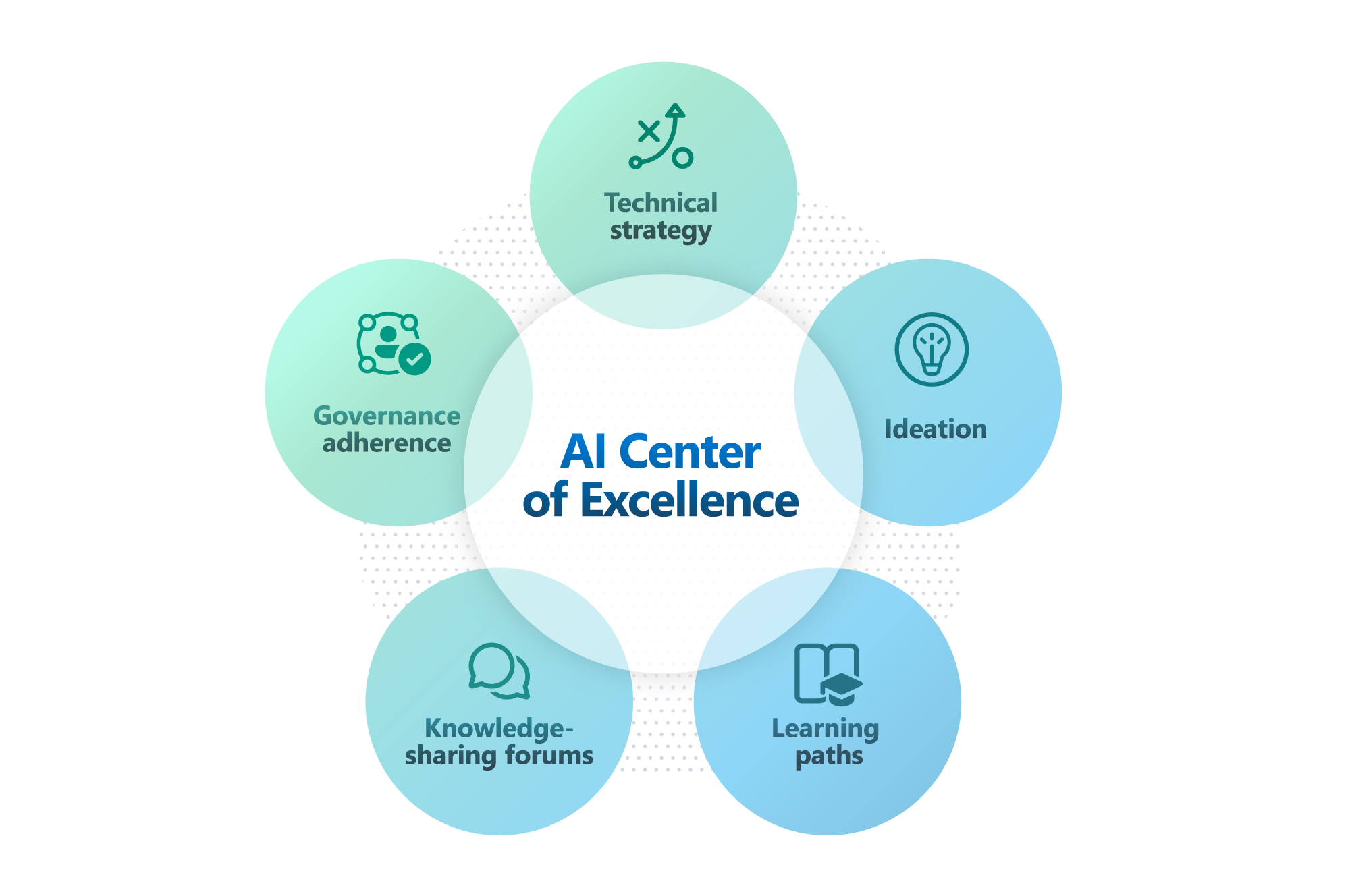
That work is organized around four core functions: Strategy, architecture, roadmap, and culture. In practical terms, that means our CoE council gives teams a shared intake and prioritization path, reusable patterns, clearer standards, and a mechanism for turning local experimentation into enterprise learning.
“We did a lot of good work building community and excitement around AI,” Wan says. “But at some point, we needed to evolve and put more structure around what we’d built.”
Our council also helps our teams think about governance earlier. In our internal agent work, for example, the conversation moved from “What did we build?” to “What’s running, who owns it, what’s compliant, and what should scale?” That visibility helped teams account for manageability, security, and readiness sooner.
This is also where culture has a real impact. Our enablement work defines expectations for how teams propose ideas, learn patterns, share knowledge, and adopt AI responsibly. Champions programs (such as our Copilot Champs effort) and community forums are also important, because AI adoption fragments quickly when teams learn in isolation.
Key takeaways
An enablement council—or Center of Excellence—helps you move from isolated AI projects to repeatable, enterprise-scale adoption.
- Create a central team to help scale AI across the organization. An AI Center of Excellence can provide standards, guidance, learning resources, and shared practices so teams don’t have to solve the same problems independently.
- Turn successful experiments into reusable patterns. Capture what works, document best practices, and share them broadly so teams can build on proven approaches instead of starting from scratch.
- Build governance and readiness into the development process. Help teams consider ownership, compliance, security, and operational support before solutions are deployed at scale.
Learn more
How we did it at Microsoft
- Read about how our AI Center of Excellence powers AI deployment at Microsoft.
- Check out the ways that we manage agents with Agent 365 and Copilot controls.
- See how we’re driving Copilot adoption with our Champs Community.
Further guidance
Chapter 4: Create a data council to ensure your AI is trustworthy and reusable
AI doesn’t scale on access alone. It also depends on trusted, discoverable, governed data. That’s where our AI data council comes in.
Our Microsoft data council is responsible for:
- Defining our enterprise data strategy
- Establishing our governance policies and controls
- Improving how we secure access to AI
- Raising our data quality
- Strengthening our lineage and transparency
- Improving our data literacy
- Prioritizing our data investments

“High-quality, well-governed data is essential to allow us to accelerate implementation and adoption of AI tools at the company. Data quality, accessibility, and governance are imperatives for AI systems to function effectively, and recognizing that is propelling our data strategy.”
Miguel Uribe, principal PM manager, Microsoft Digital
Our data strategy has evolved through the same tension that many enterprises are experiencing: The need to balance speed with control. We’ve moved through decentralized and centralized models, and today we’re working with a more federated, data mesh-oriented approach.
This allows our domain teams to stay close to the data they understand best, while shared platforms enforce standards for governance, metadata, security, and interoperability. In our council model, that’s how we balance domain ownership with enterprise consistency.
In practical terms, our AI data council has focused on three foundational dimensions:
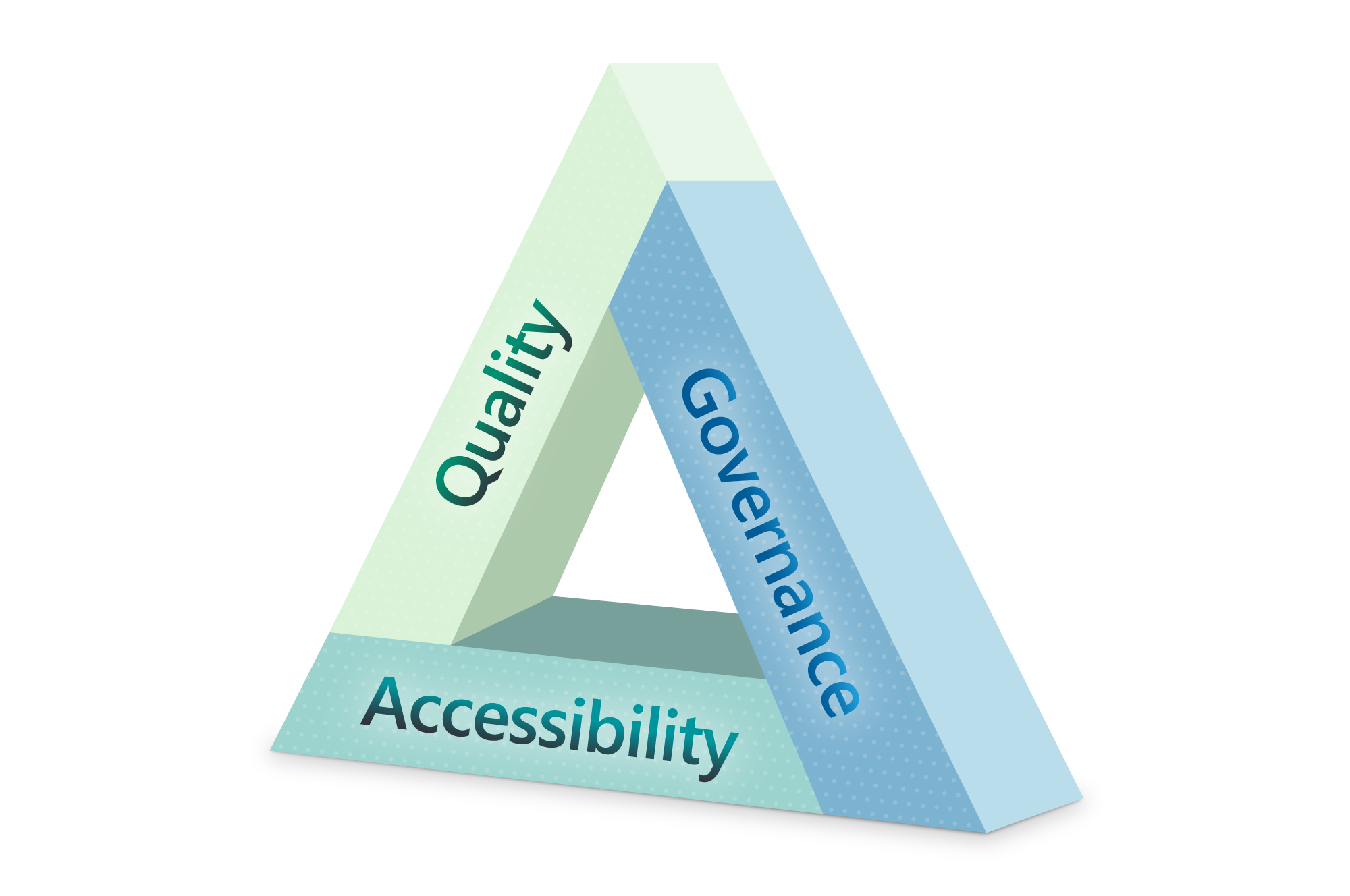
AI-ready data needs to be available, complete, accurate, and current. It should be discoverable and accessible without weakening security. And it needs lineage, policy enforcement, and transparency, so both people and systems can trust what they find.
In our data story, Microsoft Purview supports our governance, classification, monitoring, lineage, and policy enforcement. Microsoft Fabric helps us unify siloed data into a shared mesh architecture that supports analytics and AI scenarios. We also use a catalog model as a discovery layer, so employees and AI systems can find canonical datasets and understand ownership, freshness, and governance constraints.
“High-quality, well-governed data is essential to allow us to accelerate implementation and adoption of AI tools at the company,” says Miguel Uribe, a principal PM manager in Microsoft Digital. “Data quality, accessibility, and governance are imperatives for AI systems to function effectively, and recognizing that is propelling our data strategy.”
Data literacy is another major function of this council.
Our data council works with the AI Center of Excellence to create learning pathways, certifications, and community programs that move employees beyond data awareness into applied data and AI capability. This is crucial, because organizations don’t build trustworthy AI with architecture alone. They can only create it when teams understand how data powers outcomes and how governance supports speed, instead of blocking it.
Key takeaways
Here are some principles our AI data council relies on to make sure trusted, governed data shapes every organizational AI decision from the start:
- Make trusted data a council-level responsibility. AI-ready data needs strategy, governance, discoverability, and prioritization, not just platform work.
- Use a federated model with shared standards. A data mesh-oriented approach can preserve domain ownership while still enforcing enterprise trust.
- Treat data literacy as part of readiness. Employees need to understand how data supports AI systems if they’re going to build and run them responsibly.
Learn more
How we did it at Microsoft
- Discover how a data council is powering our unified data strategy at Microsoft.
- Learn how we’re building the foundation for enterprise AI at Microsoft with AI-ready data.
- Check out our approach to governing AI agents at scale in this playbook.
Further guidance
Chapter 5: Build a responsible AI and compliance council to scale trust
AI governance needs an organizational home that your teams can see, understand, and work with. Our responsible AI and compliance council:
- Enforces our responsible AI principles
- Defines our compliance and risk frameworks
- Oversees our review and monitoring processes
- Keeps our AI delivery aligned with the broader standards and policies we use to govern Microsoft

“The Office of Responsible AI established clear principles and a step-by-step assessment framework and tool. Our responsibility is to rigorously follow this process and ensure compliance across our products and initiatives.”
Naval Tripathi, principal engineering manager and responsible AI co-lead, Microsoft Digital
Our foundation for this work at Microsoft is our Office of Responsible AI and our Microsoft Responsible AI Standard. This body translates responsible AI standards into concrete expectations for projects across the company.
In our internal IT organization, our responsible AI motion materializes through a combination of leadership alignment, division-level ownership, and a network of champions who support teams during design and release assessment.
In other words, our council is both centralized and distributed by design.
For customers building a similar council, the biggest lesson we’ve learned is that responsible AI has to be embedded into delivery, not bolted on at the end. In our case, our teams register projects in a workflow tool and complete initial assessments before they start work and then go through a deeper release assessment when a scenario requires it.
Our champions participate as reviewers and advisors, which helps our teams think through impacts, mitigations, and documentation early in the lifecycle of their projects. This creates a consistent review record across our many different AI projects and agent types.
“The Office of Responsible AI established clear principles and a step-by-step assessment framework and tool,” says Naval Tripathi, principal engineering manager and co-lead for Microsoft Digital’s responsible AI team. “Our responsibility is to rigorously follow this process and ensure compliance across our products and initiatives.”
Your responsible AI council should enforce the following principles when overseeing AI work at your organization:
- Fairness
- Inclusiveness
- Reliability and safety
- Transparency
- Accountability
- Privacy and security (as part of the broader Microsoft framework)
Structures will vary from company to company, but the overall pattern is consistent: define standards centrally, activate champions locally, create a review workflow that teams can actually use, and keep regulatory and policy updates flowing back into training and development practices.
Key takeaways
Responsible AI becomes scalable when review, accountability, and guidance are built into your work. Here are some tips to help you handle this area at your company:
- Build a council that makes responsible AI operational. Principles matter, but teams also need workflows, reviewer roles, and decision support.
- Use champions to extend the model. Centralized standards scale better when local subject matter experts help interpret and apply them.
- Make review part of the design process. Responsible AI works when teams engage with it early and continuously.
Learn more
How we did it at Microsoft
- See why responsible AI matters and how we infuse it into internal AI projects at Microsoft.
- Learn how we’re tackling Microsoft 365 Copilot governance internally.
Further guidance
Chapter 6: Prove value and improve decisions with a measurement council
AI governance means deciding where to invest. It also means being able to prove whether those investments changed anything that matters. That’s why an AI measurement council belongs in the center of your operating model, not on the edge of it.
In our organization, this council is responsible for:
- Defining a unified KPI framework
- Measuring and reporting our value realization
- Enabling monthly and quarterly reviews
- Informing our prioritization
- Tracking our maturity
- Scaling progress across our organization
“The six value areas give us a framework for measurement, but we need to observe and collect information where measurement starts to make it practical. Teams need to understand the processes affected, including how long work takes, how many resources are involved, and what the workflow looks like before and after AI.”
Myron Wan, principal group product manager, Microsoft Digital
Our own value framework emerged because a single metric couldn’t capture the range of outcomes that AI can create. We now organize value through six areas:
- Revenue impact
- Productivity and efficiency
- Security and risk management
- Employee and customer experience
- Quality improvement
- Cost savings
Not every initiative needs to contribute to every area. What matters is having a consistent language for value, choosing measures that fit the scenario, and deciding up front how those measures will be observed.
“Measurement sources vary based upon the type of AI initiative,” Wan says. “The six value areas give us a framework for measurement, but we need to observe and collect information where measurement starts to make it practical. Teams need to understand the processes affected, including how long work takes, how many resources are involved, and what the workflow looks like before and after AI.”
A measurement council needs to go beyond basic savings claims. The first phase of our value work emphasized the following metrics:
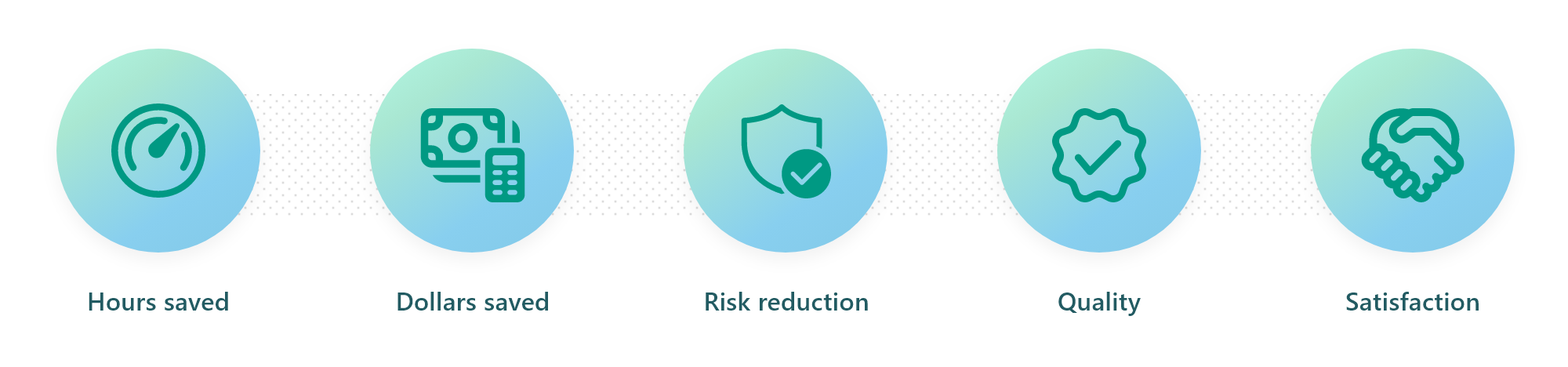
The next phase asked a harder question: Where were those hours and dollars being reinvested, and what business outcome did that reinvestment create? That shift matters, because time saved is only a strong metric when the organization can explain what the regained capacity enabled next.
Your mechanics are important, too. We use value-versus-effort scoring to identify AI opportunities inside support workflows, looking at factors such as repetition, autonomy potential, time savings, data availability, complexity, and implementation time. That approach helps us prioritize specific subprocesses—including follow-up work in ticket management—where AI can create measurable value.
We also emphasize baselining and time-and-motion comparisons, because AI often exposes where teams were not measuring their existing workflows clearly enough. In our experience, measurement belongs in the investment decision itself. If teams wait until launch, they are likely to be missing telemetry, baseline data, or ownership clarity.
The measurement council should also keep the broader operational metrics visible. These include responsible AI adherence, AI and data fluency, playbook and toolkit usage, published use cases, data modernization progress, reusable AI components, service-level agentification, and role-level adoption. That wider lens helps the council measure organizational readiness and scale relative to business output.
Key takeaways
Define AI value early, then use consistent measurement to improve decisions over time. Here are some lessons we’ve absorbed in this area:
- Design AI measurement before launch. Your teams need a baseline, clear telemetry, and agreed-upon measures as part of the investment decision.
- Measure more than savings. Reinvestment, quality, risk, experience, and maturity signals are all part of AI value.
- Review results on a regular rhythm. Monthly and quarterly review cycles help your leaders compare investments, test assumptions, and make faster adjustments.
Learn more
How we did it at Microsoft
- Read how we measure the impact of our AI investments in IT at Microsoft.
- Learn more about the how we measure the value of Microsoft 365 Copilot and agents at Microsoft.
Further guidance
Conclusion
Setting up a council model at your organization won’t make managing AI simple. The overall goal is to make enterprise AI more coherent. A connected set of councils helps an organization decide what matters, improve the workflows behind it, produce and manage trustworthy data, strengthen execution, govern responsibly, and measure what changes.
That’s how AI work starts to look more like a repeatable operating model and less like scattered experimentation.
“What got us here won’t get us to where we need to go next. We started with broad experimentation, and now we’re continuously evolving to think about scale, alignment to business goals, and making sure our investments are driving the right outcomes.”
Myron Wan, principal group product manager, Microsoft Digital
The biggest lesson from our experience is that these councils work best as part of a connected ecosystem. Strategy without enablement stalls. Enablement without data weakens outcomes. Data without responsible AI weakens trust. Process without measurement lessens accountability.
That interdependence is what makes the model useful. It also makes it adaptable. The specific council names or reporting paths may differ from ours, but the capabilities still need homes. And flexibility and refinement is vital.
“What got us here won’t get us to where we need to go next,” Wan says. “We started with broad experimentation, and now we’re continuously evolving to think about scale, alignment to business goals, and making sure our investments are driving the right outcomes.”
Key takeaways
Together, these principles show how connected AI councils can become a coherent operating model for enterprise AI deployment. Here are some of the major lessons learned from our experience:
- Use councils as a connected system. Each council should solve a distinct problem, but the model only works when the different councils reinforce one another.
- Start with business problems, not AI features. Strategy should define the “what” and “why,” while AI helps deliver the “how.”
- Improve workflows and data before you scale AI. Process discipline, trusted data, and governance all increase the odds that AI creates durable value.
- Build for learning as well as control. Your AI councils should reduce duplication, create reusable patterns, and help the organization get smarter over time.
- Measure outcomes on a regular rhythm. AI accountability depends on value definition, review cadence, reinvestment clarity, and ongoing refinement.
Learn more
How we did it at Microsoft
- Read our Inside Track post on how we guide AI deployment with a set of employee councils at Microsoft.
- Check out our insights on steering AI deployment with a strategy council.
- Learn how we’re powering the technical veracity of AI at Microsoft with a Center of Excellence.
- See how a data council is powering our unified AI data strategy at Microsoft.
- Discover ways we’re reshaping Microsoft with continuous improvement and AI.
- Learn about our approach to infusing responsible AI principles across Microsoft.
- Explore the techniques we use for measuring the impact of our AI investments at Microsoft.
Further guidance
- Discover the different Microsoft AI solutions available for enterprise use.
- Check out the latest about Microsoft 365 Copilot.
