

Information technology is an ever-evolving landscape. Artificial Intelligence is accelerating that evolution, providing employees with unprecedented access to information and insights. Data-driven decision making has never been more critical for businesses to achieve their goals.
In light of this priority, we have established a data council to help accelerate our companywide AI-powered transformation.
Our data council is a cross-functional team with representation from multiple domains within Microsoft, including Microsoft Digital, the company’s IT organization; Corporate, External, and Legal Affairs (CELA); and Finance.

“By championing robust data governance, literacy, and responsible data practices, our data council is a crucial part of our AI-powered transformation. It turns enterprise data into a strategic capability that fuels predictive insights and intelligent outcomes across the organization.”
Naval Tripathi, principal engineering manager, Microsoft Digital
Our data council’s mission is to drive transformative business impact by establishing a cohesive data strategy across Microsoft Digital, empowering interconnected analytics and AI at scale. Our vision is to guide our organization toward Frontier Firm maturity through a clear blueprint for high-quality, reliable, AI-ready data delivered on trusted, scalable platforms.
“By championing robust data governance, literacy, and responsible data practices, our data council is a crucial part of our AI-powered transformation,” says Naval Tripathi, principal engineering manager in Microsoft Digital. “It turns enterprise data into a strategic capability that fuels predictive insights and intelligent outcomes across the organization.”
AI councils at Microsoft
Check out our series on how employee councils are guiding how we use AI here at Microsoft.
- Guiding our AI deployment with a set of employee councils.
- Harnessing AI: How a data council is powering our unified data strategy at Microsoft (this story)
- Powering the technical veracity of AI at Microsoft with a Center of Excellence
- Accelerating transformation: How we’re reshaping Microsoft with continuous improvement and AI
- Responsible AI: Why it matters and how we’re infusing it into our internal AI projects at Microsoft
- Visualizing success: Steering your AI deployment with a strategy council
- Measuring the impact of our AI investments in IT at Microsoft
Our evolving data strategy
Over the past two decades, we at Microsoft—along with other large enterprises—have continuously evolved our data strategies in search of the right balance between control and agility. Early approaches were highly decentralized, with different teams owning and managing their own data assets. While this enabled local optimization, it also resulted in inconsistent quality and limited enterprise-wide insight.
Our subsequent shift toward centralized data platforms brought much-needed standardization, security, and scalability. However, as data platforms grew more sophisticated, ownership often drifted away from the business domains closest to the data, slowing responsiveness and diluting accountability.
Today, we and other leading companies are embracing a more balanced, federated approach, often described as a data mesh. Rather than forcing all our data into a single centralized system or allowing unchecked decentralization, the data mesh formalizes domain ownership while embedding governance, quality, and interoperability directly into shared platforms.
With this approach, our domain teams publish data as well-defined, discoverable products, while common standards for security, metadata, and compliance are enforced through automation rather than manual processes. This model preserves enterprise trust and consistency without sacrificing speed or autonomy.
By adopting a data mesh mindset, we can scale analytics and AI more effectively across the organization while still keeping ownership closely connected to the business focus. The result is a system that supports innovation at the edges, strong governance at the core, and seamless collaboration across domains, enabling the transformation of data from a technical asset to a strategic, enterprise-wide capability.
Quality, accessibility, and governance
To scale enterprise data and AI, organizations must first ensure their data is trusted, discoverable, and responsibly governed. At Microsoft Digital, our data strategy is designed to create data foundations that power intelligent applications and effective decision making across the company.

“High-quality, well-governed data is essential to accelerate implementation and adoption of AI tools. Data quality, accessibility, and governance are imperatives for AI systems to function effectively, and recognizing that is propelling our data strategy.”
Miguel Uribe, principal PM manager, Microsoft Digital
By implementing a data mesh strategy at scale, we aim to unlock valuable data insights and analytics, enabling advanced AI scenarios. Our data council focuses on three core dimensions that make AI-ready data possible:
- Quality: Making sure enterprise data is reliable and complete
- Accessibility: Enabling secure and discoverable access to data
- Governance: Protecting and managing our data responsibly
Together, these dimensions form the foundation for scalable innovation and AI-powered data use. They connect data silos and ensure consistent, high‑quality access across the enterprise—enabling both humans and AI systems to work from the same trusted data foundation. As AI use cases mature, this foundation allows AI agents to retrieve and reason over data through enterprise endpoints, while supporting advanced analytics, data science, and broader technology.
“High-quality, well-governed data is essential to accelerate implementation and adoption of AI tools,” says Miguel Uribe, a principal PM manager in Microsoft Digital. “Data quality, accessibility, and governance are imperatives for AI systems to function effectively, and recognizing that is propelling our data strategy.”
Quality
AI-ready data is available, complete, accurate, and high-quality. By adopting this standard, our data scientists, engineers, and even our AI agents are better able to locate, process, and govern the information needed to drive our organization and maximize AI efficiencies.
By utilizing Microsoft Purview, our data council can oversee the monitoring of data attributes to ensure fidelity. It also monitors parameters to enforce standards for accuracy and completeness.
Accessibility
Ensuring that our employees get access to the information they need while prioritizing security is a foundational element of our enterprise data strategy. Microsoft Fabric allows us to unify our organization’s siloed data in a single “mesh” that enables advanced analytics, data science, data visualization and other connected scenarios.
Microsoft Purview then gives us the ability to democratize that data responsibly. By implementing a data mesh architecture, our employees can work confidently, unencumbered by siloed or inaccessible data, and with the assurance that the data they’re working with is secure.
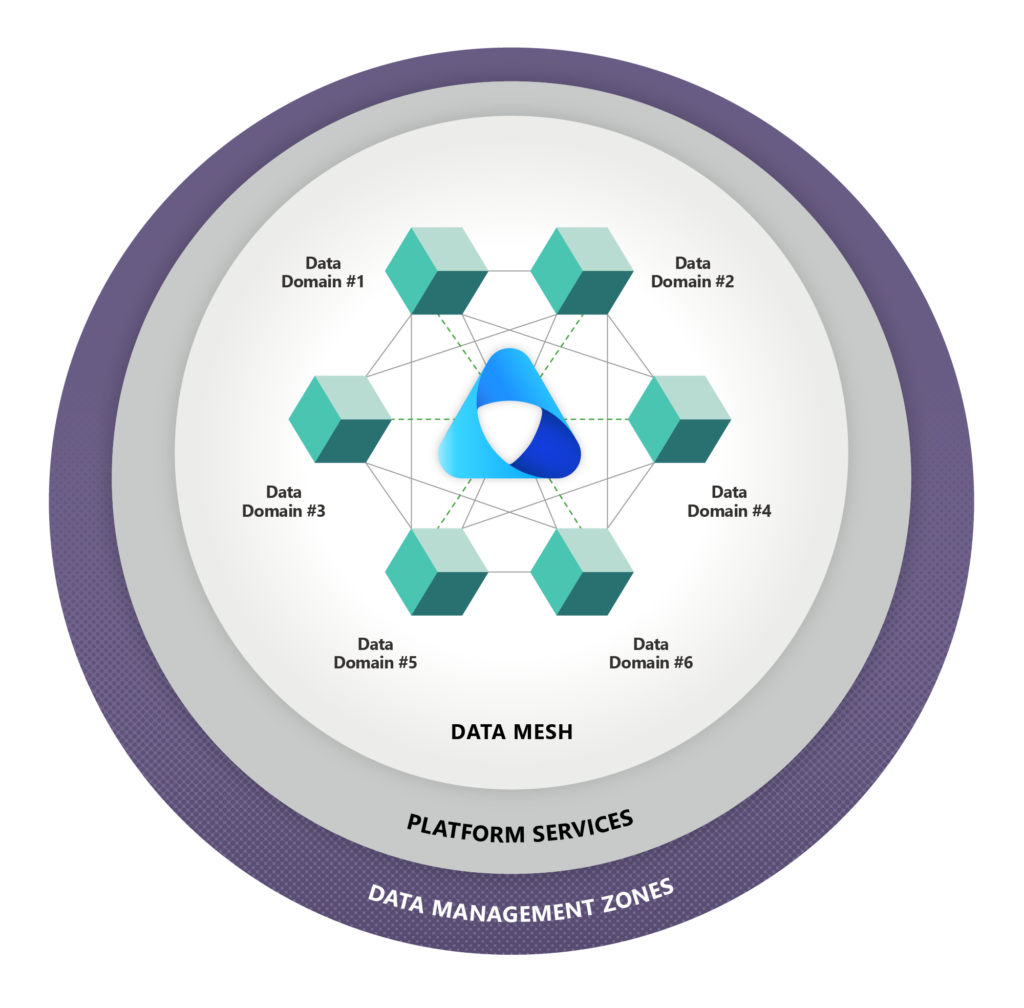
The data mesh connects and distributes data products across domains, enabling shared data access and compute while scaling beyond centralized architectures.
Platform services are standardized blueprints that embed security, interoperability, policies, standards, and core capabilities—providing guardrails that enable speed without fragmentation.
Data management zones provide centralized governance capabilities for policy enforcement, lineage, observability, compliance, and enterprise-wide trust.
Governance
As organizations scale AI capabilities, strong governance becomes essential to ensure security, compliance, and ethical data use. Data governance—which includes establishing data policies, ensuring data privacy and security, and promoting ethical AI usage—is critical, as is compliance with General Data Protection Regulation (GDPR) and Consumer Data Protection Act (CDPA) regulations, among others.
However, governance is not only a technical capability; it’s also a cultural commitment.
Responsible data use must be embedded into the way teams manage data and build AI solutions. Through Microsoft Purview, we implemented an end-to-end governance framework that automates the discovery, classification, and protection of sensitive data across the enterprise data landscape.
This unified approach allows teams to innovate confidently, knowing that the data powering their insights and AI systems is trusted and protected, as well as responsibly managed.
“AI systems are only as reliable as the data that powers them,” Uribe says. “By investing in trusted and well-managed data, we accelerate not only the adoption of AI tools but our ability to generate meaningful insights and intelligent outcomes.”
The data catalog as the discovery layer
By serving as a common discovery layer for humans and AI, the data catalog ensures that governance translates directly into speed, accuracy, and trust at scale.
A unified data strategy only succeeds if both people and AI systems can consistently find the right data. At Microsoft, this is enabled by our enterprise data catalog, which operationalizes the standards set by our data council.
For business users, the catalog provides intuitive search, ownership transparency, and trust signals—enabling confident self‑service analytics. For AI agents, the same catalog exposes machine‑readable metadata, allowing agents to programmatically discover canonical datasets, validate schema and freshness, and respect governance constraints.
Our role as Customer Zero
In Microsoft Digital, we operate as Customer Zero for the company’s enterprise solutions, so that our customers don’t have to.
That means we do more than adopt new products early. We deploy them at enterprise-scale, operate them under real‑world constraints, and hold them to the same standards our customers expect. The result is more resilient, ready‑to‑use solutions and a higher quality bar for every enterprise customer we serve.

“When we engage product teams with real telemetry from how data is created, governed, and consumed at scale, we move the conversation from theory to execution. That’s how enterprise readiness becomes real.”
Diego Baccino, principal software engineering manager, Microsoft Digital
Our data council embodies this Customer Zero mindset through its Enterprise Readiness initiative. By engaging product engineering as a unified enterprise voice, the council drives strategic conversations that surface operational blockers, influence roadmap prioritization, and ensure new and existing data solutions are truly ready for enterprise use.
These learnings are then shared broadly across Microsoft Digital to accelerate adoption, reduce duplication, and scale proven patterns across teams.
“When we engage product teams with real telemetry from how data is created, governed, and consumed at scale, we move the conversation from theory to execution,” says Diego Baccino, a principal software engineering manager in Microsoft Digital and a member of the council. “That’s how enterprise readiness becomes real.”
This work is deeply integrated with our AI Center of Excellence (CoE), where Customer Zero principles are applied to accelerate AI outcomes responsibly. Together, the AI CoE and the data council focus on improving data documentation and quality—foundational capabilities that are required to make AI feasible, trustworthy, and scalable across the enterprise.
By grounding AI innovation in measurable data quality and governance standards, Microsoft Digital ensures that experimentation can safely mature into production‑ready solutions. The partnership between our data council, our AI CoE, and our Responsible AI (RAI) Council is essential to our broader data and AI strategy.
“AI readiness isn’t aspirational—it’s operational,” Baccino says. “By measuring the health of our data, setting clear quality baselines, and using those signals to guide product and platform decisions, we turn data into a strategic asset and AI into a repeatable capability.”
Together, these teams exemplify what it means to be Customer Zero: Transforming enterprise experience into action, governance into acceleration, and data into durable competitive advantage.

Learn more
Advancing our data culture
Our data council plays a pivotal role in advancing the organization transition from data literacy to enterprise data and AI capability. In conjunction with our AI CoE, it creates curricula and sponsors learning pathways, operational practices, and community programs to equip our employees with the skills and mindset required to thrive in a data- and AI-centric world.
While early efforts focused on improving data literacy, our data council ’s mission has evolved to enable data and AI capability at scale together with our AI CoE—where employees not only understand data but can effectively apply it to build, operate, and govern intelligent solutions.
“Our focus is not just teaching our teams about data. It is enabling employees to apply data to create AI-driven outcomes. When teams understand how data powers AI systems, they can make better decisions, design better products, and build more responsible AI experiences.”
Miguel Uribe, principal product manager, Microsoft Digital
Our curriculum includes high-level courses on data concepts, applications, and extensibility of AI tools like Microsoft 365 Copilot, as well as data products like Microsoft Purview and Microsoft Fabric.
By facilitating AI and data training, offering internally focused data and AI certifications, and internal community engagement, our council ensures that employees develop the capabilities required to responsibly build and operate AI-powered solutions. Achieving data and AI certifications not only promotes career development through improved data literacy, it also enhances the broader data-driven culture within our organization.
“We recognize that AI capability is built when data skills are applied directly to real AI scenarios and business outcomes—not when learning exists in isolation,” Uribe says. “Our focus is not just teaching our teams about data; it is enabling employees to apply data to create AI‑driven outcomes. When teams understand how data powers AI systems, they can make better decisions, design better products, and build more responsible AI experiences.”
Lessons learned
Our data council was created to develop and execute a cohesive data strategy across Microsoft Digital and to foster a strong data culture within our organization. Over time, several critical lessons have emerged.
Executive sponsorship enables transformation
Executive sponsorship is a key element to ensure implementation and adoption of a data strategy. Our leaders are committed to delivering and sustaining a robust data strategy and culture and have been effective champions of the council’s work.
“Leadership provides support and reinforcement of the council’s mission, as well as guidance and clarity related to diverse organizational priorities,” Baccino says.
Cross-functional collaboration accelerates impact
Our council’s work has also benefited from the diverse representation offered by different disciplines across our organization. Embracing diverse perspectives and understanding various organizational priorities is critical to implementing a successful data strategy and culture in a large and complex organization like Microsoft Digital.
Modern platforms allow for scalable AI productivity
Technology and architecture also play a critical role in enabling enterprise data and AI capability. Platforms like Microsoft Purview and Microsoft Fabric provide the governance, discovery, and analytics infrastructure required to create trusted, AI-ready data ecosystems.
Combined with strong leadership support and community engagement, these platforms allow our organization to move beyond isolated data projects toward connected, enterprise-wide intelligence.
As our organization continues to evolve, our data council’s strategic work and valuable insights will be crucial in shaping the future of data-driven decision making and AI transformation at Microsoft.

Key takeaways
Here are some things to keep in mind as you contemplate forming a data council to help you manage and scale AI impacts responsibly at your own organization:
- A data mesh strikes the balance enterprises have been chasing. By formalizing domain ownership while enforcing standards through shared platforms, you avoid both chaotic decentralization and slow, over-centralized control.
- Governance is an accelerator when it’s automated and embedded. Using platforms like Microsoft Purview and Microsoft Fabric, governance shifts from a manual gatekeeping function to a built‑in capability that enables faster, trusted analytics and AI.
- AI systems are only as strong as their discovery layer. A unified enterprise data catalog allows both people and AI agents to find, trust, and use data consistently—turning standards into operational speed.
- Customer Zero turns theory into enterprise‑ready execution. By operating its own data and AI platforms at scale, Microsoft Digital provides real telemetry and practical feedback that directly shapes product readiness.
- Building AI capability is a cultural effort, not just a technical one. Our data council’s focus on applied learning, certification, and real-world AI scenarios ensures data skills translate into durable business outcomes.
- AI scale exposes the cost of fragmented data ownership. A data council cuts through silos by aligning priorities, resolving tradeoffs, and concentrating investment on the data assets that matter most for AI impact.
- Shared metrics create shared ownership. Publishing data quality and AI‑readiness scores at the leadership level reinforces accountability and positions data as a core enterprise asset.

Try it out

Related links
- Learn more about the councils that are steering AI projects at Microsoft.
- See how we’re tackling Microsoft 365 Copilot governance internally at Microsoft.
- Explore how we’re unlocking enterprise AI extensibility at Microsoft with Microsoft Copilot Studio.
- See AI-powered agents in action: How we’re embracing this new ‘agentic’ moment at Microsoft.
