

We’re in a new world of work support today, where Microsoft 365 Copilot and agentic AI make getting detailed help with a problem as easy as typing a quick question into a chat interface.
At Microsoft, we’ve put that potential into action by building the Employee Self-Service Agent, a centralized “front door” for employee support inquiries on all things Microsoft. Whether the question is related to an IT, human resources (HR), or campus services-related challenge, this agentic solution delivers geographically relevant, role-specific content on demand.
Our agent was rolled out in stages to our global workforce, as we continually added topic categories, features, and geographic availability. It eventually reached our entire workforce—more than 300,000 employees and vendors in 103 countries and regions—before being publicly released last November.
Our team in Microsoft Digital—the company’s IT organization—played a pivotal role in our global rollout, working closely with the product team and providing valuable feedback throughout development. It’s all part of our Customer Zero philosophy here at the company.
The agent proved its value early, piloting in large, primarily English-speaking regions—including Canada, India, the UK, and the US—and reaching more than half of our global workforce. But we wanted to raise the bar, so we turned to the rest of Europe.
The next chapter in the rollout was the Europe North region, which brought in 21 countries that are home to a wide variety of languages, cultures, country-specific HR policies, and nuanced IT support requirements.

“For the Employee Self‑Service Agent to work in Europe North, we had to listen locally to understand each country’s realities and respect those differences, rather than forcing a single global approach.”
Allan Hvass, director, Employee Experience in Europe North, Microsoft Digital
However, early deployments in smaller markets in the region revealed that when local content for a specific geography was missing, the agent sometimes defaulted to policies related to the US or other unrelated countries. Sensitive HR scenarios and strict country-level rules increased the complexity and resulting challenges.
Our team in Microsoft Digital met the challenge by working through front‑end field adoption and back‑end product updates to successfully land the Employee Self-Service Agent in Europe North’s small and midsize countries. This included adapting the product to distinct local realities in each country.
“For the Employee Self‑Service Agent to work in Europe North, we had to listen locally to understand each country’s realities and respect those differences, rather than forcing a single global approach,” says Allan Hvass, director for Employee Experience in the Europe North region of Microsoft Digital.
Mobilizing field representatives
To help with the tricky aspects of driving local adoption of the Employee Self-Service Agent, our team in Microsoft Digital formed an adoption advisory team. The team included leadership representatives from all major countries and business divisions.
The group established on‑the‑ground field representatives to create better communications channels with the Europe North countries. This helped us learn what was and wasn’t working locally while we extended support for neighboring countries and kept excitement around the agent alive.

“I encouraged my colleagues to use the agent, and then to tell customers about their experience,” Rusen says. “A story grounded in real use is much more powerful and authentic than any slide deck.”
Daniel Rusen, sales enablement and operations leader, Europe North
Because the team had already been communicating about the agent internally, including hosting all-hands meetings to spark early usage, we were able to collect thousands of instances of employee feedback. Key themes surfaced, including policy accuracy by country, quality of language, and IT support variance by market.
Daniel Rusen, a sales enablement and operations leader for Europe North, served as one of the field representatives. He helped the advisory team close the loop between the field and the core project by highlighting the language and local relevancy issues that were reported. He also became an evangelist for the agent, encouraging other sales executives to use the tool and experience it first-hand.
“I encouraged my colleagues to use the agent, and then to tell customers about their experience,” Rusen says. “A story grounded in real use is much more powerful and authentic than any slide deck.”
Driving adoption with contextual experiences
To support the rollout of the Employee Self-Service Agent across Europe North, we designed an adoption approach aligned with regional priorities and local ways of working.
We focused on making the value of the agent immediately tangible. Through Microsoft Viva Engage communications, we connected the agent directly to Europe North business goals and highlighted the most relevant, high-impact scenarios—helping employees quickly recognize when the agent was the right “front door” for their support needs.

“Adoption is not about pushing a tool, it’s about helping people recognize, in their own context, when it truly makes their day easier. By focusing on relevant scenarios, simple communication, and hands-on experiences, we made the Employee Self-Service Agent useful from the start.”
Edith Dubuisson, senior business program manager, Employee Experience in Europe North, Microsoft Digital
To avoid overwhelming users, we prioritized simple, focused communication formats. For example, an Advent calendar campaign combined the agent with Copilot capabilities, enabling employees to discover one practical, actionable use case at a time.
In parallel, we hosted targeted readiness sessions to demonstrate key end-to-end scenarios and share practical tips and best practices. This ensured employees not only understood the value of the agent, but also felt confident using it from day one—creating a strong and positive first experience.
“Adoption is not about pushing a tool, it’s about helping people recognize, in their own context, when it truly makes their day easier,” says Edith Dubuisson, a senior business program manager in Microsoft Digital. “By focusing on relevant scenarios, simple communication, and hands-on experiences, we made the Employee Self-Service Agent useful from the start.”
Fine-tuning the agent
Built in Copilot Studio, the Employee Self-Service Agent works on global, regional, and area levels to make sure that users receive the content that corresponds to their geographical location and preferred language.
The Microsoft Global Support Services group manages the agent capability and improvements, driven by a strong partnership with internal engineering teams. The team triaged feedback and partnered with the product group to tag accurate policies and knowledge by country, and to tune agent behavior and guardrails for localized content. They prioritized quick fixes and high-impact content gaps.
Updating the Employee Self-Service Agent to fix content mismatches in Europe North wasn’t about tweaking the AI in isolation. Instead, we needed to overhaul the content that the agent relies on.

“Instead of treating mismatches as failures alone, we used them as signals to improve the underlying content—revising articles, correcting categorization, and closing gaps in coverage. Over time, this combination of tightly scoped data sources, country-level tagging, and ongoing content curation turned the agent into a far more reliable assistant.”
David Finney, director, IT Service Management, Microsoft Digital
The team “grounded” the agent in a set of trusted, IT-approved sources: About 250,000 vetted knowledge base articles and 15-20 different internal SharePoint sites containing policies, guidelines, how-to articles, and related information.
Then they tackled regional nuances, one of the biggest drivers of content mismatches (when a user gets a reply based on content that doesn’t match their country or region). The team tagged content by geography (such as UK-only or Romania-only), so the agent would be fed the correct information for that geographic area.
The process of fixing mismatches also yielded insights.
David Finney, a director of IT Service Management in Microsoft Digital, frames the process as a clear lesson: AI is only as good as the content behind it, so the real work is often on the back end.
“Instead of treating mismatches as failures alone, we used them as signals to improve the underlying content—revising articles, correcting categorization, and closing gaps in coverage,” Finney says. “Over time, this combination of tightly scoped data sources, country‑level tagging, and ongoing content curation turned the agent into a far more reliable assistant.”
Impact and results
The Global Support team added a continuous feedback loop to keep the agent’s content aligned with reality. Users can flag low-quality and inaccurate answers directly through the agent interface. That data flows to a dedicated knowledge management team, creating an efficient pipeline for feedback to inform back‑end fixes and product improvements.

“We’re measuring success by a reduction in tickets, but that’s based on the user having a better experience using the Employee Self-Service Agent versus calling our global help desk and talking to a person. We can only be truly successful if we are creating a better experience for our users.”
Anders Jepsen, director, Field IT Management, Microsoft Digital
Today, the Employee Self-Service Agent’s metrics are moving in the right direction.
The team is optimistic as the Global Support Services data shows agent activity steadily increasing after it officially went live last October, as shown in the following image. At the same time, usage of Legacy Bot (an existing digital support chatbot) decreased, along with support interactions via phone, email, and web.
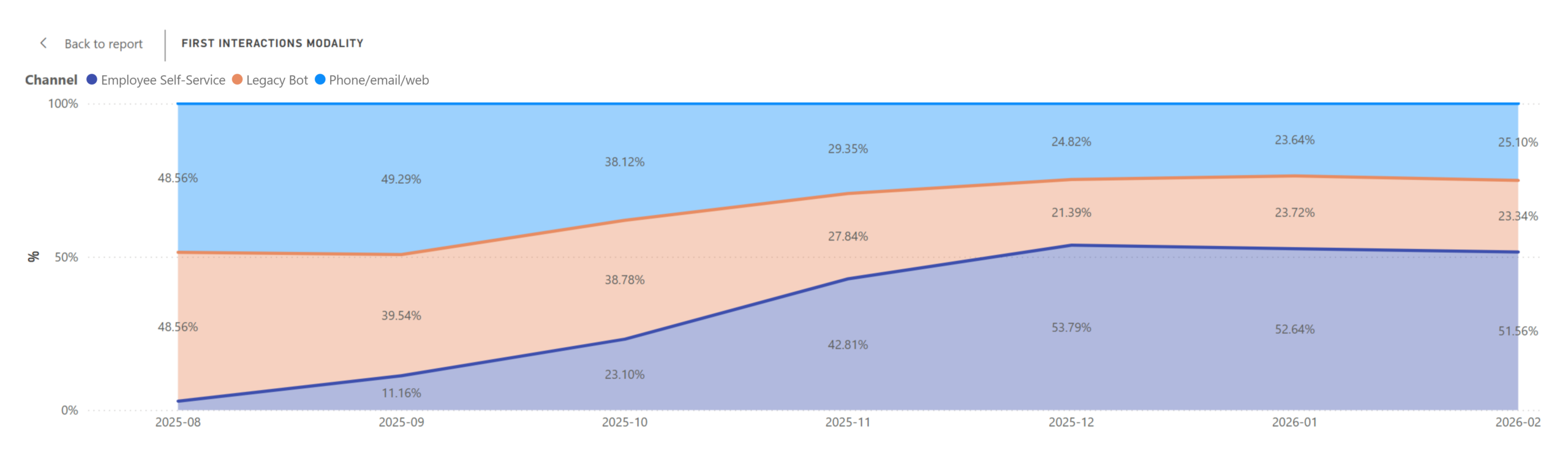
This data suggests the agent is meeting its ultimate goal: To provide users with an improved support experience, including better first‑touch answers that build employee confidence and yield faster issue resolution. This reduces escalation to human-run support channels and decreases the volume of tickets our employees have to create.
“We’re measuring success by a reduction in tickets, but that’s based on the user having a better experience using the Employee Self-Service Agent versus calling our global help desk and talking to a person,” says Anders Jepsen, a director of Field IT Management in Microsoft Digital. “We can only be truly successful if we are creating a better experience for our users.”
What’s next for self-service support
Our experience deploying the Employee Self-Service Agent in Europe North has allowed us to create a playbook for other small and midsize countries in similar situations, including dealing with multiple languages and specific regional policies.

“Our long-term ambition is to reduce our human-led support tickets by 40 percent. In some areas, like Europe North, we are already taking a significant step toward that.”
Trent Berghofer, general manager, Microsoft Digital Modern Support
The agent now serves as both a self-service tool and the first contact point for employee questions. It doesn’t completely remove humans from support, because if that first point of contact doesn’t resolve the IT issue, a team of humans is available to help.
In the end, the fewer support tickets that are opened, the more time employees can have back for higher-value tasks.
“Our long-term ambition is to reduce our human-led support tickets by 40 percent,” says Trent Berghofer, a general manager in Microsoft Digital Modern Support. “In some areas, like Europe North, we are already taking a significant step toward that.”
The Employee Self-Service Agent is a great example of using the power of AI to increase employee productivity and efficiency, as they access highly curated support through the tool on demand. It fits in with our company’s overall strategic efforts to evolve into an AI-driven Frontier Firm.
“The agent brings IT, HR, and facilities together in one place,” Dubuisson says. “It’s not just a Q&A bot. It gives you information, guides you, and even holds your hand through troubleshooting. The agent tells you what to do and can even do it for you. It standardizes, simplifies, and still lets you chat with someone or get a call back when you need it.”

Key takeaways
Here are steps organizations can take today to implement an AI-powered employee support hub:
- Evaluate your employee support systems. Assess whether employees have a single, trusted “front door” for support issues, or if your organization’s support is still fragmented across different tools.
- Audit local policy coverage in your AI solutions. Identify where tools may be defaulting to global or geographically incorrect content–especially in regions with multiple countries or languages–to validate accuracy and boost trust.
- Pilot localized AI support efforts in a diversified region. Engage regional HR, IT, and field adoption teams early on to make sure that AI experiences reflect real, country-specific employee needs.


Related links
- Check out our in-depth guide to deploying the Employee Self-Service Agent.
- See how we’re accelerating support services at Microsoft with the Employee Self-Service Agent.
- Read about how the agent improves campus and facilities-related support at Microsoft.
- Explore Microsoft Learn content about the Employee Self-Service Agent.
- Watch a Microsoft Ignite Session about the Employee Self-Service Agent.
