Commerce personalization experiences continue to expand beyond traditional storefronts as customers interact with businesses across stores, websites, mobile apps, marketplaces, social channels, and conversational experiences. AI and agents are creating even more possibilities for how customers, employees, and business buyers interact with commerce. For developers and architects, this raises an important question: how do you introduce new custom experiences without rebuilding the commerce capabilities behind each one?
Microsoft Dynamics 365 Commerce provides a composable, API-first architecture that separates the experience layer from the commerce engine. New licensing offers customers more flexibility to use Dynamics 365 Commerce to build custom applications, connect third-party experiences, and support new commerce scenarios. Organizations can create experiences for their specific business requirements while using Dynamics 365 Commerce capabilities for pricing, promotions, inventory, loyalty, orders, fulfillment, and other commerce processes.
How AI and new channels are reshaping commerce experiences
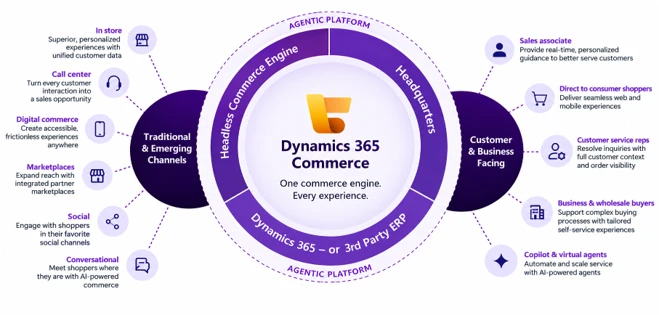
Omnichannel commerce has traditionally focused on connecting experiences across stores, e-commerce sites, mobile applications, and call centers. Those channels remain important, but marketplaces, social channels, conversational experiences, purpose-built applications, and now agents are expanding the ways customers and employees can interact with commerce. For architects, the important consideration is not which interface comes next, but how commerce capabilities can be made available quickly in new custom channels without implementing the underlying business logic separately for each one.
Dynamics 365 Commerce supports traditional and emerging channels, including stores, e-commerce, business-to-business (B2B), call centers, marketplaces, and other digital experiences. Its composable architecture provides a common commerce engine that organizations can use across these experiences and extend as their channel strategies evolve.
Why composable commerce starts with a decoupled architecture
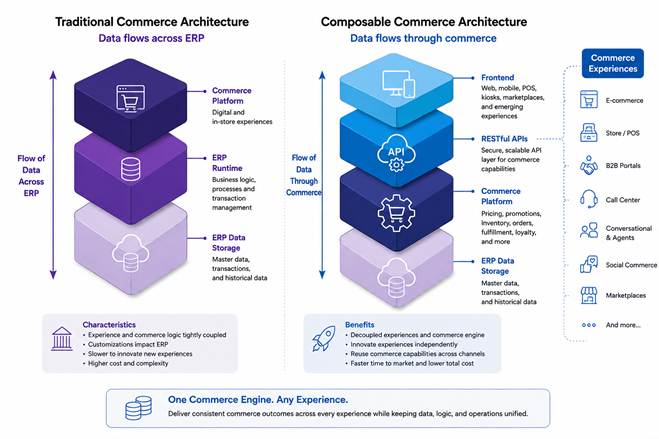
Commerce scale unit is the distributed runtime that provides commerce capabilities across Dynamics 365 Commerce channels. It exposes commerce business logic through APIs and processes interactions with channel databases, Dynamics 365 Commerce headquarters, and other services. By separating the experience layer from the commerce engine, developers can create experiences for specific customer, employee, partner, or business scenarios while using common commerce capabilities underneath them.
For example, an organization can build a custom mobile application that uses Dynamics 365 Commerce for product information, pricing, promotions, inventory availability, loyalty, and orders. A manufacturer can create a specialized B2B experience for distributors, while a retailer can connect a third-party e-commerce platform to Dynamics 365 Commerce and integrate commerce transactions with downstream business processes.
Build custom experiences with commerce scale unit APIs
Commerce scale unit exposes commerce capabilities through RESTful APIs, giving developers a consistent way to incorporate Dynamics 365 Commerce into custom and third-party experiences. Applications can use APIs for supported commerce scenarios involving products and customers, pricing and discounts, inventory, loyalty, carts and checkout, orders, returns, fulfillment, and other commerce operations.
This gives development teams more flexibility in how they build the experience itself. A custom storefront, mobile application, marketplace integration, or other front end can be designed around its own requirements while using Dynamics 365 Commerce for the commerce capabilities it needs. For organizations using Dynamics 365 more broadly, those interactions can also connect with the finance and supply chain processes that support commerce operations.
PETER HAHN provides another example of this approach. The fashion retailer combines a custom web shop with Dynamics 365 Commerce modules and specialized third-party solutions, with Dynamics 365 connecting commerce operations to finance and supply chain processes. Learn how PETER HAHN uses a composable commerce architecture.
Retail transaction orchestration and import options for Dynamics 365 Commerce
The architecture for a custom commerce experience also depends on where retail transactions originate and how Dynamics 365 Commerce participates in processing them. In some scenarios, a custom or third-party experience uses commerce scale unit APIs as part of the transaction. In others, the retail transactions are captured by an external system and then brought into Dynamics 365 Commerce. New licensing offers provide additional flexibility for both approaches.
- With Dynamics 365 Commerce headless orchestration, a custom or third-party client can use commerce scale unit APIs to access supported Dynamics 365 Commerce capabilities and orchestrate retail transactions. This approach can support custom storefronts and applications, third-party commerce experiences, and other purpose-built channels that use Dynamics 365 Commerce services as part of the transaction.
- With Dynamics 365 Commerce headless import, transactions captured outside Dynamics 365 Commerce can be imported into Commerce for subsequent processing. This provides an integration option for architectures in which an external application captures the transaction and Dynamics 365 Commerce supports downstream commerce processes.
Together, these options give organizations more flexibility to select an approach based on their commerce architecture, transaction requirements, and the role Dynamics 365 Commerce plays within the solution.
Build a commerce architecture for what’s next
Commerce experiences will continue to evolve as organizations introduce new applications, channels, and ways for customers and employees to interact with their business. AI and agents add new possibilities to that landscape, increasing the value of an architecture that makes commerce capabilities available independently of the experience consuming them.
Dynamics 365 Commerce provides an API-first commerce engine for Microsoft-delivered, as well as custom and third-party experiences, The Commerce Scale Unit provides access to commerce capabilities and Dynamics 365 connects those interactions with the operational and financial processes behind them. With new licensing options for retail transaction orchestration and retail transaction import scenarios, organizations have greater flexibility to build the commerce experiences they need today and extend their architecture for what comes next.
Learn more about Commerce Scale Unit architecture through Dynamics 365 Commerce documentation. Start using Headless Commerce Integration.