Six months ago in Atlanta, I closed my post with a promise: SQLCon is coming to Europe, and I can’t wait to see you there. This week in Barcelona, we made it happen.
Across the announcements we shared in Barcelona, SQL continues to build on the foundation enterprises have trusted for decades. This gives organizations more control where their workloads run, more room for applications to grow, and more intelligent tools for operating databases in the agentic era.
Running data and AI on infrastructure you control
For organizations across Europe, digital sovereignty has become a priority. They need greater control over where data resides without putting modern app development, performance, or AI beyond reach.
This is a reality that Microsoft SQL has been preparing for decades, steadily strengthening security, resilience, and performance across its ecosystem. Capabilities such as Transparent Data Encryption, released in 2008, Always Encrypted in 2016, and Ledger in 2022 have continued to strengthen the security and control organizations need for sovereign environments.
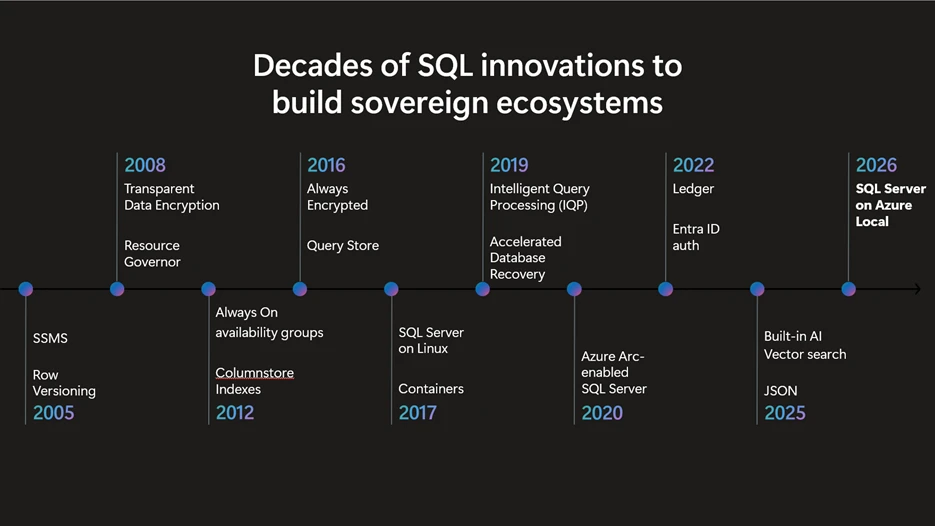
Building on this history, we’re now announcing general availability of SQL Server on Azure Local for both connected and disconnected operations.
This release brings the Azure control plane and management to customer-controlled environments, providing a consistent SQL and Azure experience for workloads that need to remain close to their applications, users, or physical operations. This includes:
- Connected deployments: Organizations can use Azure-based management while keeping workloads and data local.
- Azure Local Disconnected Operations (ALDO): Organizations get a local control plane for their private sovereign environments, supporting operations where cloud connectivity is unavailable or restricted.
For organizations that want to leverage AI in these environments, Foundry Local on Azure Local, now in preview, enables teams to build AI experiences close to their data. Applications, databases, and AI models can remain within the customer-controlled environment, so sovereignty requirements don’t put AI innovation out of reach.
For deployment options, licensing, and local AI capabilities, learn more about SQL Server on Azure Local.
Giving applications room to grow with Azure SQL Database Hyperscale
As applications mature, their demands rarely stay predictable. Workloads grow, usage patterns change, and the database needs to constantly adapt without forcing teams to rethink the application architecture around it.
Azure SQL Database Hyperscale is designed to provide flexibility while delivering the performance applications need. Azure SQL Database Hyperscale is SQL Server rearchitected for cloud scale. By decoupling compute and storage, Hyperscale gives applications room to evolve and the scale to meet more demanding workloads.
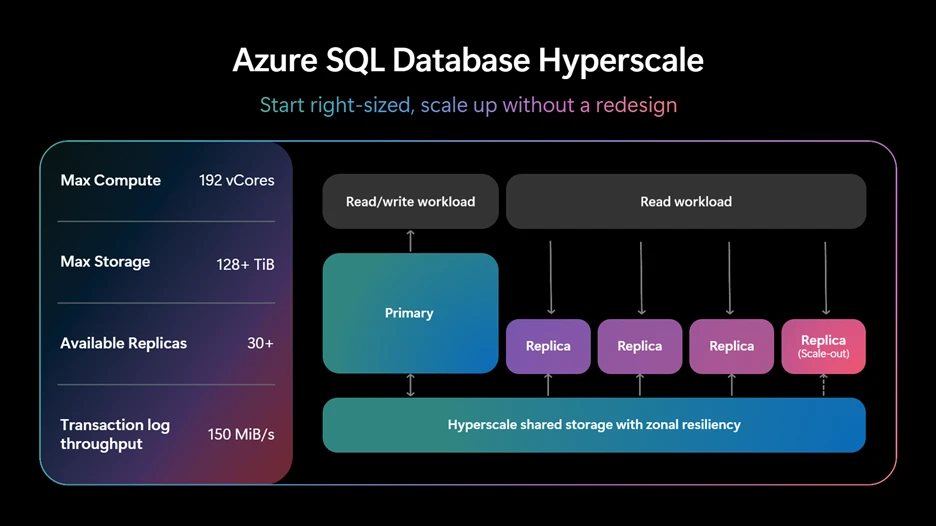
Now, we’re extending that flexibility and performance even further:
- More compute: 160 and 192 vCore Premium-series service objectives are now generally available.
- More scale and better cost efficiency: Hyperscale serverless auto-pause scales to zero and instantly resumes. Along with higher-density elastic pools, both these features are now in preview, providing cost efficiency to customers.
- Vector search: DiskANN vector indexes are now generally available, bringing high-performance vector search to operational data. SQL’s vector index now has full DML support, allowing you to modify data in vector-indexed tables while the index automatically stays updated in real-time.
- A simpler path to Hyperscale: A new Azure Arc migration experience is in preview, bringing assessment, provisioning, migration, validation, and cutover into a centralized workflow.
The scale figures become more meaningful when they represent businesses preparing for the moments when demand is highest and the tolerance for disruption is lowest. SAP Commerce Cloud offers a compelling example.
SAP and Microsoft developed a plan to migrate over 6,000 production databases to Azure SQL Database Hyperscale while prioritizing a seamless transition for customers. Hyperscale removed earlier storage and compute ceilings, giving SAP access to as many as 192 vCores and 128 TB of storage for individual databases, alongside zone redundancy supporting a 99.995 percent service-level agreement.
The result: SAP Commerce Cloud processed $17.8 billion in merchandise with 100 percent uptime during Black Friday and handled nearly 11,000 orders per minute at peak. That is the kind of growth a database platform must be ready to support.
Performance and cost
Performance must also be considered alongside cost. In an independent study commissioned by Microsoft, Azure SQL Database Hyperscale delivered up to 50 percent better price-performance than Amazon Aurora PostgreSQL under the tested conditions. The complete methodology and workload qualifications are available at Hyperscale Benchmark.
Our goal is to give customers the ability to choose a strong foundation early and keep building on it. Hyperscale combines the familiar SQL platform with an architecture that accommodates changing application needs, including new AI experiences operating directly on business data.
Turning database signals into guided action
As applications and database estates grow, signals become scattered across engines and environments, making issues harder to spot and resolve.
Database Hub in Microsoft Fabric, now in public preview, brings inventory, health, performance, security, risk, and optimization signals into a centralized view of your database estate. Administrators and developers can quickly see where attention is needed, explore aggregated or per-resource trends and opportunities through consolidated charts and dashboards, and act from within the hub using database agents.
Database agents for SQL and PostgreSQL on Azure help turn these signals into guided action. The agents reason over database signals, continuously helping administrators understand performance bottlenecks, identify optimization opportunities, recommend actions, and, within appropriate guardrails, help carry those actions forward. SQL Database Agent combines SQL’s native intelligence that includes IQP (Intelligent Query Processing), which is based on decades of domain-specific development and workload telemetry. Intelligent Query Processing, along with AI for reasoning, makes it the industry’s best DB agent.
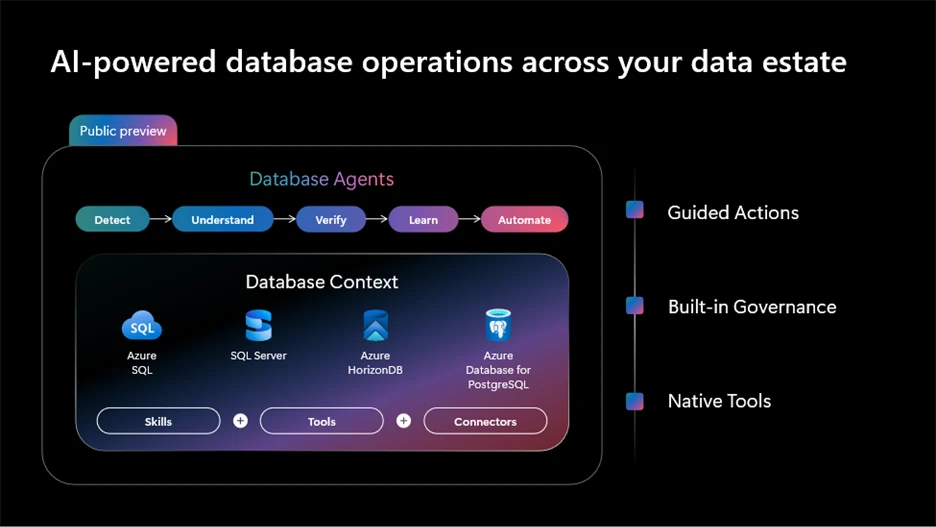
The preview experience begins with database agents for SQL in Database Hub and for PostgreSQL in Visual Studio Code, with these capabilities coming to both surfaces over time. Our vision is a consistent, extensible agent experience that works cohesively across the tools and environments developers and database professionals use, rather than intelligence tied to a single interface.
Across these agentic operations, human judgment remains central. The aim is to shorten the distance between a signal and a well-informed action while respecting existing permissions, operational guardrails, and developer control.
Bringing AI assistance into familiar developer workflows
As AI continues to become a bigger part of database development, our goal is to make it useful in the tools and workflows developers and DBAs already rely on.
Agent Mode for GitHub Copilot in SQL Server Management Studio is now generally available, helping developers reason across database objects and complete multistep tasks from a single goal or prompt. It can investigate dependencies, analyze execution plans, generate and evaluate DDL, review proposed changes, and iteratively gather context to help users move complex database work forward. SQL Projects and Schema Compare are also generally available in SSMS, alongside SQL Formatter in SSMS and Visual Studio Code, making it easier to bring database changes into source control and maintain consistent T-SQL.
We are also extending these capabilities beyond the development environment. Data API builder adds vector and JSON support to help connect SQL data with modern applications and agents through REST, GraphQL, and MCP endpoints.
Together, these announcements help teams bring AI into database development while keeping familiar tools and engineering practices at the center.
What we build next
Thank you for being part of this community. The announcements we have made at SQLCon Barcelona are a milestone, but the work that matters most is what you carry home and create with it. Whether that means revisiting your applications’ digital sovereignty needs, giving them room to grow, or finding a better way to understand and manage your data estate, we want our investment in SQL to help turn that momentum into something valuable for our users and customers. Here’s where you can start:
- Deploy SQL Server on Azure Local
- Deploy SQL Server on Azure Local Disconnected Operations
- Move your database to Azure SQL Database Hyperscale
- Try Database Hub in public preview
You can learn in greater detail about all the announcements at aka.ms/sqlconnews. Thank you for your continued trust and we cannot wait to see what you build with SQL. Until then, adios!