Sample and Map from a Single Convex Potential: Generation using Conjugate Moment Measures
- Nina Vesseron, CREST, ENSAE
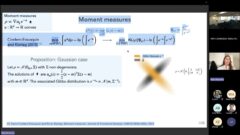
The standard approach to generative modeling separates model fitting into two independent steps: first choosing a noise distribution to sample from, and then learning a transformation that maps these samples to the data distribution. In this work, we explore an alternative route that ties sampling and mapping. Our work draws inspiration from moment measures to explore a new factorization that links both sampling and action through a single convex potential, which we call the conjugate moment measure factorization. We propose an algorithm to learn the convex potential associated with this factorization in the generative modeling setting, where samples from the data distribution are available, and we validate this algorithm on generative tasks. In addition, we derive the Monge–Ampère equation associated with this factorization and propose an algorithm to learn the convex potential in a sampling context, when only the unnormalized probability density function is available.
Speaker bio
Nina Vesseron is a PhD candidate at ENSAE Paris, France, and will join ENS Paris as a postdoctoral researcher in November 2026. Her work explores how theoretical ideas from optimal transport can be turned into practical methods for machine learning, including applications to sampling and generative modeling.
Taille: MSR New England Generative Modeling & Sampling Seminar
-
-
-
-
-
-
-
-
-
-
-
Rare event analysis via stochastic optimal control
- Yuanqi Du & Carles Domingo-Enrich
-
Constrained Generative AI for Materials Inverse Design
- Mouyang Cheng
-
-
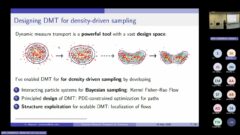
Designing Dynamic Measure Transport for Sampling
- Aimee Maurais
-
-
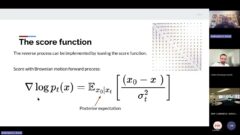
Physics and information theory of generative diffusion
- Luca Ambrogioni
-
-
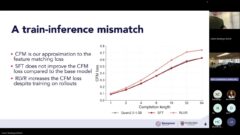
Matching features, not tokens: Energy-based fine-tuning of language models
- Mujin Kwun,
- Carles Domingo-Enrich
-
-
-
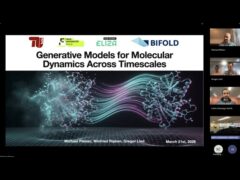
Generative Models for Molecular Dynamics Across Timescales
- Michael Plainer,
- Winfried Ripken,
- Gregor Lied
-
-
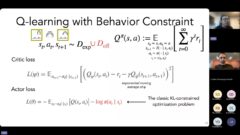
Q-learning with Flow-Matching Policies
- Qiyang (Colin) Li
-
-