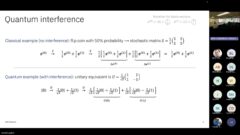
Data-Driven Discovery and Verification of Singularities in Nonlinear Partial Differential Equations
- Yixuan Wang | Caltech
Motivated by the Clay Prize problem on the blowup of Navier-Stokes equations (NSE), I present numerical approaches that facilitate deeper insights into singularity formation, demonstrating that machine learning methods, especially Physics-Informed Neural Networks and Neural Operators, significantly enhance the capability to identify and characterize potential blowups with high precision. Motivated by an exact symbolic search for blowups, we pioneered the Kolmogorov–Arnold Network (KAN) architecture, a novel machine learning paradigm whose interpretability and excellent scaling properties are achieved through learnable nonlinearities, gaining broad recognition in the AI for science community.
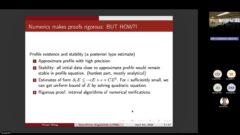
Building on these insights, I introduced a robust analytical framework to establish blowups with clear stability, with rates automatically inferred, and without explicit spectral information of the linearized operator. This formulation naturally suggests a robust numerical algorithm for tracking singularity formation and beyond, potentially applicable to singularities with multiple scales and complicated systems like NSE. Finally, I will talk about our resolution of a longstanding open problem of non-uniqueness of weak solutions to NSE, which is crucial in the understanding of turbulence, leveraging again the synergy between high-fidelity numerical solutions and rigorous computer-assisted proofs.
Speaker bio
Yixuan Wang is a PhD candidate in applied math at Caltech. His research builds systematic proofs inspired by numerics and amenable to computer-assisted verification, alongside high-precision machine learning tools such as neural operators and pioneered the Kolmogorov–Arnold Network (KAN), particularly motivated by the study of the Navier-Stokes singularity, one of the Millennium prize problems.
Taille: MSR New England Generative Modeling & Sampling Seminar
-
-
-
-
-
-
-
-
-
-
-
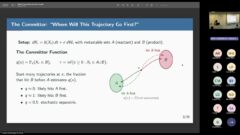
Rare event analysis via stochastic optimal control
- Yuanqi Du & Carles Domingo-Enrich
-
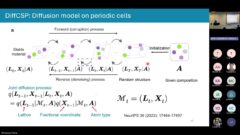
Constrained Generative AI for Materials Inverse Design
- Mouyang Cheng
-
-

Designing Dynamic Measure Transport for Sampling
- Aimee Maurais
-
-
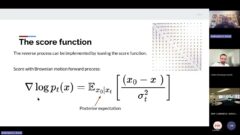
Physics and information theory of generative diffusion
- Luca Ambrogioni
-
-
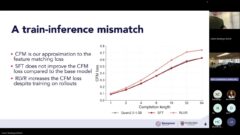
Matching features, not tokens: Energy-based fine-tuning of language models
- Mujin Kwun,
- Carles Domingo-Enrich
-
-
-

Generative Models for Molecular Dynamics Across Timescales
- Michael Plainer,
- Winfried Ripken,
- Gregor Lied
-
-
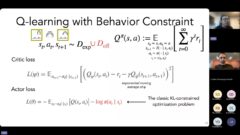
Q-learning with Flow-Matching Policies
- Qiyang (Colin) Li
-
-