Generative AI for High-Stakes Decision-Making with Applications in One Health
- Lingkai Kong | Harvard University
With rapid advances in machine learning, data-driven methods have become a powerful tool for decision making. Yet in real deployments, we repeatedly face three bottlenecks: the observational scarcity gap in data, the policy synthesis gap in modeling and learning, and the human AI alignment gap in deployment. My research develops generative AI methods to bridge these gaps, motivated by high stakes problems in One Health, which connects human, animal, and environmental health.
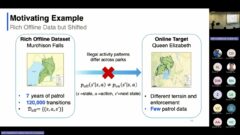
In this talk, I will show: (1) how flow matching addresses the observational scarcity and policy synthesis gaps by selectively reusing shifted offline data to improve RL sample efficiency and synthesize expressive policies under complex combinatorial space, and (2) how LLM agents bridge the alignment gap by incorporating expert guidance directly into planning, yielding optimization strategies consistent with stakeholder priorities. Throughout, I will highlight collaborations with field partners—from environmental health, including conservation planning in African national parks, to human health, including work with the WHO on optimizing HIV testing policies in South Africa.
Speaker bio
Lingkai Kong is a Postdoctoral Fellow at the Harvard John A. Paulson School of Engineering and Applied Sciences. He earned his Ph.D. in Computational Science and Engineering from the Georgia Institute of Technology. His research advances generative AI by integrating it with optimization and reinforcement learning to tackle high stakes decision making challenges, with applications in human health and environmental health. He collaborates closely with field partners to translate algorithmic innovations into tangible social impact. His work has appeared in top venues including ICML, NeurIPS, and ICLR, and he has delivered tutorials at major data science conferences such as KDD. He is a recipient of the Otto and Jenny Krauss Fellowship.
시리즈: MSR New England Generative Modeling & Sampling Seminar
-
-
-
-
-
-
-
-
-
-
-

Rare event analysis via stochastic optimal control
- Yuanqi Du & Carles Domingo-Enrich
-
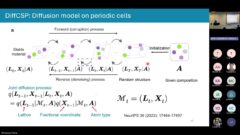
Constrained Generative AI for Materials Inverse Design
- Mouyang Cheng
-
-
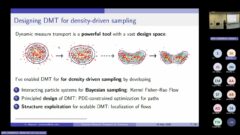
Designing Dynamic Measure Transport for Sampling
- Aimee Maurais
-
-

Physics and information theory of generative diffusion
- Luca Ambrogioni
-
-
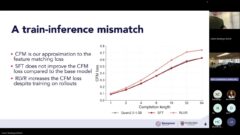
Matching features, not tokens: Energy-based fine-tuning of language models
- Mujin Kwun,
- Carles Domingo-Enrich
-
-
-

Generative Models for Molecular Dynamics Across Timescales
- Michael Plainer,
- Winfried Ripken,
- Gregor Lied
-
-
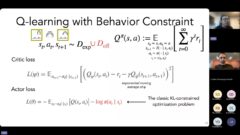
Q-learning with Flow-Matching Policies
- Qiyang (Colin) Li
-
-