
CRAFT
Creative Robotics and Future Technologies
Microsoft’s data-centre footprint is expanding rapidly to meet the growing global demand for compute and storage. Our team is exploring the potential of automation and robotics to enhance the sustainability, efficiency, and reliability of the datacenter operations.
The team is comprised of experts in mechanical design, electronics, computer systems, machine learning and robotics, who work together to turn our ideas into reality. We don’t just brainstorm solutions – we bring them to life! Thanks to our state-of-the-art prototyping workshops, we are able to quickly and effectively test and implement our ideas, making a real impact on the world. By leveraging our diverse skill sets and cutting-edge technology, we co-design the hardware and software and create innovative solutions in the area of datacenter robotics.
Enabling Self-Maintaining Datacenters
Our team has been investigating how dexterous modular robotics, AI, and automation can enable self-maintaining datacenters. By focusing initially on datacenter networking, we have been building robotic systems that aim to reduce downtime and enhance reliability through proactive and reactive maintenance, with a vision for fully automated datacenters in the future.
The automation of networking tasks often involves the manipulation of optical transceivers within densely packed cable configurations. Such environments are characterized by an abundance of delicate, overlapping, and intersecting cables, leading to frequent occlusions. Robotic manipulation in cluttered environments presents significant challenges, particularly when the clutter includes thin, deformable objects like cables, which complicate perception and decision-making processes. Check out our work on transceiver manipulation in sparse and dense cable environments (check the project web page (opens in new tab)).
One of our first robotic systems is the TMR, designed for dexterous transceiver manipulation. The TMR securely grips and handles individual transceivers while minimizing accidental interaction with nearby cables. Equipped with a sophisticated vision system, it autonomously navigates these complex environments, understanding and adapting to dynamic, deformable cables.
Here are some of the examples of the work the group has done. In the first video, we design RJ45 and QSFP connector insertion policies using admittance control and force feedback for port search and alignment. These insertion tasks are challenging due to tight tolerances, requiring the policies to perform fine force control to infer the current contact state and position relative to the port. We demonstrate the ability to perform these insertion tasks with high success rate, performing end-to-end removal and replacement of all connectors on a GB200 GPU switch.
Automating repair and maintenance tasks in datacenters requires robots to operate in dense cable environments where overlapping cables occlude target components and must be displaced without damage. Traditional prehensile approaches are impractical in such settings due to the difficulty of isolating individual cables and the risk of entanglement. We present a non-prehensile cable parting approach using a chopstick-inspired tool that slides between cables and creates localized clearance around a target transceiver port. The tool and motion primitives are designed to enable safe cable displacement without requiring explicit force sensing or cable-specific planning. We evaluate the approach across randomized cable configurations in both a MuJoCo physics simulation and real-world experiments using a dual-arm UR5e system, where one arm performs cable decluttering and a second arm inserts a transceiver into the cleared port. Results are demonstrated across different cable environments, and successful end-to-end transceiver insertion is achieved in the integrated multi-robot pipeline.
Project Silica
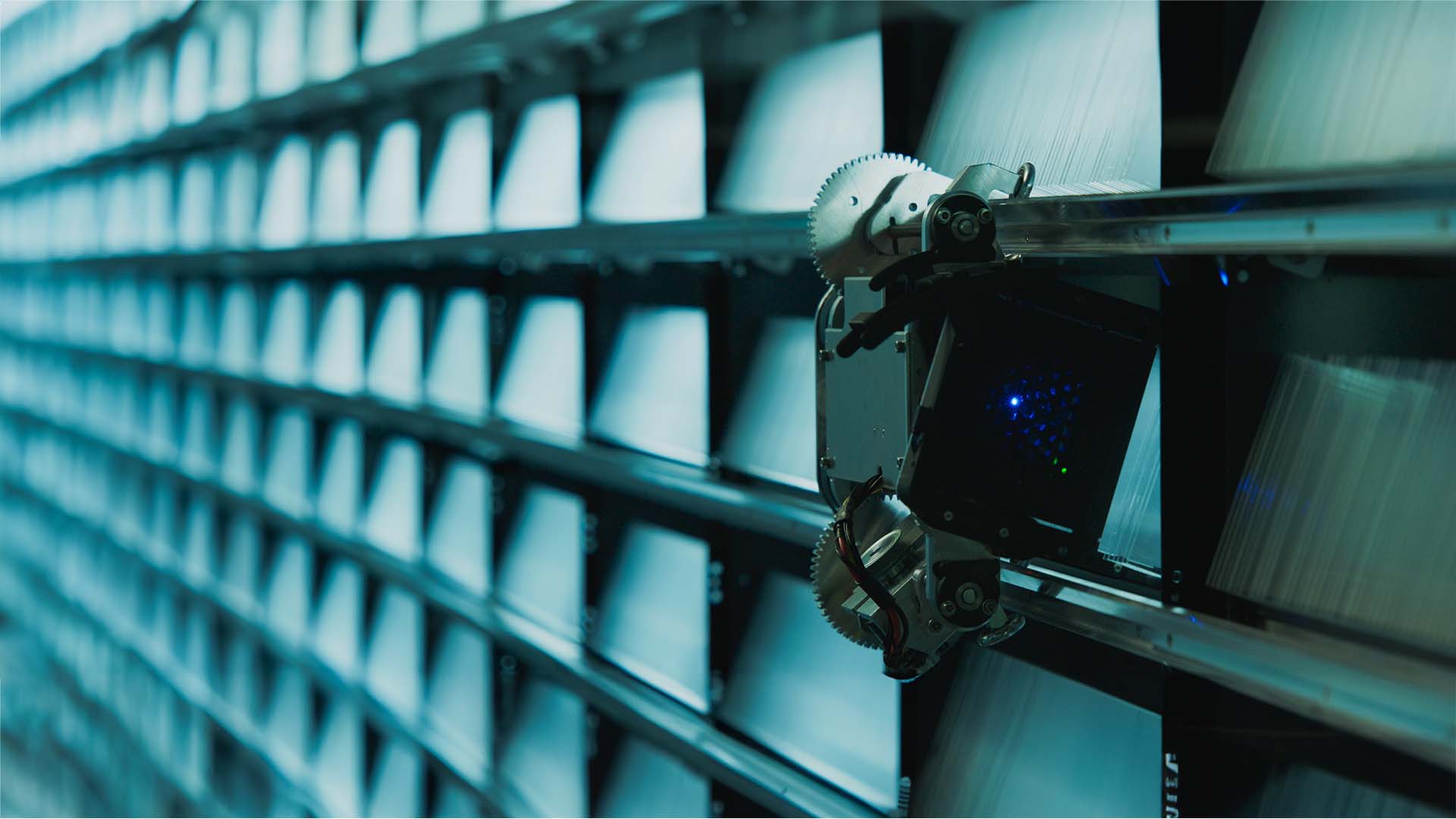
Our earliest project involved developing a library system for Project Silica. This project consists of a mesh network of autonomous robots designed to quickly and reliably handle and transfer glass media between systems responsible for reading, storing, and writing data. This innovation will enable customers to store long-term information, such as digital movie sources, for thousands of years. The Silica technology has been designed and built from the media up for long-term, sustainable storage. Our challenge was to create a storage system that was reliable, cost-effective, and adaptable to changing workloads over time.
The following video demonstrates a prototype of the Silica library: