Microsoft Research Africa, Nairobi

Join Mercy Muchai (opens in new tab) on Thursday Nov 5th at 3pm EAT as she presents:
Paza: How Architecture, Language Typology, and Adaptation Shape Speech Recognition in African Languages
Despite rapid and meaningful advances in speech recognition, building robust ASR systems for low-resource languages remains challenging. Key questions persist: how much data should be collected and in what forms, which model architectures offer the best opportunities for training and deployment, and what adaptation strategies are most effective for new domains and languages?
Drawing on research work that informed the Paza Speech Playbook and other publications, Muchai will present an architecture-aware evaluation of 53 speech models and their accuracy-efficiency trade-offs across 39 African languages. She will also share findings from a systematic study fine-tuning three models from distinct architectural paradigms, showing how architecture, language typology, and adaptation strategy shape recognition performance and real-world deployment.
Mercy Muchai is a Research Engineer at Microsoft Research Africa in Nairobi. She leads the end-to-end AI/ML engineering efforts within the lab. Her work focuses on building globally equitable AI tools and models that can reason over multimodal data, with a particular emphasison improving the linguistic and cultural understanding of Generative AI for underrepresented languages and communities.
Her recent work includes leading the research and development of automatic speech recognition models for African languages; including PazaBench, the Paza Speech Models and co-creating the Gecko Playbooks – a collection of toolkits for building more equitable AI systems. Muchai is also a Computer Science graduate student at the University of Texas at Austin.
Past seminars
-
uGAP: A Unified Geospatial AI Platform for African Geographic Data
October 2026 Seminar
-

AI, Radio Astronomy, and the Search for Life Beyond Earth
August 2026 Seminar
-

The Policy Layer that Governs Africa’s Algorithmic Ecosystem
June 2026 Seminar
-
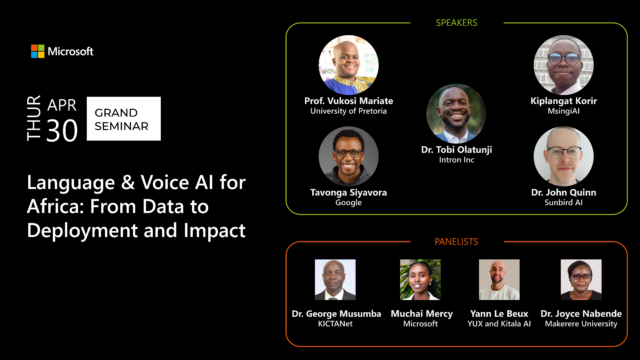
Language & Voice AI for Africa: From Data to Deployment and Impact
April 2026 Grand Seminar
-

Beyond Swahili: Designing Inclusive AI for Bantu Languages
February 2026 Seminar
-

GeoMind: A Multi-Agent Framework for Geospatial Decision Support
January 2026 Seminar
-

Anaximander: Interactive Orchestration and Evaluation of Geospatial Foundation Models
December 2025 Seminar
-

Building Better Language Models Through Global Understanding
July 2025 Seminar
-

AI for Africa's Future: Innovation, Equity, and Impact
April 2025 Grand Seminar
-

A Fever Dream of Machine Learning Framework Composability
December 2024 Seminar
-

Making Sentence Embeddings Robust to User-Generated Content
May 2024 Seminar
-

AI For All: Embracing Equity for All
April 2024 Seminar
-

Wildlife Conflict Resolution: Boma & Cattle Detection in the Masai Mara using AI
September 2023 Seminar
-

MEGA: Multi-lingual Evaluation of Generative AI
June 2023 Seminar
-

Large Language Models and Low Resource Languages
April 2023 Seminar
-

Behind the label: Glimpses of data labelling labours for AI
February 2023 Seminar
-

Fighting the Global Social Media Infodemic: from Fake News to Harmful Content
January 2023 Seminar
-

Detecting and mitigating bias in voice activated technologies
May 2022 Seminar
-

Overview of AI Research at the VUB Artificial Intelligence Lab
March 2022 Seminar
-

Social Media and Elections in Africa: A blessing or a curse?
February 2022 Seminar