Ask a manufacturing leader to name the company’s most important resource, and the answer will usually involve their experts, their processes, and their physical properties, like plants or machinery. All of which would be correct answers, but beneath each of these essential resources is the same underlying asset: the intelligence that enables the business to operate.
Intelligence lives in the engineer who can hear a spindle drifting out of tolerance before a gauge detects it. It lives in the systems teams open every morning, and in the data that keeps production moving shift after shift. It is the accumulation of knowledge, experience, and context that empowers people to make the right decisions at the right time. For most manufacturers, however, that intelligence is fragmented across people, processes, data, and systems that were never designed to work together.
It is the accumulation of knowledge, experience, and context that empowers people to make the right decisions at the right time.
Ben Grimes, corporate vice president, US Manufacturing & Mobility, Microsoft
Unlocking industrial intelligence means connecting that knowledge and putting AI into the flow of work, so it can understand how the business operates, surface what matters, and help people act with greater speed and confidence. That is the difference between companies experimenting with AI through isolated pilots and those turning intelligence into measurable, competitive advantage across the value chain.
And this is the key conversation taking shape this week at IMTS 2026, the largest manufacturing technology show in North America.
Intelligence is half the equation. Trust is the other half.
In my keynote at IMTS, “Industrial Intelligence Unlocked,” I took these observations one step further: Frontier Firms do not simply buy more AI tools. They connect intelligence that understands how work gets done, how business impact is measured, and how enterprise knowledge fits together. At scale, trust is what sets the pace.
Leaders design trust in from the beginning, on a secure, compliant, and observable foundation beneath every agent. Agents carry identity, operate inside clear boundaries, and are accountable for outcomes. When agents are set in motion, innovation moves quickly, more employees are empowered in the flow of work, and IT keeps control without becoming the bottleneck.
If intelligence and trust are the foundation, the practical question is how they show up in daily operations. What I’ve seen across the industry is that three forms of intelligence must come together:
- Work intelligence. It starts with understanding work: how people get things done, who they collaborate with, what was discussed and agreed. Present across conversations, meetings, and documents, AI can recognize patterns, carry context forward, and turn individual experience into a shared understanding.
- Data intelligence. Every decision on a factory floor runs on data. To move from insight to action, intelligence has to understand not only the data, but what it means: which metrics matter, how performance is measured, where the tradeoffs are made. Data intelligence means both people and agents can make informed decisions from the same source of truth.
- Operational intelligence. Intelligence is also a holistic understanding of how the business is meant to run: the policies, the standards, the operating procedures. Grounding organizational intelligence in context is what lets AI apply the right guidance, at the right moment, for the right person.
When brought together, these facets reveal the most impactful shift in the industry: intelligence stops being something you consult and becomes something that runs alongside the business, reasoning consistently and acting within context as it moves across teams and systems.
The return on intelligence is already being realized
This is not a forecast. Manufacturers are reporting results now, and that is coming through clearly at IMTS, where conversations with our customers and ecosystem partners are focused on practical AI deployments with measurable operational impact.
Riddell put trusted ERP data directly into the flow of its frontline sellers’ work. Its AI assistant, RIA, connects to SAP and answers natural language questions about pricing, delivery dates, and order status inside Microsoft Teams. By reducing time spent searching across disconnected systems, Riddell has returned more than 21,000 hours to the team each year.
AGCO is taking a governed approach to scaling employee-built AI agents with Microsoft Copilot Studio and Microsoft 365 Copilot. Its maker community has grown to roughly 2,000 people, with several hundred enterprise agents now in production. In some quality workflows, reviews that once took weeks can now be completed in about an hour.
Siemens, Rockwell Automation, PTC, RSM, MCA Connect, and Insight featured Microsoft in demonstrations of their latest AI innovations—spanning the intelligent digital thread and product lifecycle, AI-powered engineering and factory operations, and more adaptive supply chains.
Together, these experiences showed how Microsoft technology and deep industry expertise come together to move AI from promising use cases into practical solutions built for the realities of manufacturing.
When intelligence is shared, innovation spreads
Across IMTS, the conversations on the digital thread, physical AI, and agents at scale pointed to the same shift: industrial intelligence creates the most value when it moves beyond isolated teams and becomes part of how the entire organization works.
Frontier Firms do not centralize innovation in a small group of experts. They put the power to create in every room of the house—closer to the people who know the work, see the opportunity, and can imagine a better way forward. With trusted intelligence in the flow of work, more people can solve problems, improve processes, and turn ideas into measurable outcomes.
Because when intelligence is connected, trusted, and shared, innovation no longer belongs to a few. It spreads, and human ingenuity scales with it.
Step into the Factory of the Future
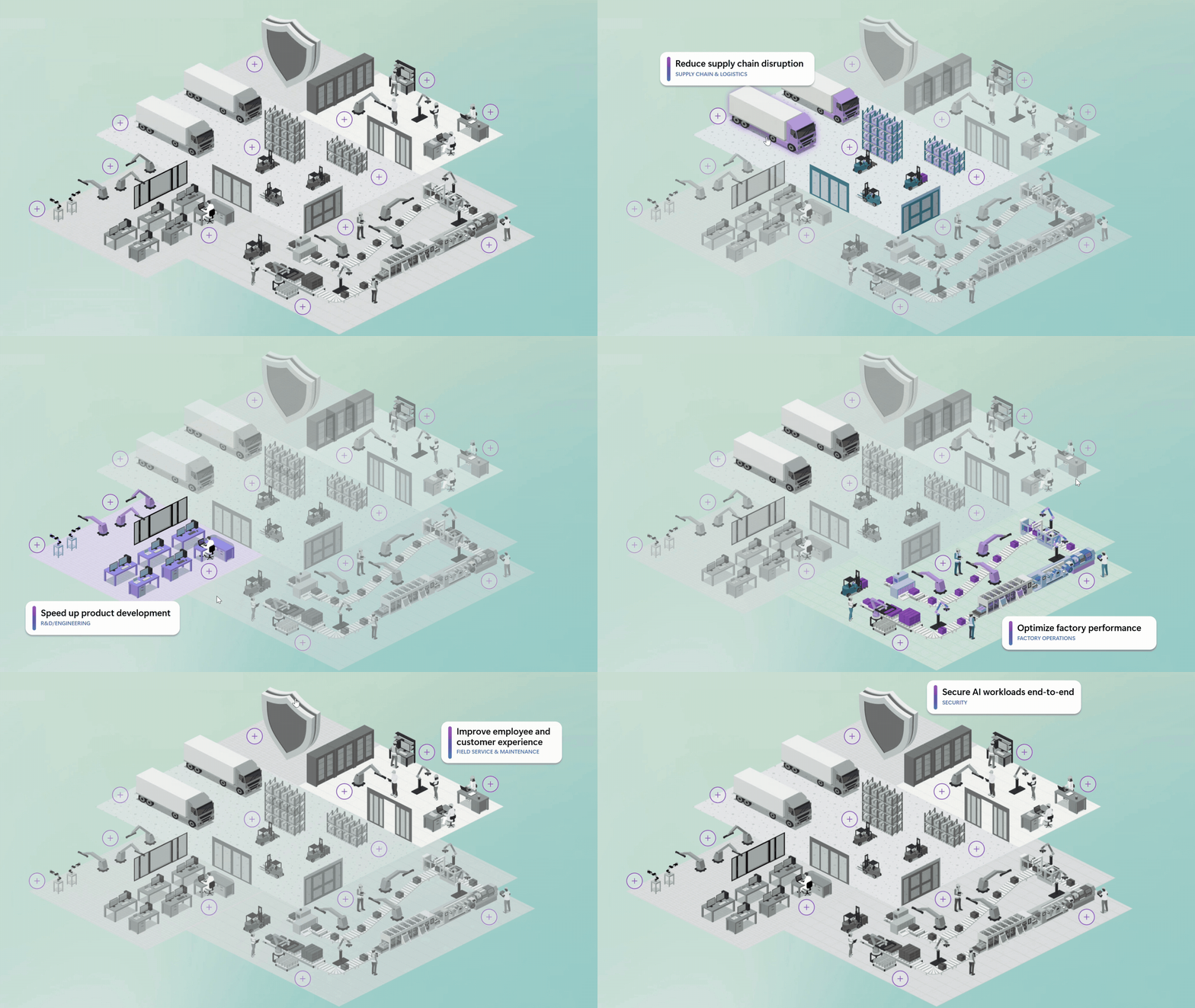
Explore how intelligence connects every part of the factory
Some visuals in this article were created using AI-assisted tools.