
July 29, 2026
Share this page


Surface Pro turns crowds into creators of public art
In this article:
- Philippe Dubost and Marie de Biasio use Surface Pro to turn people's movements and drawings into animated characters that become part of large-scale public projection shows.
- Les Fantômes transforms audiences from passive spectators into active collaborators, inviting anyone to help create a shared work of digital art.
- Surface Pro powers the installation's portable creative workflow, capturing movement, connecting cameras, printers, scanners, and custom TouchDesigner software, and adapting easily to different venues.
- By keeping the technology largely invisible, Les Fantômes lowers the barrier to participation, making digital art feel intuitive, playful, and accessible.
- The project demonstrates how technology can foster creativity, connection, and collective authorship, creating shared experiences that bring people together rather than pulling them apart.

Join the MSFT:FWD newsletter.
Receive stories worth opening, every time. MSFT:FWD delivers forward-worthy stories, simply.
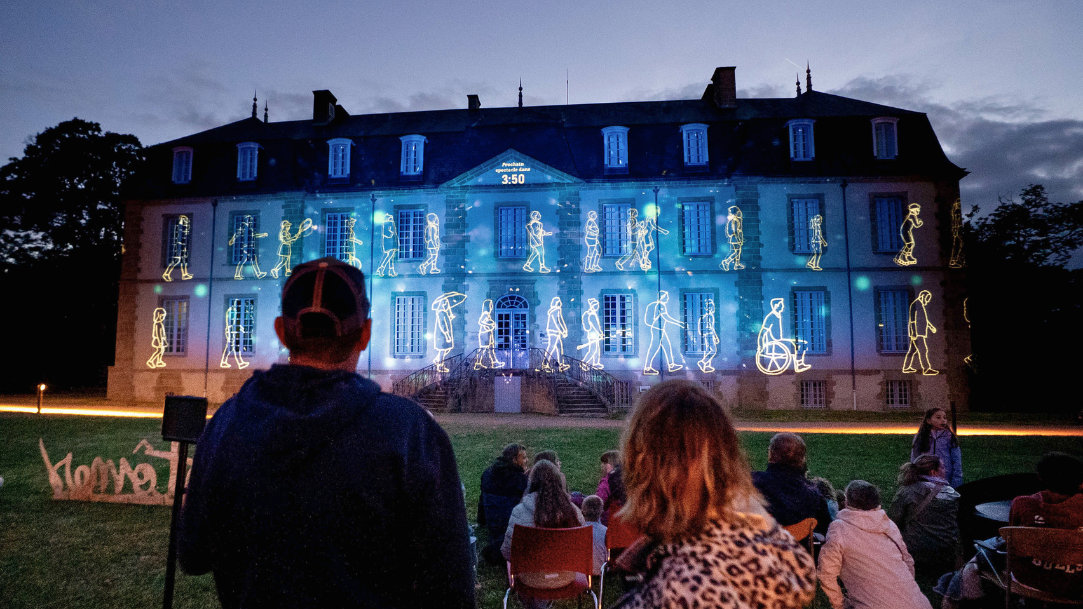
The crowd is quiet, the night air thick with anticipation, as they wait on the lawn of a chateau in the French countryside. For a few seconds, nothing happens. Then the music swells, color splashes across the stonework, and the performers make their entrance.
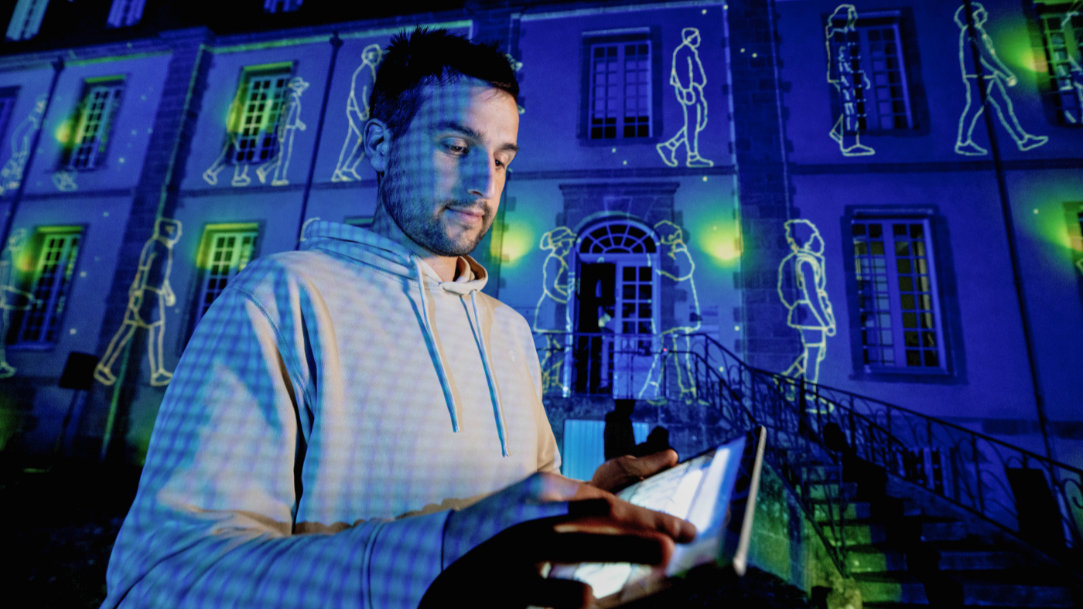
Those performers — vibrant, hand-drawn human figures made of light — fill the building’s stone facade. Some swim from end to end, a moving mosaic of breaststroke, backstroke, and front crawl. Others pirouette, wave, or break into a dance as audience members laugh, point, and cheer — delight that comes not only from the spectacle, but from the role each one of them has played in its creation.
This is Les Fantômes, a collaborative light show founded by creative technologist Philippe Dubost and set producer Marie de Biasio.
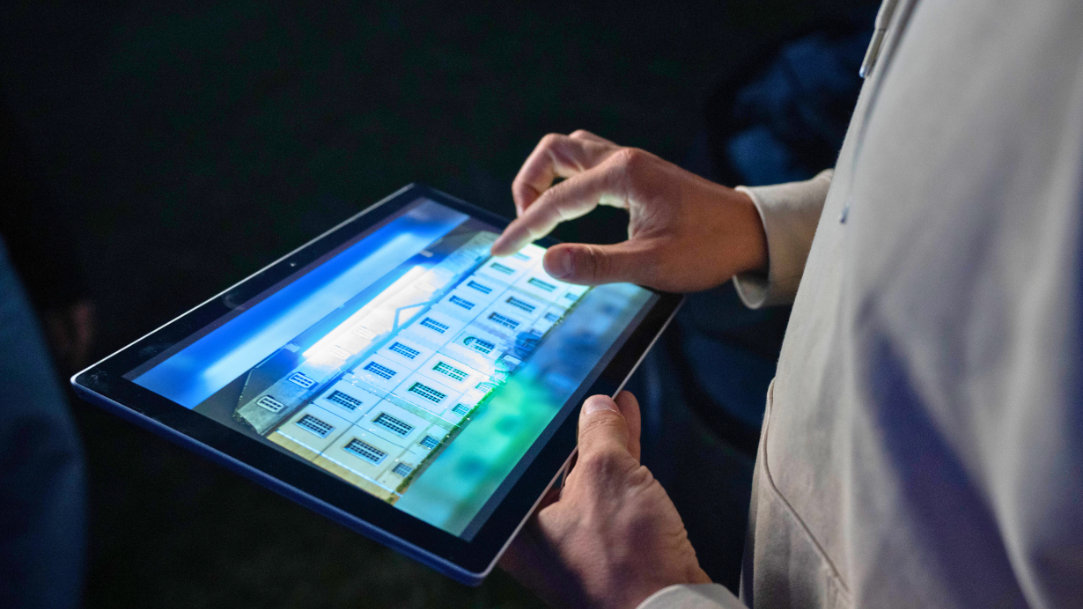
“It all starts with the Scanbox,” Dubost explains, referring to the mobile recording station built around a Surface Pro. A participant stands in front of it, gives the tablet’s camera a brief action — a thumbs up, a jump, a little dance — and receives a printout showing eight individual frames of their movement. Next, they use transparent paper to sketch over the sequence, adding details, clothing, props, or a new version of themselves, before feeding the page back into the system, where Windows-based TouchDesigner software turns the illustration into an animated character.
How Les Fantômes works
Move: A participant makes a short gesture in front of the Scanbox, where Surface Pro captures the movement.
Print: The gesture becomes an eight-frame sequence on translucent paper.
Draw: The participant sketches over their own poses, turning the outline into a character.
Scan: The finished page goes back into the system, before Windows-based TouchDesigner software prepares it for animation.
Project: The character appears after dark, joining others in a public artwork made by the audience observing it.
The format works, Dubost believes, because it helps guests get past the nervousness of performing in public. “People are often very shy at the beginning,” he says. “But when they scan their drawings and see them come to life, they realize that with just a pencil, paper, and their own body and imagination, they have managed to make something really cool.”
That mix of creative freedom, physical input, and shared surprise — plus the thrill of seeing oneself projected onto a historic building — is what makes Les Fantômes feel different from many digital art experiences. Rather than bending over a device in solitude or standing back from a finished display, the crowd is drawn in, turning personal expression into something playful, social, and unmistakably human.
From spectacle to collective authorship
Moving images have long fascinated Dubost. As a child, he filmed skate videos, breaking each trick into a series of poses. That early interest in timing, movement, and illusion later carried into interactive systems and projection design.
For more than a decade, he worked on major entertainment projects for prominent global acts like Madonna, Cirque du Soleil, and the Red Hot Chili Peppers, using light and video to create immersion. It was large-scale and technically demanding, but he craved a more intimate kind of exchange. Les Fantômes (“The Phantoms”) grew from that impulse to bring the medium closer to the audience, offering them a way to partake directly.
De Biasio helped turn this idea into a cross-country public-art exhibit. While Dubost leads the artistic and technical direction, she brings production discipline. As a duo, they have built a collective experience that, despite the intricate nature of the technology involved, feels playful and intuitive.
A project at a school in Nantes perfectly encapsulated this balance, Dubost recalls. Over the course of two weeks, 200 students worked together to create a single animated figure. Each contributed one second of movement and drawing, adding a fragment to a character that would later come alive on a neighboring building.
The coordination was intense, with children, teachers, drawings, scans, and projection cues all needing to come together. Challenging, yes, but the scale offered a vivid reminder of the social and emotional impact of shared creativity, says Dubost. “The students were so excited, asking each other which part they’d contributed, where in the show their bit appeared. It was an incredible thing to witness.”
Technology’s hidden impact
For Les Fantômes to keep making those moments, the system has to work reliably out on the road for weeks at a time. Surface Pro has become part of that touring reality. A single device has traveled to dozens of locations, enduring the rough and tumble of repeated installation, packing, and transport. “It’s scratched and scuffed but still running perfectly… it has to be pretty strong to survive around 70 cities with us,” Dubost says, chuckling.
That durability matters because Les Fantômes is built for public settings, not controlled demos. Depending on where it appears — a school courtyard, a festival square, or against a historic structure — the team may need to rethink where the Scanbox sits, how far the projection has to travel, and how the animations should play across the architecture. Through all of that, the setup has to keep working smoothly enough for the public interaction to feel seamless.
The tools behind Les Fantômes
Inside the Scanbox, Surface Pro acts as the public touchpoint between the visitor and the system: camera, screen, movement capture, and print command in one compact device.
Windows gives Dubost the working environment behind the installation, supporting TouchDesigner, connected hardware, and the quick adjustments needed when the show moves between venues.
Part of the wider Surface creative toolkit, Surface Slim Pen supports drawing and annotation on screen. In Les Fantômes, the public drawing step remains deliberately analog, with guests sketching by hand over printed frames.
“We try to hide the technology,” Dubost explains, noting that Surface Pro is thin enough to be worked into the Scanbox’s wooden casing, giving it a more organic, analog feel. That discretion is key. The less visible the device is, the more attention stays on the person taking part and the art they’re creating.
Low-profile doesn’t mean low importance, however. The tablet’s large, high-resolution touchscreen gives audience members an easy way to record their actions, portrait mode suits the rig’s upright design, and Windows gives Dubost the flexibility to link the camera, printer, scanner, USB peripherals, TouchDesigner, and custom software that move each drawing through the system.
Those connections keep the handoff from camera to printout to scan moving quickly, so guests can stay with the creative act rather than waiting on the technology. The Windows environment also makes things easier to adjust on the fly. Dubost can pair a keyboard and mouse, change the interface, test it, and return the Surface Pro to the Scanbox, often close to showtime.
A very special feeling
Digital culture often asks people to watch, scroll, click, and react, while offering them little real influence over what they see. Dubost and de Biasio’s work gives them a more active role to play, even as technology makes it possible.
By lowering the barrier to public art, Les Fantômes allows participants to take small creative risks in a communal, inclusive space, then see that contribution enlarged to be enjoyed by all involved. “When the first character pops on the facade, people say, ‘Wow, I belong to this, I’m part of this show,’” Dubost says. “That’s a very special feeling.”