Enterprise readiness can sound like something to worry about after you land a large customer. In reality, some of the decisions that determine whether enterprises will trust your product happen much earlier. Choices about reliability, security, cost, and responsible AI can strengthen your product now while preparing you for the customers you want next.
You don’t need to build every enterprise capability at once. A good place to start is understanding what your customers need now, what your next buyer may expect, and what evidence could help them feel confident in your solution.
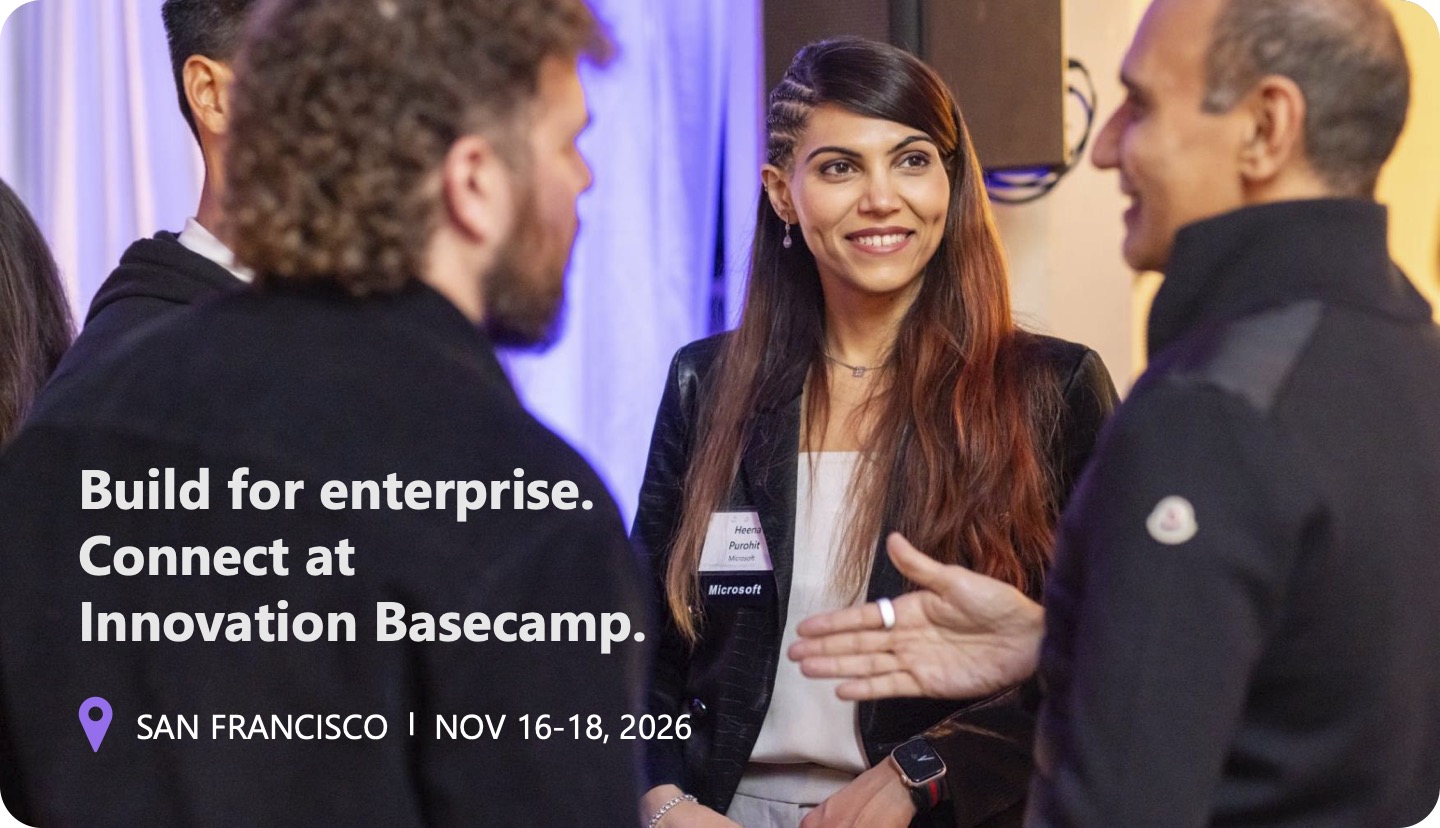
Whether you’re beginning to explore enterprise readiness or preparing for larger customers, you can put these ideas into practice at Microsoft for Startups Innovation Basecamp, November 16–18 in San Francisco. It takes place alongside Microsoft Ignite 2026, is complimentary to attend. Explore startup demos, connect with business leaders, and get onsite technical guidance from the Microsoft for Startups Concierge team.
1. Strengthen the foundations your customers rely on
The right foundations depend on your product and how customers use it. One way to identify where to focus is to walk through a failure scenario with your team. What could most affect customer trust, such as exposing sensitive information or interrupting a critical workflow?
Talk through how you’d detect it, who would respond, and how you’d recover. Then choose one improvement to make now, such as testing your recovery process or reducing the sensitive data you retain.
How Reality Defender approached customer trust
Reality Defender builds real-time detection of AI-generated voice, video, and images into customer systems to help organizations address deepfake and impersonation risks. When customers raised concerns about sending sensitive media to a vendor’s cloud, the team made privacy part of the product design.
Enterprise buyers and governments were clear: sending customer voices and faces to a vendor’s cloud for storage was difficult. So we built Zero Retention mode, where media is analyzed in memory and ejected after analysis. We prioritized customer control over our own learning loop, giving up visibility into production data we would otherwise use to debug and improve models, but increasing trust and conversion rates in the process. Lesson: build privacy into the architecture, not the contract.
Colton Barnett, Director of Alliances, Reality Defender
As you make similar decisions for your product, consider what information you need to collect and retain, and how you’ll explain those choices to customers.
Hear more from Reality Defender on trust in the age of synthetic media at Microsoft Ignite 2026, or meet the team and see its technology at Basecamp.
2. Build for the customer you’re pursuing next
Once you’ve identified the foundations your customers rely on, the next step is deciding how to evolve them as your business grows. Enterprise readiness doesn’t have to mean jumping from a minimum viable product (MVP) directly to serving large enterprise customers. Your next milestone might be your first paying customer, your first 100 customers, or expansion into a regulated industry.
As your customer base grows, expectations can change. Access controls that protect users today may also support a future security review. Observability that helps your team troubleshoot now can prepare it for more complex workloads.
Talking with someone in your next target customer segment can help you understand how your product needs to fit into their workflow. You might ask: “What would make it difficult for your team to adopt or expand its use of our product?”
Their answer could point to an integration, a validation step, or a need for greater accuracy and repeatability. Understanding those expectations can help you prioritize what matters most for your next customer rather than building capabilities they may not need yet.
How Moderne adapted to customer workflows
Moderne helps development teams make code changes at enterprise scale while maintaining visibility and control. Its technology provides a deterministic engine that teams can use with AI coding agents to generate changes for review and merging.
As enterprises adopted agentic development, we saw agents changing code through inference, and most customers didn’t realize deterministic outcomes were achievable. We repositioned Moderne from a modernization tool to the deterministic foundation for agentic software development: our Lossless Semantic Tree gives agents compiler-accurate context, and our recipes make changes repeatable at scale. We prioritized meeting customers in their IDEs, repos, and pipelines. Our lesson: focus on the accuracy and repeatability customers need from code changes, and make those capabilities available where they already work.
Matt Finkelstein, Chief Partnerships Officer, Moderne
As Moderne has adapted its technology to meet enterprise customer needs, the team has also leveraged Microsoft for Startups support through co-selling opportunities, event participation, and updates to its Microsoft Marketplace offer.
Moderne’s experience shows how understanding customer workflows can shape both product priorities and positioning. Connect with the team at Basecamp’s After Dark networking reception to hear more about its approach and explore what your next customer milestone could require.
3. Prove what enterprise buyers need to know
Understanding your next customer’s needs is an important step, but enterprise adoption often requires demonstrating how your solution meets those expectations. Beyond the people who will use your product day to day, security, IT, procurement, and business stakeholders may each need different information before a deployment can move forward.
As an opportunity takes shape, it can help to understand who needs to approve the purchase, which requirements matter, and how the customer will measure success. Before your next enterprise conversation, try creating a short deployment brief that brings those details together:
- Customer value: The use case, intended outcome, and how success will be assessed.
- Deployment requirements: The data, integrations, and access controls the customer needs.
- Operations and oversight: Support responsibilities, review processes, and where human approval is required in AI-enabled workflows.
Having this information in one place can help both teams identify open questions before they slow a deployment.
How Brain Co. approaches higher-stakes workflows
Brain Co. builds AI systems for business workflows, designed around an organization’s rules, data, and business outcomes. Its systems connect information with the tools teams use, while keeping people involved in reviewing what happens next. The company applied this approach to sales prospecting for a global hospitality company.
Sales reached a third of prospects because research took too long. We built agents to gather evidence across sources, filter weak signals, and personalize outreach using account and interaction history from Dynamics and Outlook. Salespeople tested signal relevance and reviewed drafts in Outlook before sending. Positive response rates more than tripled with signal-based personalized outreach. Our lesson: better outreach starts with better research, and better research starts with AI tuned to your business.
Ben Kornick, Head of Product, Functional Suites, Brain Co.
Brain Co.’s example shows what customers may want to understand about an AI-enabled workflow: what information informs its output, where people review it, and how the team will measure the business result. Being ready to explain those points can help a buyer assess how the solution fits their needs.
Brain Co. will explore building reliable agents for business workflows in its Microsoft Ignite 2026 Table Talk and how enterprises are evaluating AI for operational workflows in its Lightning Session. At Basecamp, you can meet the team and see its approach in a live demo.
Explore enterprise readiness at Basecamp
Building toward enterprise readiness means making thoughtful choices about your product, your customers, and what buyers need to know. At Basecamp, you can get guidance, see startup solutions in practice, and hear perspectives on enterprise adoption. Here are a few ways to take part:
- For technical questions and program guidance: Connect with the Microsoft for Startups Concierge team onsite to discuss technical challenges, explore program benefits, and learn about growth pathways relevant to your startup.
- To see how startups address customer needs: Visit the Demo Hub to explore startup solutions and ask how teams approach integration, reliability, and customer needs. Access is included with registration to any Basecamp event.
- To hear perspectives on enterprise adoption: Attend the Frontier Innovation Summit to hear from Microsoft leaders, customers, investors, and startups about what it takes to bring emerging technologies from idea to enterprise use.
- To exchange ideas with the startup community: Join the After Dark networking reception to connect with people across the ecosystem and talk through the customer, workflow, or deployment challenges you’re working on.
Join us at Basecamp to hear firsthand how startups are building for enterprise customers.
November 16–18 | Yerba Buena Lane, San Francisco
Take your next step at Basecamp
Explore startup demos, connect with the Microsoft for Startups Concierge team, and hear how founders are preparing for enterprise adoption.
*Basecamp offers complimentary attendance. Register by November 12. Registrations are subject to review.