Scaling Density Functional Theory with Gaussian Splatting
- Andrés Guzmán-Cordero, Mila
- Microsoft Research New England Generative Modeling & Sampling Seminar
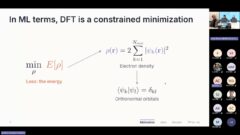
Density functional theory (DFT) strikes a practical balance between accuracy and computational cost in many problems of computational chemistry and materials science. However, many DFT calculations are limited by fixed atom-centered basis sets, which dictate how accuracy and cost scale with system size. I will discuss Gaussian Splatting for Density Functional Theory (GS-DFT), which represents molecular orbitals as a cloud of Gaussians whose positions, shapes, and mixing coefficients are optimized jointly by gradient descent to minimize the energy without training data. Conceptually, GS-DFT is 3D Gaussian splatting with the renderer replaced by quantum mechanics. To understand this method, I will discuss two key solver components: adaptive density fitting with screening for efficient evaluation of two-electron integrals, and a regularized differentiable orthogonalization of the molecular orbitals. Empirically, the optimized basis reaches the accuracy of the largest conventional basis sets with a fraction of the parameters, converging systematically in energy, density, and nuclear forces. At equal parameter count, it captures the stretched-bond and anion physics that fixed bases only recover with specialized basis augmentation. The resulting solver exhibits quadratic peak memory scaling in the cloud size, allowing us to simulate systems of up to 2,742 atoms (10,406 electrons) without any modifications at triple-zeta scale using a single four-GPU node.
Speaker bio
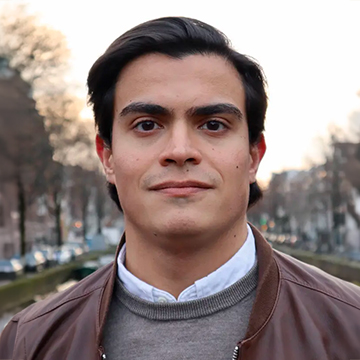
Andrés Guzmán-Cordero is a second-year PhD student in Computer Science at the Université de Montréal and Mila – Quebec AI Institute, advised by Kirill Neklyudov. His research develops machine learning methods for scalable ab initio electronic structure calculations, with the goal of bringing ab-initio molecular dynamics to large biomolecules. He holds an MPhil from the University of Amsterdam, where he worked with Jan-Willem van de Meent on variational inference in flow-based generative models, and wrote his thesis as a visiting researcher in Alán Aspuru-Guzik’s Matter Lab at the University of Toronto. He received his BSc from the Vrije Universiteit Amsterdam, working with André Lucas on statistical models for particle tracking.
Series: MSR New England Generative Modeling & Sampling Seminar
-
-
-
-
-
-
-
-
-
-
-
-
-
-
-
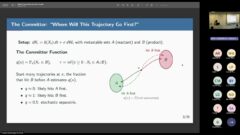
Rare event analysis via stochastic optimal control
- Yuanqi Du & Carles Domingo-Enrich
-
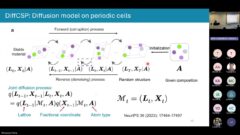
Constrained Generative AI for Materials Inverse Design
- Mouyang Cheng
-
-
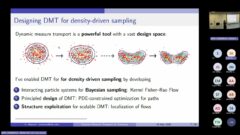
Designing Dynamic Measure Transport for Sampling
- Aimee Maurais
-
-
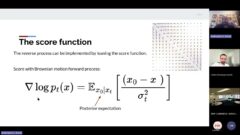
Physics and information theory of generative diffusion
- Luca Ambrogioni
-
-
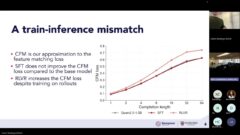
Matching features, not tokens: Energy-based fine-tuning of language models
- Mujin Kwun,
- Carles Domingo-Enrich
-
-
-
Generative Models for Molecular Dynamics Across Timescales
- Michael Plainer,
- Winfried Ripken,
- Gregor Lied