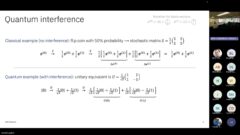
Extending measure dynamics beyond generative modeling
- Jiequn Han | Flatiron Institute
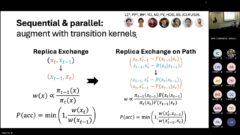
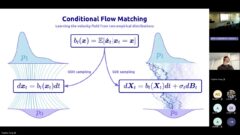
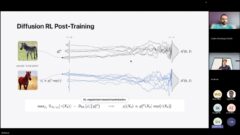
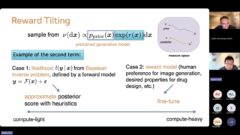
Transport-based generative models, such as score-based diffusion and flow-matching, are a leading paradigm for learning complex data distributions. Much of the recent frontier involves extending these models beyond standard generation. In the first part of this talk, I will briefly overview our recent efforts in this direction, demonstrating how to flexibly control pre-trained measure dynamics at inference time tilting to new rewards. However, these successes—and standard generative modeling at large—rely on a crucial assumption: access to clean training data. In many scientific and engineering settings, clean data is never observed. Instead, samples are only available after passing through a noisy, possibly nonlinear and ill-conditioned corruption channel. The core challenge is learning a generative model for the unobserved clean distribution using only these corrupted observations and the forward process. To tackle this, the main focus of the talk will introduce the Self-Consistent Stochastic Interpolant (SCSI), a transport-based framework that inverts such corruptions at the distribution level. The method iteratively refines a transport map so that, when composed with the forward model, it exactly reproduces the corrupted observations. This fixed-point formulation yields an efficient algorithm requiring only black-box forward evaluations. We establish convergence guarantees and demonstrate strong empirical performance on high-dimensional imaging and scientific reconstruction tasks.
Speaker bio
Jiequn Han is a Research Scientist at the Center for Computational Mathematics, Flatiron Institute, Simons Foundation. He conducts research on machine learning for science, drawing broadly from the methodologies and challenges of various scientific disciplines, with a focus on solving high-dimensional problems in scientific computing, primarily those related to PDEs and generative modeling. He holds a Ph.D. in Applied Mathematics from Princeton University and dual bachelor’s degrees in Computational Mathematics and Economics from Peking University. His research has been recognized with the SIAM Computational Science and Engineering (CSE) Early Career Prize (awarded biennially to one scholar).
系列: MSR New England Generative Modeling & Sampling Seminar
-
-
-
-
-
-
-
-
-
-
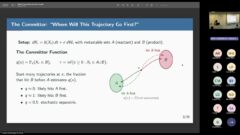
Rare event analysis via stochastic optimal control
- Yuanqi Du & Carles Domingo-Enrich
-
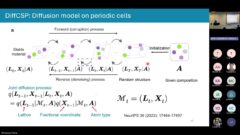
Constrained Generative AI for Materials Inverse Design
- Mouyang Cheng
-
-
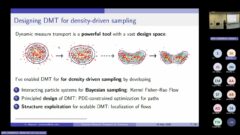
Designing Dynamic Measure Transport for Sampling
- Aimee Maurais
-
-

Physics and information theory of generative diffusion
- Luca Ambrogioni
-
-
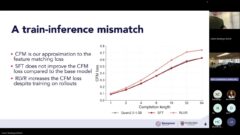
Matching features, not tokens: Energy-based fine-tuning of language models
- Mujin Kwun,
- Carles Domingo-Enrich
-
-
-
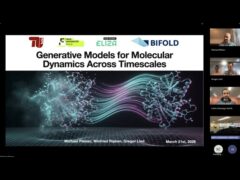
Generative Models for Molecular Dynamics Across Timescales
- Michael Plainer,
- Winfried Ripken,
- Gregor Lied
-
-
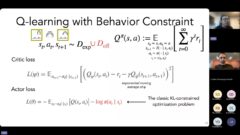
Q-learning with Flow-Matching Policies
- Qiyang (Colin) Li
-
-
-
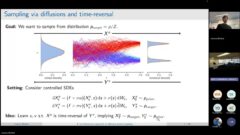
A non-Markovian approach to diffusion-based sampling
- Lorenz Richter