

Biomedical ML
News & features
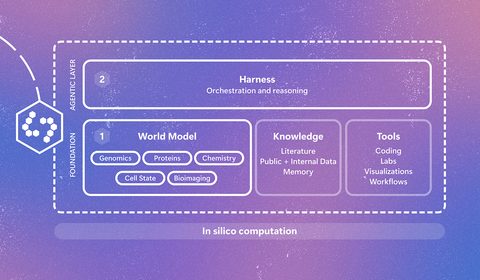
Introducing Quine: An AI research system designed for the complexity of biology
| Nicolo Fusi and Jonathan M. Carlson
Biology doesn’t operate in silos, and neither should the AI representation of it. Quine is an early-stage research effort to create a multimodal world model of biology. By connecting insights across biological scales and modalities, Quine helps scientists computationally search…
Kevin K. Yang, Sarah Alamdari, Alex J. Lee, Kaeli Kaymak-Loveless, Samir Char, Garyk Brixi, Carles Domingo-Enrich, Chentong Wang, Suyue Lyu, Nicolo Fusi, Philip Rosenfield, Neil Tenenholtz, Ava P. Amini “The body of data available in protein sequences is something fundamentally…
Lack of children in public medical imaging data points to growing age bias in biomedical AI
Alex Lu, Stan Hua (opens in new tab), Lauren Erdman (opens in new tab) Artificial intelligence (AI) is transforming healthcare with applications from interpreting electronic healthcare records (opens in new tab) to detecting cancer from medical images. We ask: are…

Abstracts: Zero-shot models in single-cell biology with Alex Lu
| Gretchen Huizinga and Alex Lu
The emergence of foundation models has sparked interest in applications to single-cell biology, but when tested in zero-shot settings, they underperform compared to simpler methods. Alex Lu shares insights on why more research on AI models is needed in biological…
Philip Rosenfield, Alex X. Lu, Ava P. Amini, Lorin Crawford, Kasia Z. Kedzierska Single-cell foundation models are an exciting paradigm for biologists, as they may accelerate the understanding of complex cell data and reveal previously unknown biology. Single-cell foundation models…
Research Focus: Week of March 24, 2025
In this issue, we examine a new conversation segmentation method that delivers more coherent and personalized agent conversation, and we review efforts to improve MLLMs’ understanding of geologic maps. Check out the latest research and other updates.

This talk discusses how deep learning is enabling us to generate novel and useful biomolecules, allowing researchers and practitioners to better understand biology.
In the news | TechCrunch
Microsoft open sources EvoDiff, a novel protein-generating AI
This week, Microsoft introduced a general-purpose framework, EvoDiff, that the company claims can generate “high-fidelity,” “diverse” proteins given a protein sequence. Different from other protein-generating frameworks, EvoDiff doesn’t require any structural information about the target protein, cutting out what’s typically…

Research Focus: Week of May 8, 2023
In this issue: Microsoft researchers win four more awards; AutoRXN automates calculations of molecular systems; LLM accelerator losslessly improves the efficiency of autoregressive decoding; a frequency domain approach to predict power system transients.