Mathematics
Advancing the mathematical foundations that drive breakthroughs across computing, AI, and the sciences.
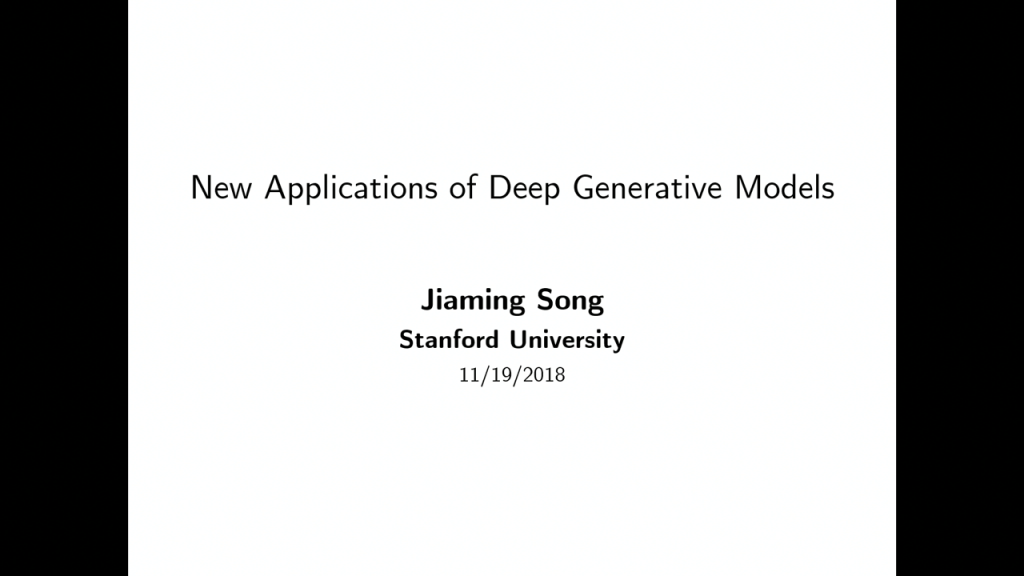
Deep Generative Models for Imitation Learning and Fairness
In the first part of the talk, I will introduce Multi-agent Generative Adversarial Imitation Learning, a new framework for multi-agent imitation learning for general Markov games, where we build upon a generalized notion of inverse…
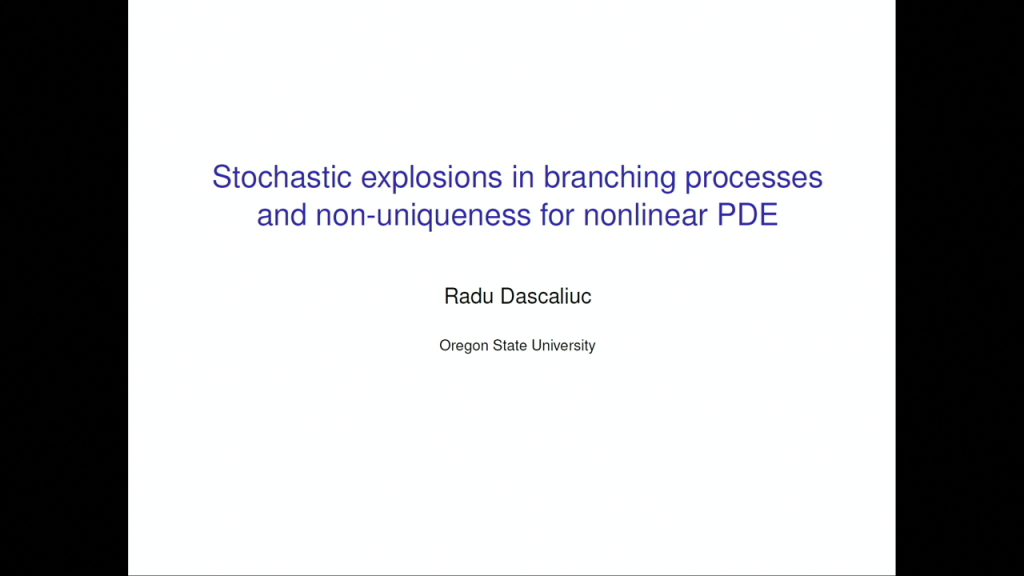
The 20th Northwest Probability Seminar: Stochastic Explosions in Branching Processes and Non-uniqueness for Nonlinear PDE
We will discuss stochastic processes, Le Jan-Sznitman cascades, that can be associated with certain nonlinear PDE and how explosion of these cascades can be exploited to prove non-uniques for the associated Cauchy problems. In particular,…
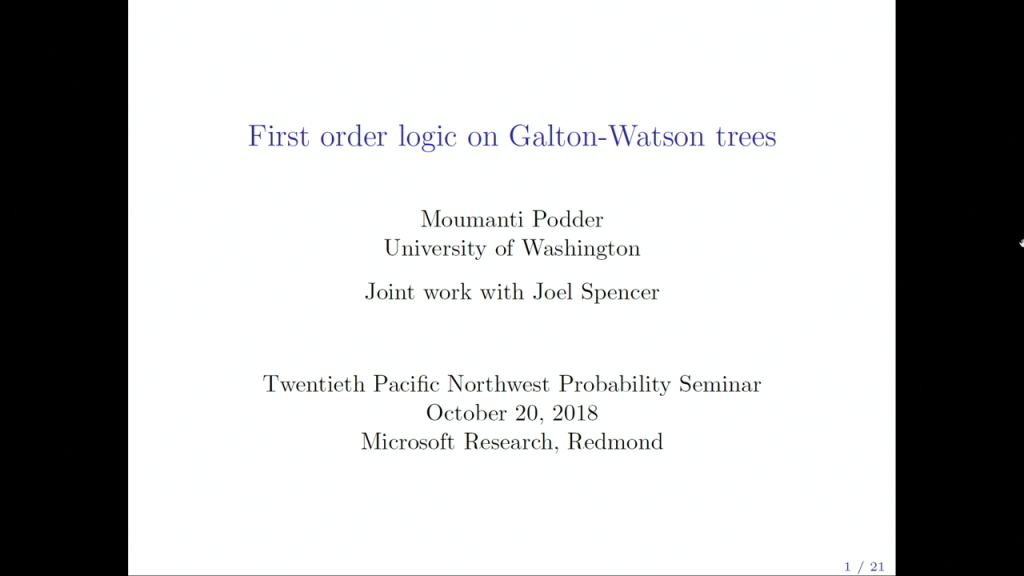
The 20th Northwest Probability Seminar: First Order Logic on Galton-Watson Trees
The 20th Northwest Probability Seminar, a one-day mini-conference organized by the University of Washington, the Oregon State University, the University of British Columbia, the University of Oregon, and Microsoft Research, was held on October 20,…
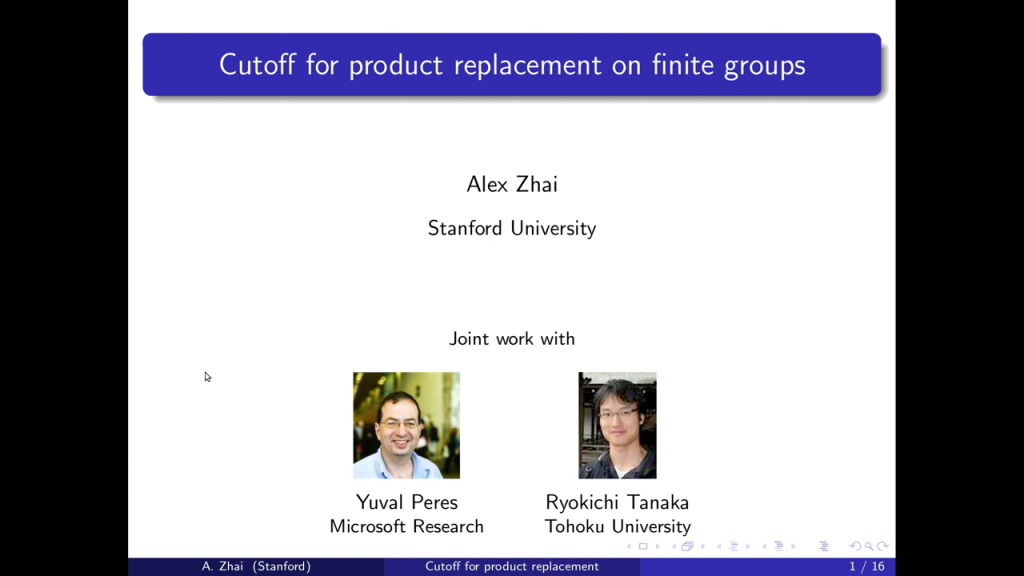
The 20th Northwest Probability Seminar: Cutoff for Product Replacement on Finite Groups
Let G be a finite group, and consider the following \emph{product replacement walk} on the set of generating n-tuples of elements of G: randomly pick two of the n elements, say g and h, and…
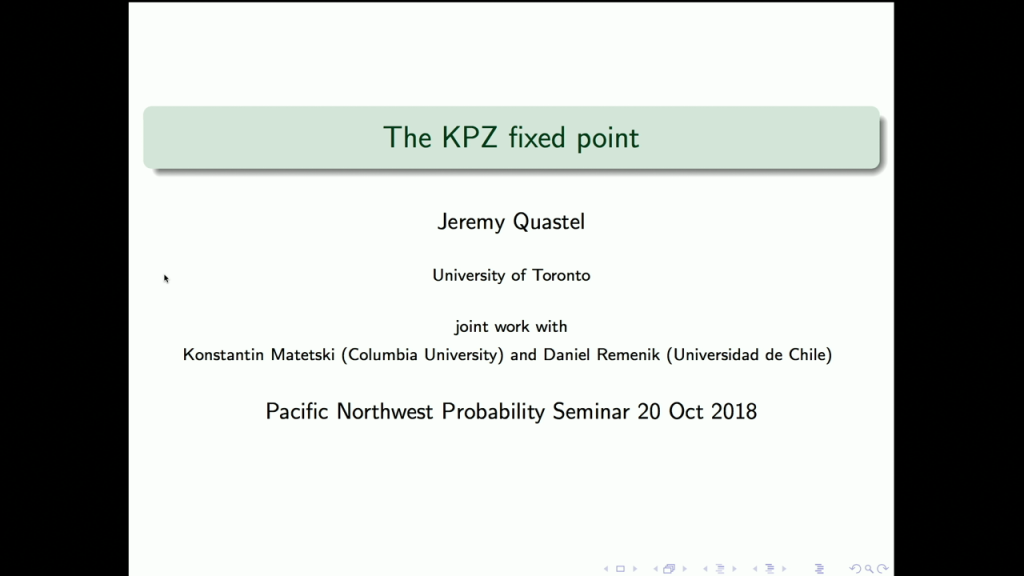
The 20th Northwest Probability Seminar: The KPZ Fixed Point
The (1d) KPZ universality class contains random growth models, directed random polymers, stochastic Hamilton-Jacobi equations (e.g. the eponymous Kardar-Parisi-Zhang equation). It is characterized by unusual scale of fluctuations, some of which appeared earlier in random…
Charles River Lecture Series
Jointly organized by Harvard University, Massachusetts Institute of Technology, and Microsoft Research New England, the Charles River Lectures on Probability and Related Topics is a one-day event for the benefit of the greater Boston area…
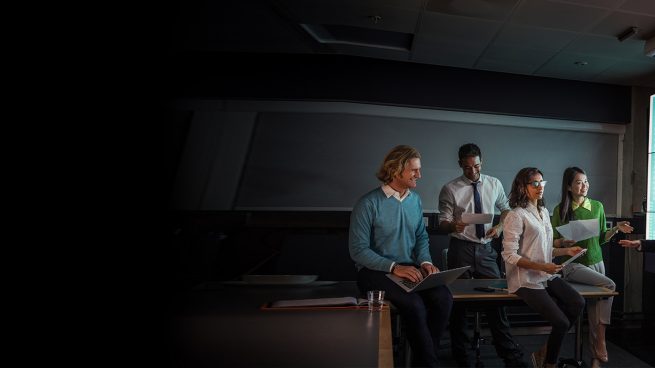
Microsoft Research New England 10th Anniversary Symposium – Closing Remarks
Senior Researcher Nicole Immorlica and Managing Director Jennifer Chayes offer closing remarks for Microsoft Research New England 10th Anniversary Symposium.