GridFM
Small foundation models for the electric grid
Architecture
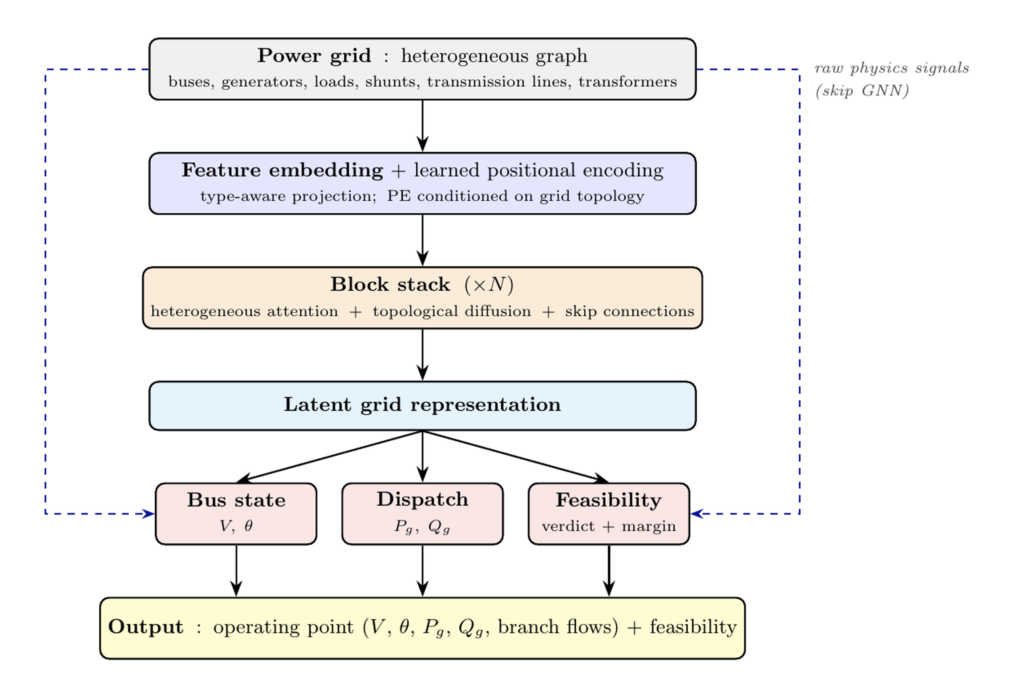
GridSFM is a block-structured discrete neural operator that processes power grids as heterogeneous graphs. Following discrete exterior calculus (DEC) principles, bus quantities (voltage magnitude, angle, nodal injections) are treated as discrete 0-forms on graph vertices, while branch flows are 1-forms on oriented edges. The bus–branch incidence acts as the discrete exterior derivative coupling the two; Kirchhoff’s current law appears naturally as its codifferential. This formulation gives the architecture a coordinate-free, topology-agnostic view of power flow that transfers across grids of different size and connectivity.
A type-aware projection embeds heterogeneous node and edge features into a shared latent space, augmented with a topology-conditioned learned positional encoding. The latent representation is refined by a stack of N blocks, each applying three sub-operations in sequence with residual skips:
- A per-type global mixer — every node attends to every other node of its type.
- A topology-aware mixer along the grid’s edges — where node types interact and the grid’s topology enters.
- A per-type MLP.
Five prediction heads output bus voltage magnitude V, angle θ, generator active dispatch Pg, generator reactive dispatch Qg, and a feasibility verdict with a continuous margin. Branch flows (Pij, Qij) are computed analytically from the predicted bus state via the π-equivalent branch model with off-nominal tap ratio, following the PowerModels.jl polar-AC formulation. This keeps the model on the AC manifold by construction rather than as a soft constraint.
Training Data
GridSFM is trained on ~200 base transmission topologies drawn from three open sources:
- PGLib-OPF — the IEEE PES benchmark library covering networks from hundreds to tens of thousands of buses.
- OPFData — a large-scale AC-OPF dataset derived from PGLib-OPF.
- The
msr_*corpus — a 48-state continental-US transmission topology set plus six multi-state regions, built by our open-data pipeline (described below).
Each base topology is expanded via a multi-axis perturbation pipeline that varies, independently and in combination:
Generator merit order — cost coefficients shuffled on 40% of generators, so dispatch learns from physics and cost structure rather than per-grid orderings.
Load profiles — 0.8×–1.5× nominal global scaling with ±10% per-load jitter; a separate high-load variant from 1.1×–1.3× covers the upper-stress tail.
Generator availability — 30% of scenarios contain outages (70% single, 20% double, 10% triple element), weighted by Pmax.
Line ratings — 20% of scenarios derate 10% of branches to 70%–95% of nominal.
Voltage limits — 15% of scenarios tighten Vmin/Vmax on 10% of buses.
A synthetic-infeasibility pipeline generates targeted failure modes — voltage squeeze, thermal bottleneck, angle tightening, DC-thermal congestion — driving a balanced ~50/50 feasible/infeasible training mix. Across all topologies and scenarios, training spans more than half a million labeled samples.
“On a brand-new grid, as few as ~10 fine-tuning scenarios already produce reasonable cost and dispatch estimates.”
A pipeline for building realistic open-data grid models
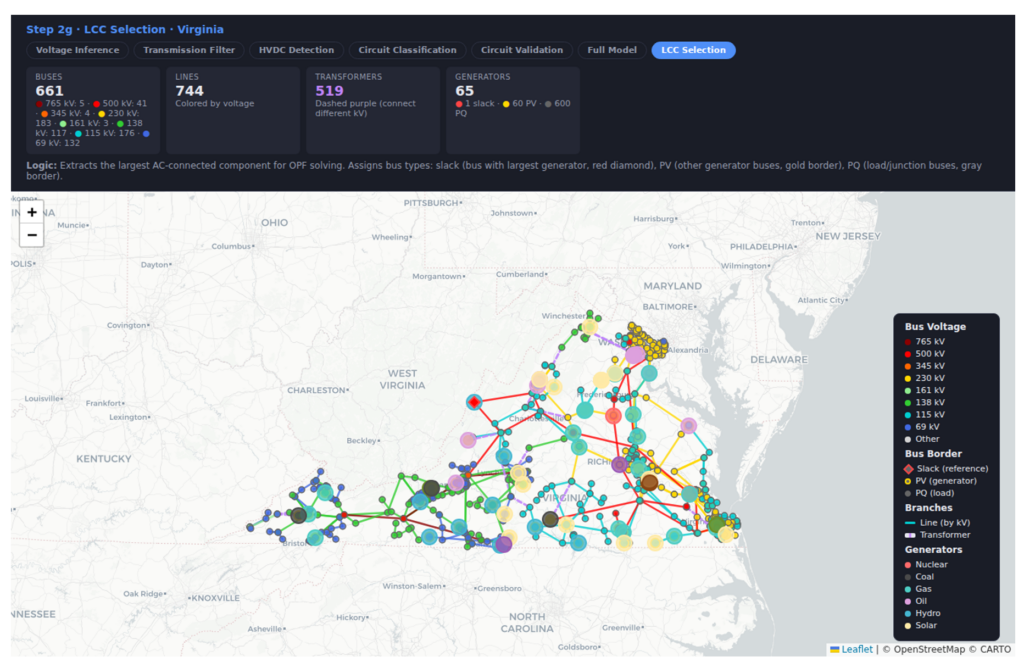
Companion to GridSFM, we built a five-stage pipeline that constructs complete, OPF-solvable transmission models entirely from public data:
- Extract power infrastructure from OpenStreetMap via a local Overpass API instance.
- Reconstruct bus-branch topology — voltage inference (neighbor consensus), line merging, and transformer detection.
- Estimate electrical parameters using voltage-class lookup tables calibrated with US Energy Information Administration plant-level data.
- Allocate hourly demand from EIA-930 to individual buses, using US Census population as a spatial proxy.
- Solve both DC and AC optimal power flow using PowerModels.jl with a progressive-relaxation strategy that automatically loosens constraints on imprecise models.
The pipeline was validated on all 48 contiguous US states and six multi-state regions, including the full Western (5,076 buses) and Eastern (21,697 buses) Interconnections. Of the 48 single-state models:
- 42 of 48 (88%) converge at the strictest relaxation level for AC-OPF at peak hour.
- 44 of 48 (92%) converge at off-peak.
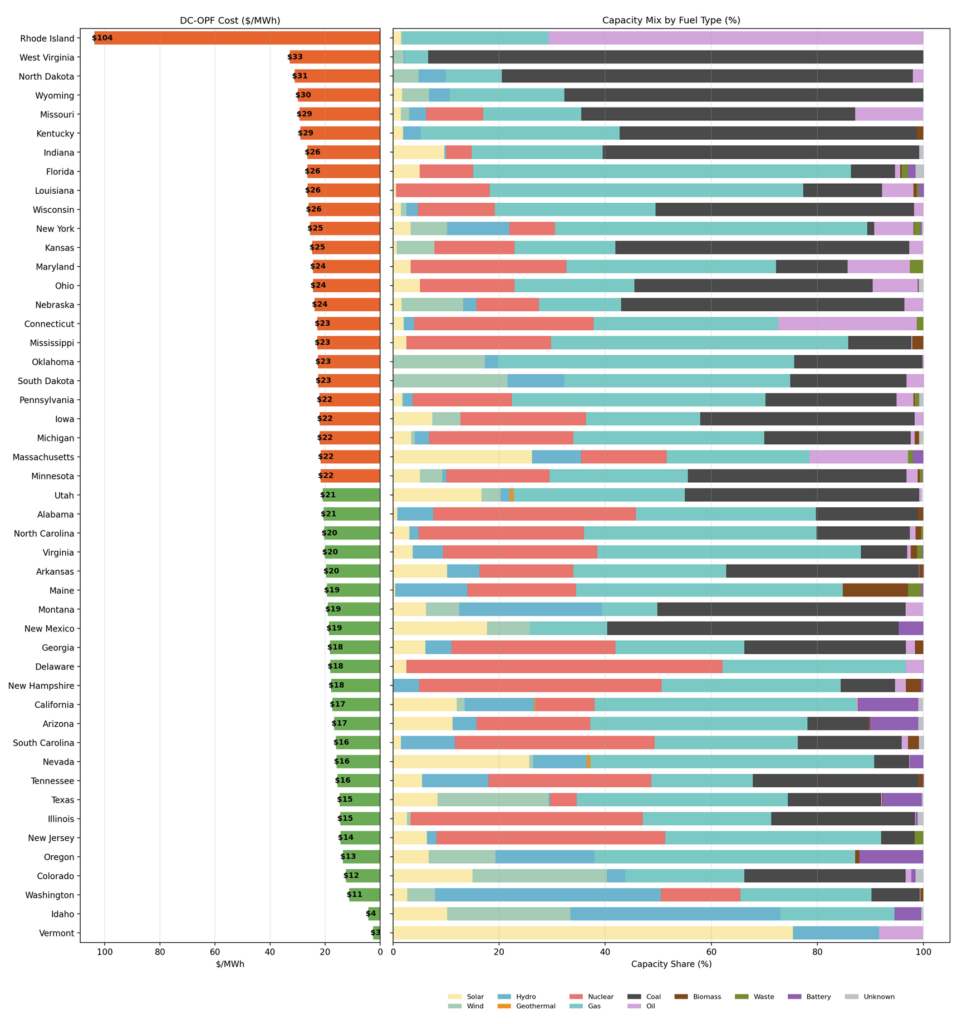
- Median dispatch cost: $22/MWh (range $2.6/MWh for hydro-dominated Vermont to $104.1/MWh for import-dependent Rhode Island).
- Median system loss: 1.0% (range 0.2%–7.1%) — physically plausible against real US transmission losses of 2–3%.
- AC–DC cost premium: median 1.8% (0.0–13.8%) — consistent with literature values.
All 54 models — 48 single-state and 6 multi-state — are publicly released at github.com/microsoft/GridSFM (opens in new tab).
Comparison to prior approaches
GridSFM is, to our knowledge, the first openly released learned AC-OPF surrogate trained jointly across ~200 base topologies. Most published learned AC-OPF surrogates are per-grid specialists — trained and evaluated on a single fixed topology. The closest comparable architecture, gridfm-graphkit (Linux Foundation Energy / IBM Research), is in the same accuracy class on per-grid metrics; GridSFM’s distinguishing properties are (a) a single backbone shared across grids, (b) feasibility as a first-class output, and (c) data efficiency: as few as ~10 fine-tune scenarios yield a useful model on a new grid.