


Gustavo de Rosa
Principal Research Software Engineer
概要
I am a Principal Research Software Engineer at Microsoft, working at the intersection of artificial intelligence research and engineering. My work focuses on turning research ideas into practical, scalable solutions, bridging the gap between scientific innovation and real-world applications.
Throughout my career, I have worked across a broad range of AI domains, including machine learning, deep learning, natural language processing, and large language models. I am particularly interested in the engineering challenges behind advancing AI capabilities, from model development and training to evaluation methodologies, experimentation frameworks, and large-scale infrastructure.
I enjoy tackling complex problems that require a combination of research insight, engineering excellence, and a strong understanding of how systems behave at scale. I value open-ended exploration, rigorous experimentation, and building tools and infrastructure that enable researchers and engineers to move faster and push the boundaries of what is possible.
My academic background includes a Ph.D. in Computer Science from Universidade Estadual Paulista (UNESP, 2022), where I focused on natural language processing and adversarial learning. I also hold an M.Sc. in Computer Science (2018), with research spanning image processing, pattern recognition, machine learning, and metaheuristic optimization, and a B.Sc. in Computer Science (2016).
Beyond my professional work, I enjoy sharing knowledge and contributing to the broader machine learning community through educational content and open-source projects.
注目のコンテンツ
Phi-4-reasoning Technical Report
We introduce Phi-4-reasoning, a 14-billion parameter reasoning model that achieves strong performance on complex reasoning tasks. Trained via supervised fine-tuning of Phi-4 on carefully curated set of “teachable” prompts–selected for the right level of complexity and diversity–and reasoning demonstrations generated…
Phi-4 Technical Report
We present phi-4, a 14-billion parameter language model developed with a training recipe that is centrally focused on data quality. Unlike most language models, where pre-training is based primarily on organic data sources such as web content or code, phi-4…
Phi-3 Technical Report: A Highly Capable Language Model Locally on Your Phone
We introduce phi-3-mini, a 3.8 billion parameter language model trained on 3.3 trillion tokens, whose overall performance, as measured by both academic benchmarks and internal testing, rivals that of models such as Mixtral 8x7B and GPT-3.5 (e.g., phi-3-mini achieves 69%…
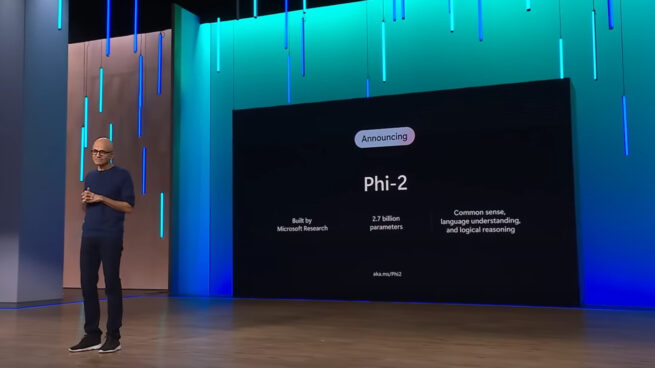
Phi-2: The surprising power of small language models
Phi-2 is now accessible on the Azure model catalog. Its compact size and new innovations in model scaling and training data curation make it ideal for exploration around mechanistic interpretability, safety improvements, and fine-tuning experimentation on a variety of tasks.
Textbooks Are All You Need
We introduce phi-1, a new large language model for code, with significantly smaller size than competing models: phi-1 is a Transformer-based model with 1.3B parameters, trained for 4 days on 8 A100s, using a selection of ``textbook quality" data from…
Archai: Platform for Neural Architecture Search
Archai accelerates your Neural Architecture Search (NAS) through fast, reproducible and modular research, allowing you to generate efficient deep networks for your applications.