
News & features
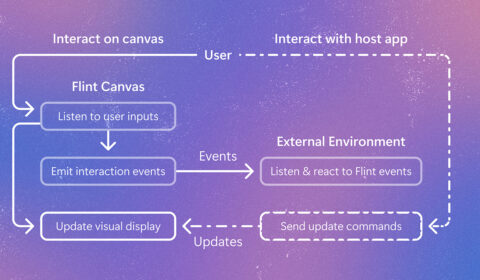
Flint-interactive: A language for creating interactive data visualizations
| Chenglong Wang, Yuwei Xiao, Alper Sarikaya, Michel Galley, Chris Quirk, and Jianfeng Gao
Flint-interactive gives AI agents a language for creating interactive visualizations. Click a chart, filter data, highlight related content, and explore beyond the view the author originally chose.
Flint: A visualization language for the AI era
| Chenglong Wang, Alper Sarikaya, Scott Tsukamaki, Michel Galley, and Jianfeng Gao
Short chart specifications are easy to write, but often produce uninspiring results. Flint is an open-source visualization language that offers a middle path, letting AI agents create expressive charts from compact, human-editable specifications.

Understanding the brain with AI-driven explanations and experiments
| Chandan Singh and Jianfeng Gao
Researchers introduce generative causal testing, which translates black box models into clear hypotheses and verifies them in the scanner, revealing what specific brain regions respond to in language.
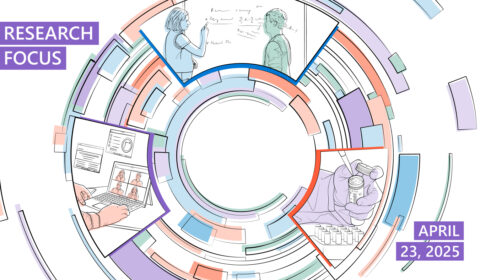
Research Focus: Week of April 21, 2025
In this issue: our CHI 2025 & ICLR 2025 contributions, plus research on causal reasoning & LLMs; countering LLM jailbreak attacks; and how people use AI vs. AI-alone. Also, SVP of Microsoft Health Jim Weinstein talks rural healthcare innovation.

BiomedParse: A foundation model for smarter, all-in-one biomedical image analysis
| Hoifung Poon, Theodore Zhao, Yu Gu, Mu Wei, and Sheng Wang
BiomedParse reimagines medical image analysis, integrating advanced AI to capture complex insights across imaging types—a step forward for diagnostics and precision medicine.

Research Focus: Week of February 19, 2024
In this issue: CaaSPER: vertical autoscaling algorithm dynamically maintains optimal CPU utilization; Improved scene landmark detection for camera localization runs faster, uses less storage; ESUS simplifies usability questionnaires for technical products and services.

NeurIPS 2023 highlights breadth of Microsoft’s machine learning innovation
We’re proud to have 100+ accepted papers At NeurIPS 2023, plus 18 workshops. Several submissions were chosen as oral presentations and spotlight posters, reflecting groundbreaking concepts, methods, or applications. Here’s an overview of those submissions.

Frontiers of multimodal learning: A responsible AI approach
New evaluation methods and a commitment to continual improvement are musts if we’re to build multimodal AI systems that advance human goals. Learn about cutting-edge research into the responsible development and use of multimodal AI at Microsoft.

Large language models (LLMs), such as ChatGPT, are able to generate human-like, fluent responses for many downstream tasks, e.g., task-oriented dialog and question answering. However, applying LLMs to real-world, mission-critical applications remains challenging mainly due to their tendency to generate…