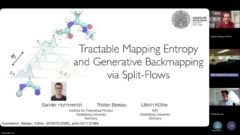
Tractable Mapping Entropy and Generative Backmapping via Split-Flows
- Tristan Bereau | Heidelberg University
- Microsoft Research New England Generative Modeling & Sampling Seminar
The transition between fine-grained and coarse-grained representations in molecular dynamics is a fundamental problem for multiscale modeling. We present Split-Flows, a new class of flow-based models designed to bridge the dimensional gap between disparate resolutions. By formulating the problem as a continuous-time measure transport, Split-Flows map the “excess” degrees of freedom of a high-dimensional system to a latent noise distribution conditioned on the coarse-grained state. This architecture enables two critical capabilities: (1) high-fidelity generative backmapping through conditional sampling, and (2) the first tractable computation of mapping entropy for arbitrary coarse-graining maps. We show that Split-Flows can accurately reconstruct complex molecular manifolds and provide a rigorous metric for quantifying information loss. Validation on biomolecular benchmarks (chignolin and lipid membranes) demonstrates that Split-Flows outperform existing heuristics, offering a robust pathway for principled multiscale machine learning.
Speaker bio
Tristan Bereau is a computational physicist working at the interface between multiscale modeling and machine learning for soft matter and biomolecules. He earned a Ph.D. in Physics at Carnegie Mellon University in 2011. After a postdoc at the University of Basel, he led an Emmy Noether research group at the Max Planck Institute for Polymer Research. He then moved to the University of Amsterdam as an assistant professor in chemistry and computer science, followed by a role in Industry. Tristan serves on the editorial boards of the journals Machine Learning: Science & Technology and Computational Science and Engineering. He is currently a professor at the Institute for Theoretical Physics at the University of Heidelberg.
Series: MSR New England Generative Modeling & Sampling Seminar
-
-
-
-
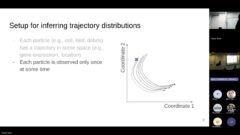
Inferring Unobserved Trajectories from Multiple Temporal Snapshots
- Yunyi Shen & Carles Domingo-Enrich
-
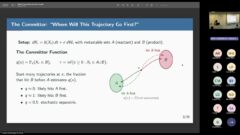
Rare event analysis via stochastic optimal control
- Yuanqi Du & Carles Domingo-Enrich
-
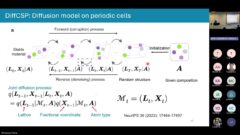
Constrained Generative AI for Materials Inverse Design
- Mouyang Cheng
-
-
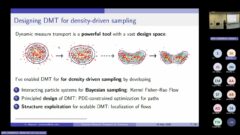
Designing Dynamic Measure Transport for Sampling
- Aimee Maurais
-
-
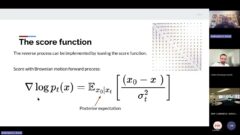
Physics and information theory of generative diffusion
- Luca Ambrogioni
-
-
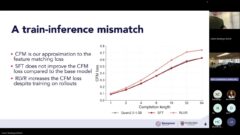
Matching features, not tokens: Energy-based fine-tuning of language models
- Mujin Kwun,
- Carles Domingo-Enrich
-
-
-
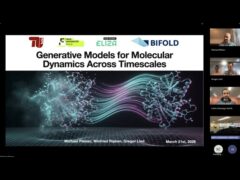
Generative Models for Molecular Dynamics Across Timescales
- Michael Plainer,
- Winfried Ripken,
- Gregor Lied
-
-
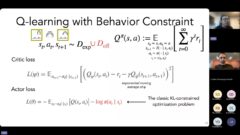
Q-learning with Flow-Matching Policies
- Qiyang (Colin) Li
-
-
-
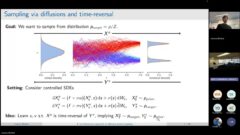
A non-Markovian approach to diffusion-based sampling
- Lorenz Richter
-
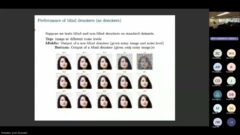
Blind denoising diffusion models and the blessings of dimensionality
- Aram-Alexandre Pooladian
-
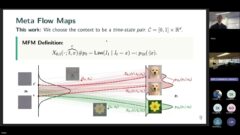
Meta Flow Maps
- Peter Potaptchik