

Delivering impactful enterprise AI today
As I work with customers across the US, I hear that many find the “promise of AI” to be somewhat overwhelming, with a variety of questions about where to start. In reality, the majority of SaaS offerings that we offer at Microsoft already include some AI capabilities, and the Azure platform has a wide variety of options available to analyze images, comprehend speech, interact with data in natural ways, and make predictions using data. AI is absolutely the future of the technology industry for many reasons, and it is estimated that this technology will deliver more than $18 trillion dollars to our economy over the next decade. As we all strive to work more efficiently and make better data-driven decisions, why is AI so essential and how can enterprises truly begin to take advantage of its promise now?
To get started, we must understand that there are various types of AI, and varying levels of complexity, risk, and capability offered with each. This is similar to the cloud adoption conversations we were all having a decade ago on the differences in SaaS (simple) versus IaaS (lift/shift) and PaaS (fully customizable). Understanding where to start with AI is critical so that we can set expectations accordingly and understand our risks and complexity levels.
Understanding AI
As we approach this increasingly broad topic, there are two primary types of AI which are helpful to understand: Artificial Narrow Intelligence and Artificial General Intelligence.
Artificial Narrow Intelligence (or Narrow AI) refers to instances in which a technology outperforms humans in very narrowly defined tasks. This includes the personal assistants that we all use each day, including chatbots on websites, language translation systems, directional mapping applications, and even autonomous cars and cargo ships! Narrow AI is the highest level of AI development that has been reached so far, and every example of AI that we leverage in the real world is categorized technically as a form of narrow Artificial Intelligence. A prime example is the US Centers for Disease Control and Prevention (CDC) COVID-19 assessment chatbot. With the right tools, it’s relatively easy for agencies to quickly stand up a bot like this, and really improve efficiencies for helpdesks and end-users alike.
Artificial General Intelligence (or Strong AI), on the other hand, is a type of distinguished AI that simulates the breadth of the human intellect, rather than focusing on more specific or narrower tasks. While we can accomplish massive business improvements with ANI today, we are still a long way from being able to leverage computing intelligence with the capacity to understand or learn any intellectual task in the same way that a human being can. There is certainly a lot of investment in this area though, and Microsoft Research has even developed a suite of tasks that teach artificial agents how to seek information actively, by asking questions instead of simply leveraging known data. Such behavior is a vital research step towards Artificial General Intelligence and delivering on this potential is also a reason why Microsoft has invested over $1 billion in OpenAI.
Relentless focus
Microsoft has been a leader in both AI research and capabilities for over 25 years, including machine learning, decades of focus in cognition, analytics and data management. There are over one million developers currently accessing our pre-built and customizable Narrow AI services today, and we were the first in the world to reach human parity in Object recognition (2016), Speech Recognition (2017), and Machine Translation (2018). Our relentless goal is to pursue new ways to empower people and organizations with systems that deliver new experiences and capabilities which help people be to more efficient, engaged and productive.
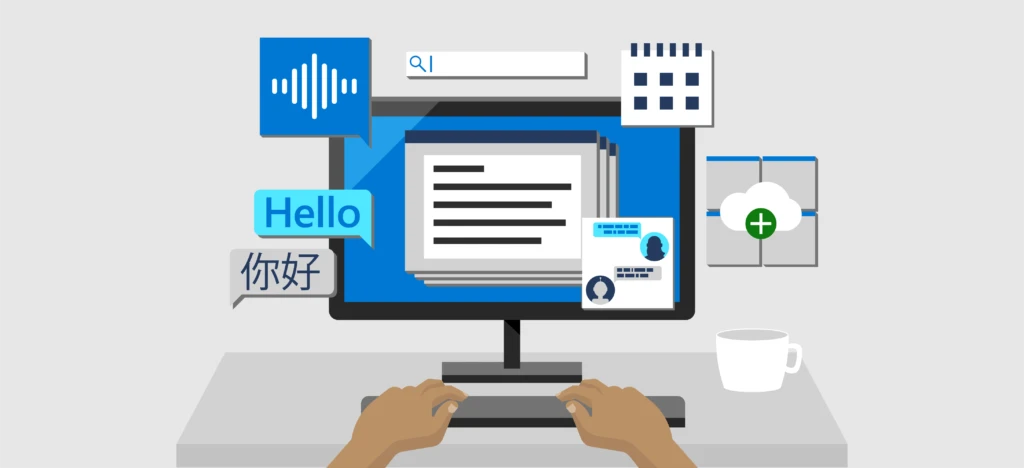
Every day, the majority of organizations are already using Microsoft AI as they access our cloud platform. Office 365 has over 90 offerings powered by artificial intelligence delivering over 420 billion interactions per month from 180 million users. This includes capabilities that empower busy professionals to manage their calendar and appointments more easily, and enable more meaningful communications by tearing down language barriers in real time and written communication. In order to help our customers get the most from Enterprise Ready AI today, we are also continually providing new tools and services which make it easier for organizations to make informed decisions, improve automation, derive new insights from data, and defend against cyberthreats across clouds, devices, and platforms.
Next steps for leaders
Leveraging AI requires organizations to define the business outcomes, and define a responsible AI strategy which enables them to engage with AI responsibly as they introduce these services and within their organization. For additional information on how to achieve your goals with AI, please visit us online to learn more about our AI platform, how we are embedding AI into Intelligent Applications, or even how to apply AI more strategically in your organization. We are thrilled by the opportunity to do more together, and we are delighted to engage with you to drive new positive outcomes in support of your mission.