

Scaling AI with confidence: How leaders are using AI to drive enterprise transformation
What the fastest‑moving companies are doing differently
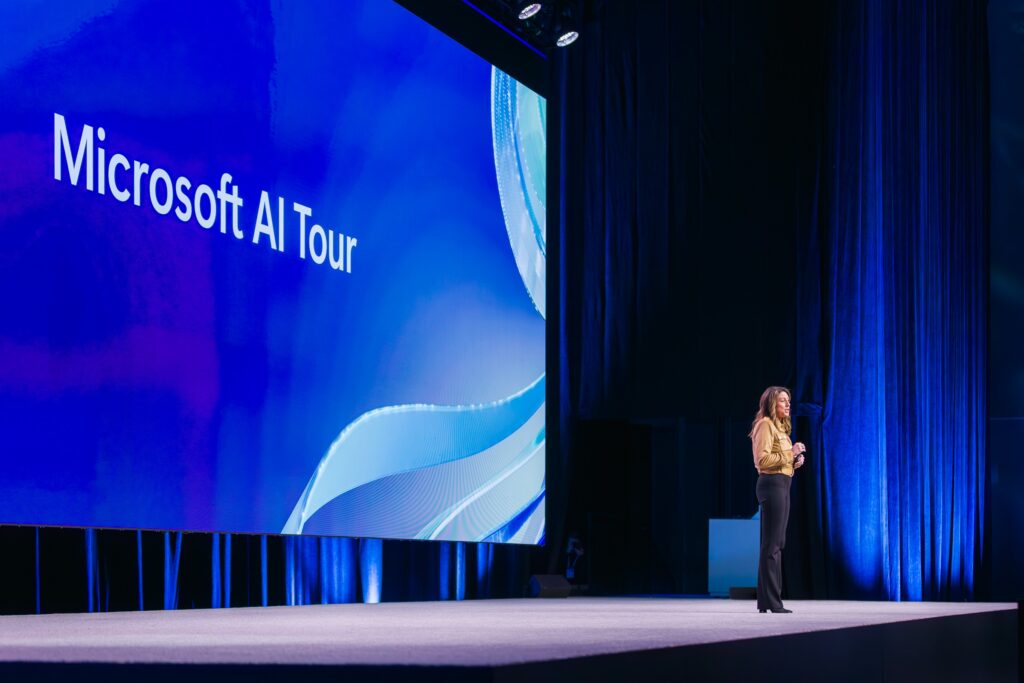
Over the past year, I’ve had countless conversations with leaders across industries, from healthcare and financial services to professional services and insurance. Most recently, at the Microsoft AI Tour in NYC, one thing became unmistakably clear:
The AI conversation has changed.
Not long ago, organizations were asking whether AI worked. Today, the leaders moving fastest are asking a different question entirely:
How do we scale AI across the business to drive meaningful outcomes—securely, responsibly, and repeatably?
The divide I’m seeing is no longer between companies experimenting with AI and those that aren’t. It’s between organizations running isolated pilots and those treating AI as a core operating model.
Leaders who are pulling ahead are taking a more strategic, differentiated approach.
In this short video, I share what I’m hearing directly from leaders who are scaling AI across their businesses, and what’s separating experimentation from transformational impact.
AI stopped being a tool and became a business strategy
Many early AI efforts focused on productivity gains: drafting documents faster, summarizing meetings, and automating small tasks. Those wins mattered, but they were just the starting point.
The organizations accelerating today are anchoring AI to business outcomes, not tools.
At the NYC AI Tour, I heard this repeatedly from customers across industries:
- A global professional services firm described moving from scattered Copilot use to redesigning end‑to‑end workflows—reducing cycle times and enabling teams to focus on higher‑value advisory work.
- A financial services organization shared that AI became a growth enabler once leadership aligned on specific outcomes like faster decision‑making and improved client experience.
What changed wasn’t the technology—it was the mindset.
AI shifted from “something teams try” to “how the business runs.”
When leaders start with outcomes—growth, speed, customer impact—AI stops being a pilot and becomes a strategic multiplier.
Scaling AI requires trust not bravery
One of the biggest misconceptions about AI adoption is that speed comes from moving fast and worrying about governance later.
In reality, the companies scaling fastest are doing the opposite.
Across these interviews, a consistent pattern emerged: trust is the accelerator.
- In highly regulated industries like healthcare and insurance, leaders emphasized that AI only scaled once governance, security, and compliance were built into the foundation.
- A healthcare organization shared that responsible AI practices were essential to clinician adoption—without confidence in data privacy, accuracy or usage stalled.
The takeaway was clear:
Responsible AI isn’t a blocker to innovation—it’s what unlocks it.
When teams trust the platform, they move faster. When leaders trust the data, they scale with confidence. Governance done right doesn’t slow momentum—it sustains it.
Leaders across industries are operationalizing AI at scale—by embedding trust directly into how work gets done. Watch now:
The real differentiator is the human side of AI
Another shift I’m seeing is how leaders talk about people.
The most successful AI stories aren’t about replacing work; they’re about elevating the employee experience.
At the NYC AI Tour, customers described AI as a way to:
- Give employees time back to focus on judgment, creativity, and relationships.
- Reduce cognitive overload by helping teams navigate massive amounts of information.
- Improve engagement by pairing AI adoption with skilling and change management.
One professional services leader shared that once teams were given space to experiment, and the training to do so, AI adoption surged. Not because it was mandated, but because it made work better and unlocked opportunities to bend the curve on innovation.
AI works best when it’s human‑led and people‑centered. Technology alone doesn’t transform organizations; people do.
From one‑off wins to a repeatable AI operating model
Perhaps the most important difference I’m seeing is how leaders think about scale.
The fastest‑moving organizations aren’t chasing use cases, they’re building systems.
Across NYC conversations, leaders described a repeatable pattern:
- Define clear outcomes
- Deploy AI securely
- Measure impact
- Reinvest and scale
A global consulting firm talked about standardizing AI across roles so success didn’t depend on individual champions. Another organization emphasized measuring outcomes, not just usage, to ensure AI investments compounded over time.
This shift—from experimentation to execution—is what turns early wins into lasting advantage. AI becomes infrastructure, not innovation theater.
The next phase of AI leadership
We’re entering a new chapter of AI adoption.
The advantage is no longer about being first; it’s about being ready to scale.
The leaders pulling ahead are aligning three things:
- Clear business outcomes
- Trusted, secure foundations
- Empowered people
When those come together, AI stops being something you add to the business, and becomes how the business operates.
The question leaders should be asking now isn’t “Should we use AI?”
It’s “Are we ready to run the business on it?”
If you’re navigating the next phase of AI at scale, these resources offer practical insight from leaders already there:
- Learn from leaders navigating AI at scale: Register now for Microsoft AI Tour
- Explore insights from leaders scaling AI: Microsoft in Business AI hub
- Go deeper: What scaling AI really takes: Microsoft customer stories