Microsoft has been named a Leader in the 2026 Gartner® Magic Quadrant™ for Cloud ERP Finance.¹ We believe this recognition reflects something finance leaders are seeing as AI moves into their work: the financial system of record matters more than ever.
Gartner evaluates vendors on their Completeness of Vision and Ability to Execute. Learn more in the Gartner Magic Quadrant report.
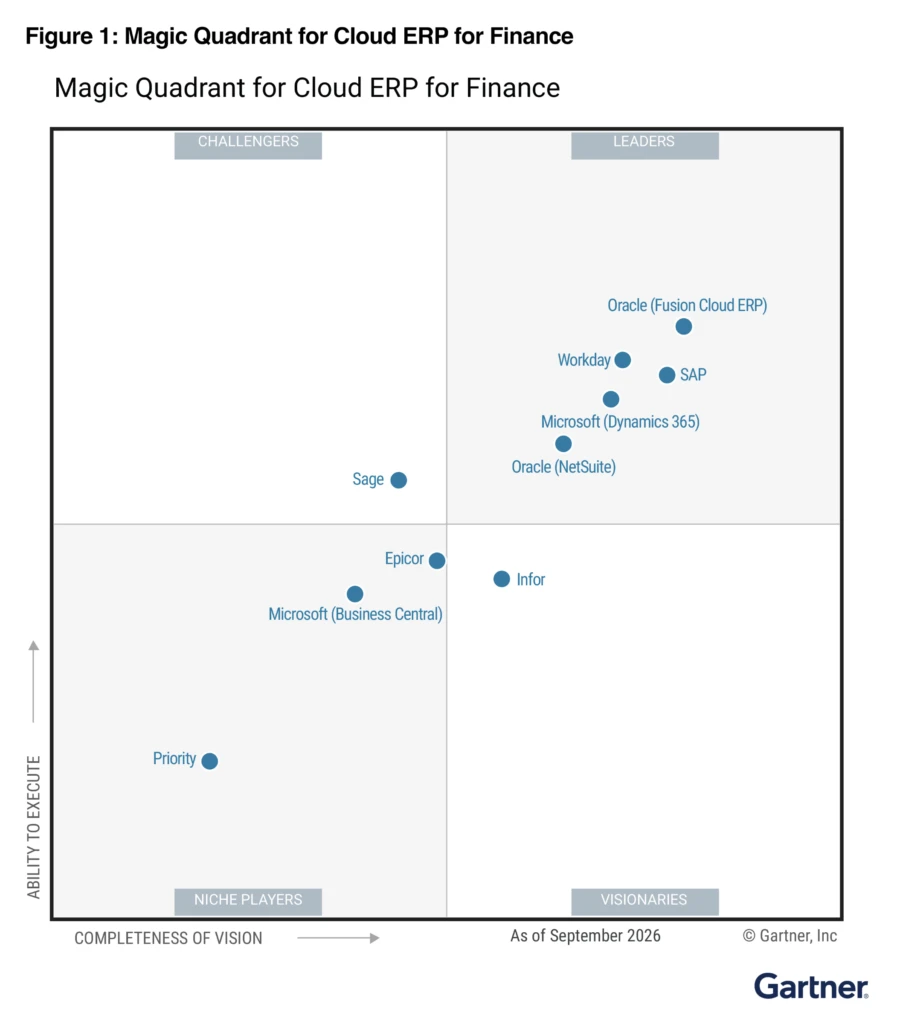
Figure 1: Magic Quadrant for Cloud ERP for Finance
There’s been no shortage of predictions that agents will make traditional business applications less important. In ERP, we’re seeing the opposite. The answers Microsoft Copilot gives a CFO and the tasks it helps complete for a controller are only as good as the financial data, processes, accounting rules, and controls underneath them. A reconciliation isn’t complete just because two totals match. The underlying transactions must be valid, any discrepancies explained, and the result able to stand up when an auditor asks how it was reached.
Handling financial complexity at the core
That dependency becomes especially important for multinational organizations, where financial complexity is built into the operating model. A single transaction may cross legal entities, currencies, tax jurisdictions, and reporting standards before it reaches consolidated results. Finance must protect the integrity of that path while the business acquires companies, enters markets, and changes how it sells. That work depends on deterministic systems that apply defined rules consistently every time. Agents are most useful when they build on that foundation, helping people understand, prepare, and act, while the ERP continues to govern how transactions are recorded.
That is why we continue to invest in the financial core of Dynamics 365 Finance. The financial journals experience is being re-engineered to support higher transaction volumes and cross-legal-entity complexity, with capabilities designed to help teams view intercompany transactions, create accruals, and preview allocations before posting. We are also investing in capabilities to help organizations address evolving regulatory requirements country by country, including electronic invoicing and e-reporting in France and the next phase of Brazil’s tax reform. For finance leaders considering an ERP modernization, the financial foundation they choose will determine how much work agents can reliably take on.
The Adecco Group illustrates what it takes to manage that complexity at scale. The world’s largest talent advisory company operates 450 legal entities across 60 countries and territories, and it is standardizing its financial processes on Dynamics 365 Finance. In Japan, the company shortened its financial close by two days, and it expects to save $540,000 over three years by decommissioning older systems. “With Dynamics 365, we have been able to significantly improve our control environment,” said Mark Hookey, Head of Finance Transformation Project Office.
Bringing the ledger to where finance works
A trusted financial core is essential, but finance work rarely stays inside the ERP. Analysis is built in Excel, questions about transactions arrive in Outlook, and decisions are made with colleagues in Teams, usually with numbers copied out of the ledger. With Copilot serving as the interface for that work, finance teams can work with ERP data in the flow of their work.
As Dynamics 365 ERP applications connect to Work IQ, Copilot can draw on financial records, business rules, and organizational context within the user’s security permissions. This means a finance leader can ask a question about the ledger during a business review and receive an answer grounded in relevant data. Copilot responses include citations and deep links to underlying records, helping reviewers trace answers to their source. With Copilot Cowork and the Dynamics 365 ERP plugin, an analyst can hand off multi-step work, such as reviewing the status of close tasks across legal entities, while remaining in control of the result. Access to financial data remains governed by the identity, permissions, and compliance controls across the Microsoft Cloud.
Using agents where they help most
Not every finance task needs an agent. Rules-based processes, such as posting and allocations, belong in the ERP, where they are executed consistently according to defined business rules. Agents add the most value where finance teams need to interpret information, such as matching transactions that do not quite line up, processing supplier invoices in different formats, and investigating exceptions.
In Dynamics 365 Finance, the Account Reconciliation Agent can help identify exceptions between subledgers and the general ledger and suggest how to resolve them, with finance teams able to define which legal entities and modules it covers, how much it processes, and when they are notified. Teams can review a simulation of the effect of a resolution before it is applied. In accounts payable, intelligent invoice recognition and suggestions to complete finance entries help more invoices move through processing without manual handling.
Pamarco Technologies, a manufacturer of anilox rolls and printing technology with seven legal entities and customers in almost 70 countries, provides an example of this approach in practice. Working with Copilot Cowork, Microsoft Copilot Studio, and the Dynamics 365 ERP MCP server on top of Dynamics 365 Finance, Pamarco applied AI to several finance workflows: progressing tasks in its financial period close workspace, coding non-purchase-order freight invoices with about 95 percent success, and preparing reporting such as its monthly board sales presentation. “We’ve been able to automate roughly 40% of financial close tasks with autonomous AI agents,” said Glyn Wilson, Chief Information Officer. Throughout, the close workspace, permissions, and records in Dynamics 365 Finance remain the system of record the finance team relies on.
Let’s get started
Agents will take on more of finance’s work, but only as much as the foundation underneath them allows. That’s why we’re investing in three things in Dynamics 365 Finance. The first is a financial core built for multinational complexity. The second is Copilot, bringing that data into the tools finance teams already use. The third is agents, applied where interpretation and judgment are needed rather than where rules already do the job. We’re proud of this recognition from Gartner, and we’ll keep investing so finance leaders can take on more without giving up the control and confidence their organizations depend on.
- Read the report: 2026 Gartner® Magic Quadrant™ for Cloud ERP Finance.
- Explore Dynamics 365 Finance or request a demo.
- See Dynamics 365 at Microsoft Ignite, November 17–20, 2026.
Microsoft named a Leader in the 2026 Gartner® Magic Quadrant™ for Cloud ERP Finance

¹ Gartner, Magic Quadrant for Cloud ERP Finance, Mike Helsel, Irmina Melarkode, October 13, 2026
Gartner and Magic Quadrant are trademarks of Gartner, Inc. and/or its affiliates. Gartner does not endorse any company, vendor, product or service depicted in its publications, and does not advise technology users to select only those vendors with the highest ratings or other designation. Gartner publications consist of the opinions of Gartner’s business and technology insights organization and should not be construed as statements of fact. Gartner disclaims all warranties, expressed or implied, with respect to this publication, including any warranties of merchantability or fitness for a particular purpose. This graphic was published by Gartner, Inc. as part of a larger research document and should be evaluated in the context of the entire document. The Gartner document is available upon request from Microsoft.