In the last year alone, the number of active agents in the Microsoft 365 ecosystem has grown 15x.1 Now, we’re getting a clearer picture of how organizations have been putting agents to work.
Organizations across industries have launched agents that deliver immediate value, from answering questions and summarizing information to helping employees work faster. It’s easy to assume the future of agent adoption will continue to be anchored in productivity use cases.
But when Microsoft analyzed usage patterns across more than 40,000 Microsoft Copilot Studio enterprise agents, a broader picture emerged.2 Productivity is indeed the dominant entry point for agent adoption. But organizations are also building agents for operational work across security, supply chain, finance, healthcare, and other business domains.
The data suggests that enterprise agent adoption is expanding in two directions at once. Productivity scenarios are scaling outward across the workforce, while more specialized agents are extending inward into business functions and processes. The opportunity is to pursue both directions, giving agents room to reason and adapt where judgment adds value while maintaining predictability and control where the work demands it. Deterministic execution, human oversight, evaluation, and governance all have a role to play in striking that balance.
The organizations that get this balance right can move beyond simply adopting agents to applying them where they can create the most meaningful business value. That’s the next frontier for enterprise agents—and new advances in how agents are built are expanding what organizations can tackle. It’s also a conversation I’ll be continuing at the 2026 Power Platform Community Conference (PPCC), where we’ll look at what this next phase means for the people actually building and operating agents.
The patterns that are changing how we think about agent adoption
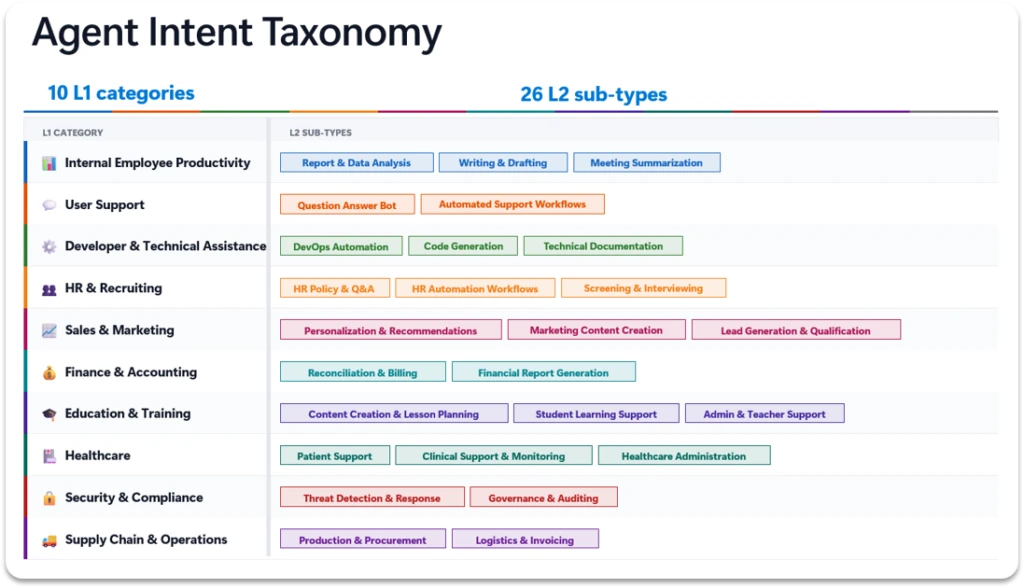
For this analysis, Microsoft analyzed telemetry from 40,093 Copilot Studio enterprise agents identified as using generative AI orchestration and having classified business intent. These agents span nearly 2,000 tenants. We examined deployment and usage patterns across ten Level 1 business intent categories and their associated Level 2 subcategories for the two-month period between May 1, 2026, and July 1, 2026.
Two patterns stood out in how organizations are putting these agents to work.
Pattern 1: Productivity remains the front door to AI
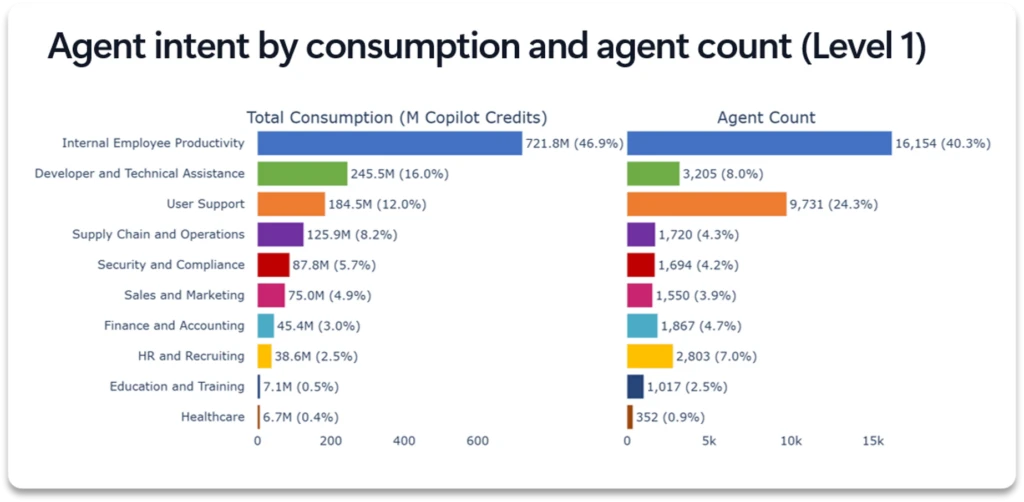
The first pattern was exactly what we’d expect to see: The majority of agents are deployed to improve employee productivity and support users. Together, agents in the Internal Employee Productivity and User Support categories account for 64.6% of deployed agents and 58.9% of overall agent activity. This makes them by far the most common enterprise agents.
That makes sense. Productivity scenarios have a low barrier to adoption and apply broadly across organizations. For many companies, they’re the natural place to start applying AI agents.
But even within productivity, the mix is changing. For example, since March 2026, Developer & Technical Assistance represented roughly 4% of total agent activity in our March analysis, but grew to 16% in the May–July dataset.3 That suggests organizations are expanding beyond traditional helpdesk-style scenarios into more sophisticated, code-first applications of agents.
And when we move down a level in the taxonomy, we see similar variety. Report & Data Analysis, Writing & Drafting, Meeting Summarization, and Question Answer Bots are all prominent scenarios.
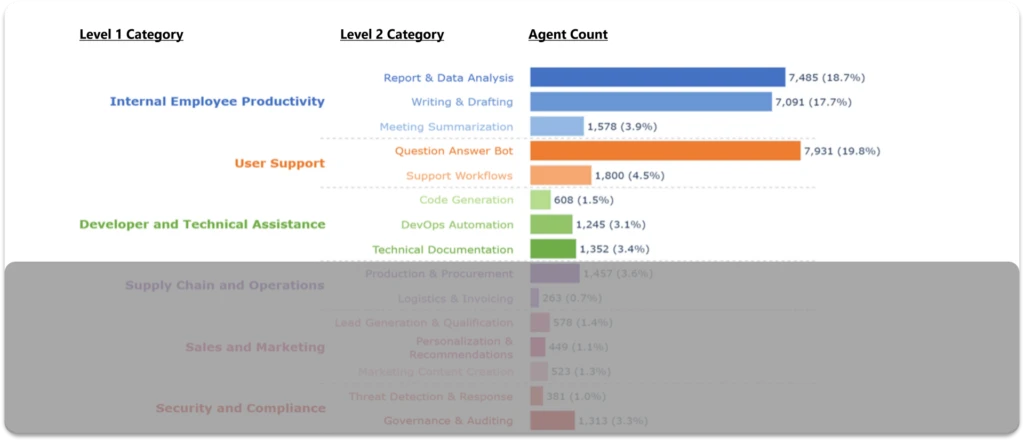
The pattern suggests that productivity adoption isn’t simply growing; it’s diversifying. As organizations gain experience with agents, they’re applying them to a wider range of increasingly specialized knowledge work.
Pattern 2: An operational long tail is emerging in agent adoption
The diversification we see within productivity is only part of the story. Beyond those high-volume scenarios, the data reveals a long tail of more specialized agents extending into Security & Compliance, Supply Chain & Operations, Finance & Accounting, Healthcare, and other business domains.
At the Level 2 subcategory, those scenarios become even more specific: Threat Detection & Response, Clinical Support & Monitoring, Production & Procurement, Logistics & Invoicing, and others.
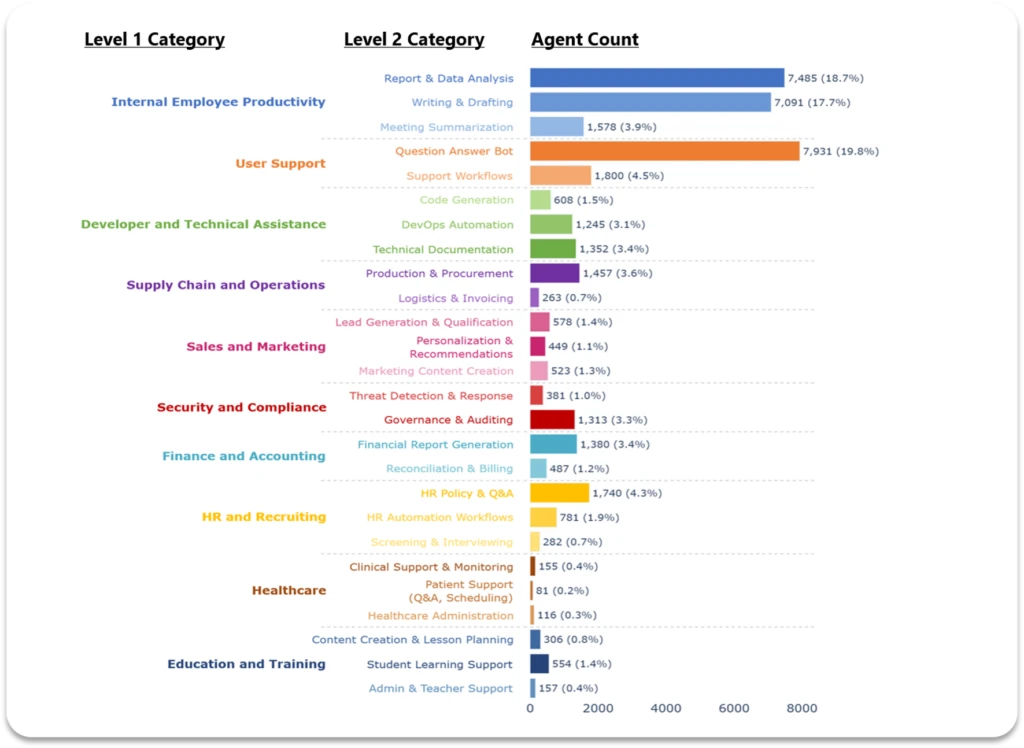
Individually, these scenarios account for a much smaller share of agent adoption than productivity. Collectively, however, they show organizations finding increasingly specialized places for agents across the business.
The distinction isn’t simply what these agents do, but where they sit in the work. Productivity agents generally augment work performed by individuals: helping someone analyze information, draft content, summarize a meeting, or find an answer. Operational agents are being applied within the business processes themselves.
On the surface, these scenarios span very different industries and functions. But much of the work they support shares several characteristics:
- It involves structured, repeatable business processes.
- It spans multiple systems and, often, multiple data sources.
- It requires coordination across people, applications, and business rules.
In other words, these agents tend to be built around work that is more specialized to the way a particular part of the business operates. That contrasts with productivity scenarios, where many of the same needs recur across roles and organizations.
Plot these scenarios together, and we see a distinct L-shape of agent adoption, which demonstrates that agents are expanding in two directions at once. According to this data, productivity scenarios are scaling outward across the workforce because the same needs exist across roles and organizations. Meanwhile, a growing range of specialized agents are extending inward into operational business functions and processes, shaped by the practices, systems, and requirements of a particular function or industry.
The opportunity isn’t in choosing a path; it’s in combining both
The data doesn’t suggest that organizations should choose between productivity-optimizing agents and operational transformation agents. Both have a role to play in how organizations adopt AI.
Broad productivity scenarios can help employees work more effectively across the organization. Operational scenarios embed agents into the execution of critical business processes. Together, they represent complementary dimensions of enterprise AI adoption: breadth and specialization.
For organizations developing their agent strategy, that raises a practical question: How do you identify the less obvious operational opportunities?
Discovery becomes a competitive advantage
Productivity opportunities are relatively easy to recognize because they’re visible to nearly every employee. Most people know when they’re spending too much time searching for information, writing emails, or completing repetitive tasks.
Operational opportunities are different. They often exist inside complex business processes, cross-functional handoffs, and systems that few people see end to end. They’re harder to identify because understanding the opportunity often requires understanding how the work moves across people, applications, data, and business rules.
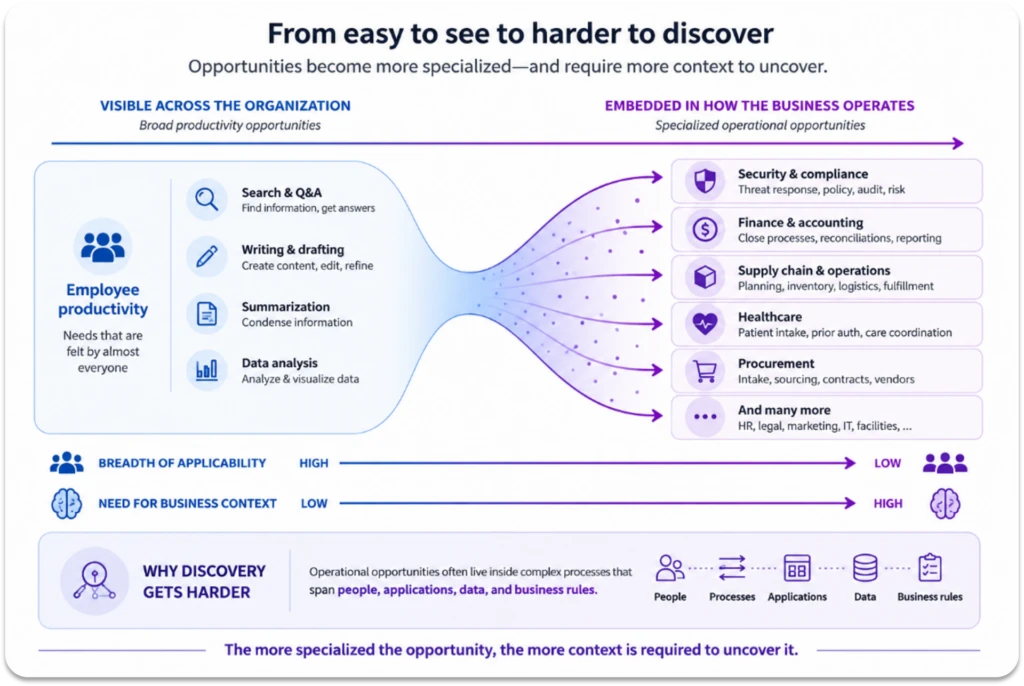
As the operational long tail grows, that context becomes increasingly useful for identifying where agents might contribute. Work IQ is one example of how Microsoft is bringing a deeper understanding of work into the agent experience, drawing on organizational context to help agents understand people, relationships, communications, business data, and how work gets done.
That richer context can help organizations both identify new opportunities for agents and build agents that are better grounded in the work they’re designed to support. At PPCC, you can go deeper on this idea in our Microsoft IQ: Building Intelligent Enterprise Agents with Copilot Studio session. We’ll explore how Microsoft IQ brings together Work IQ, Fabric IQ, Foundry IQ, and Web IQ to give agents richer context for reasoning and action.
After all, many of us are looking to create the greatest organizational leverage we can—while gaining widespread adoption.
Turn insights into action
Discover resources to identify, prioritize, and build high-value agents.

Where enterprise agents go next
The 40,000 agents in this analysis give us a snapshot of enterprise agent adoption at a particular moment. They show productivity remaining the dominant entry point while diversifying into more specialized knowledge work, alongside a growing range of agents extending into operational business processes.
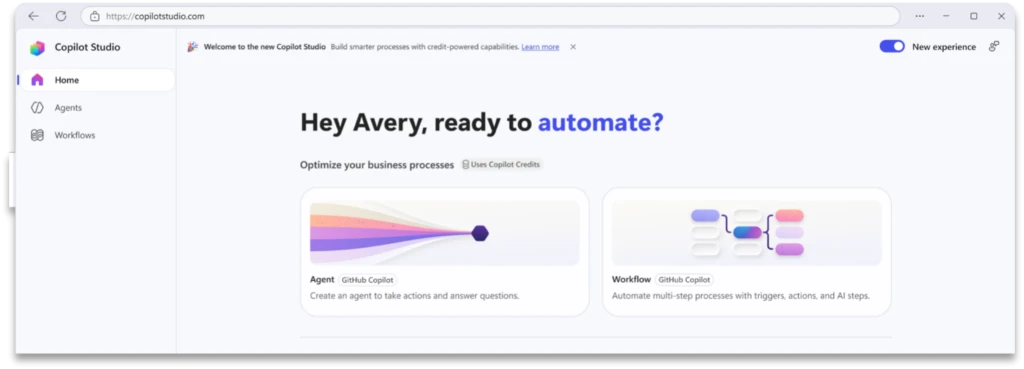
That expansion into more specialized operational work is exactly the kind of opportunity the new GitHub Copilot harness in Copilot Studio is designed to unlock. By bringing more powerful reasoning and code-first extensibility into Copilot Studio alongside its low-code experience, the harness gives makers more flexibility to tackle complex business problems and build agents for scenarios that may have previously required more custom development.
That makes what happens next especially interesting. How will greater extensibility change the kinds of business processes organizations build agents around? What new scenarios become possible as code-first and low-code development come together? And how will organizations apply these capabilities to the increasingly specialized opportunities we’re already beginning to see in the data?
The analysis used in this article has given us a baseline for what enterprise agent adoption looks like today—and a way to measure how it evolves from here. This next chapter is about expanding what makers can solve with agents. With the new harness, Copilot Studio is giving you more power and flexibility to tackle complex business problems.
So, where will you take it?
Join us at the Power Platform Community Conference in October 2026 to explore the next frontier of agent building firsthand. From identifying the right high-impact use cases to designing multi-agent systems and bringing agents, workflows, and new capabilities together, sessions across the conference will help you turn what’s newly possible into what you build next.
Sessions to look for include:
- Empower Your Agent to Do More: What’s New in Agent Capabilities
- Building your agentic enterprise with agents, workflows and autopilots in the new Copilot Studio
- From AI Idea Chaos to Build-Ready Agents: Agentic Framework for Prioritising High-Impact Use Cases
- When One Agent Isn’t Enough: Designing Scalable Multi-Agent Systems
- From Idea to AI Blueprint: A Hands-On Workshop for Business Process Innovation
We’ve seen where enterprise agents are today. Come to PPCC 2026 and help us discover where they go next. I’ll see you Wednesday, October 28, 2026, for an innovation session on building end-to-end agents with Copilot Studio.
1 Source: Microsoft, 2026 Work Trend Index Annual Report. Microsoft 365 agent telemetry, March 2025–March 2026. Active agents in the Microsoft 365 ecosystem grew 15x year over year.
2 Source: Microsoft internal Copilot Studio telemetry analysis of 40,093 enterprise agents across approximately 2,000 tenants, May 1–July 1, 2026. The analysis included agents using generative AI orchestration for which business intent could be classified. Agents were classified into 10 high-level business intent categories and associated subcategories. Percentages cited in this article represent the distribution of agents and agent activity within this dataset and should not be interpreted as representative of all Copilot Studio agents or customers.
3 Source: Microsoft internal Copilot Studio telemetry analysis. Developer & Technical Assistance represented approximately 4% of agent activity in the March 1–31, 2026 analysis, compared with approximately 16% in the May 1–July 1, 2026 analysis. Percentages reflect agent activity within each respective dataset.