TTraditionally, if you needed to learn a new technology at work, the process was straightforward. Take courses, log hours using the tools, and with time your expertise becomes more specialized and valuable. To understand AI, you’d expect to follow a similar path. But nothing about AI is traditional. And for a paradigm shift that feels algorithmic, how effectively you use agents depends on the things that make us most human.raditionally, if you needed to learn a new technology at work, the process was straightforward. Take courses, log hours using the tools, and with time your expertise becomes more specialized and valuable. To understand AI, you’d expect to follow a similar path. But nothing about AI is traditional. And for a paradigm shift that feels algorithmic, how effectively you use agents depends on the things that make us most human.
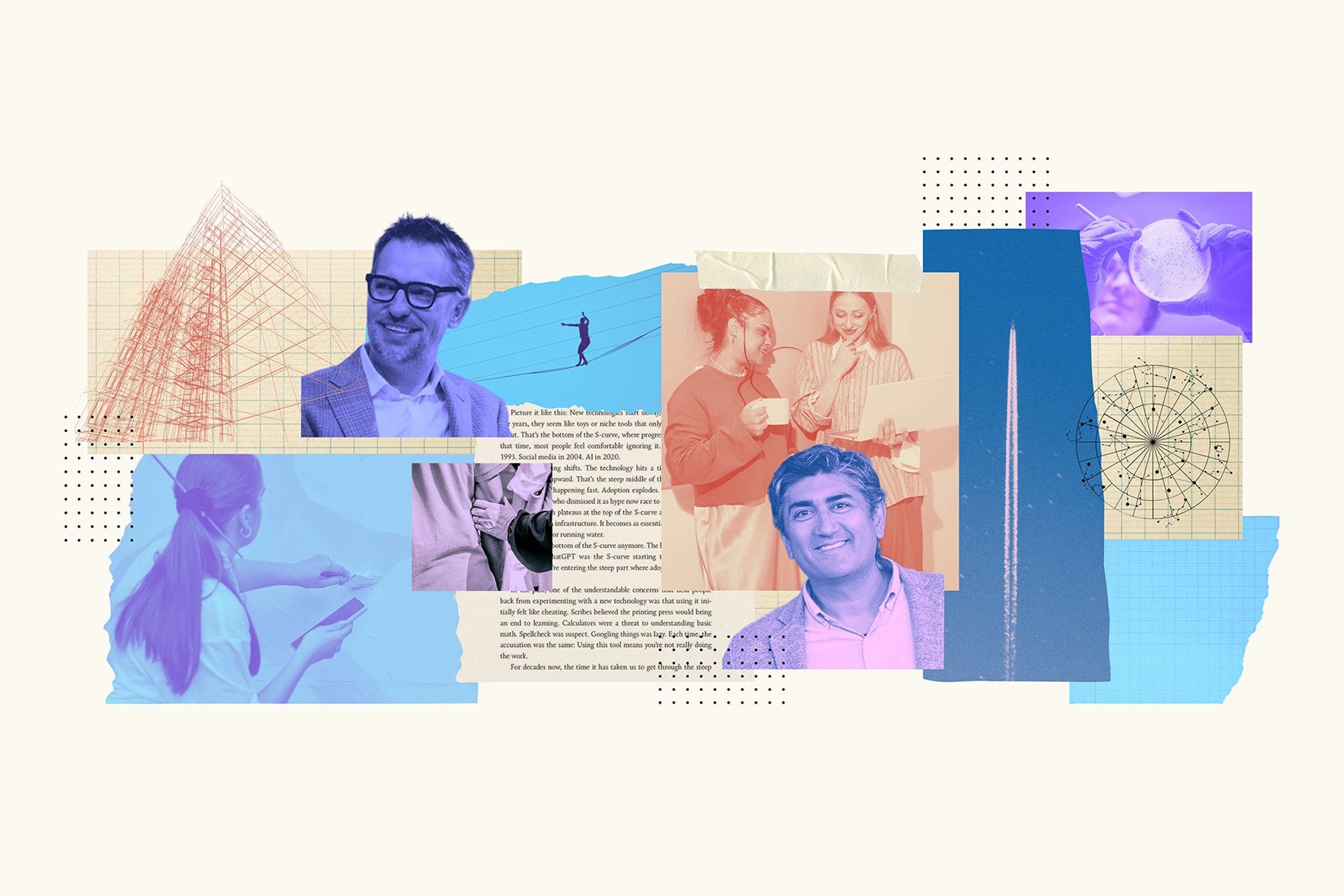
That’s the foundation of Open to Work: How to Get Ahead in the Age of AI, a new book from Ryan Roslansky, LinkedIn’s CEO and Microsoft EVP and Aneesh Raman, the company’s Chief Economic Opportunity Officer. (It’s out now and you can buy it here.) Open to Work has anecdotes, insight, and actionable guidance for workers of all stripes—from entry-level employees to executive leaders—to understand the radical shift underway at work. Throughout, Roslansky and Raman emphasize the importance of the human advantage. In this excerpt, they introduce the 5Cs, or five innate capabilities that give us an edge in working with AI.
The unique capabilities we have as humans are what make us irreplaceable. To better understand and identify these capabilities, we talked to neuroscientists, organizational psychologists, behavioral economists, and talent leaders—a wide range of experts who think about human capability and work every day.
We landed on five capabilities, focusing on the core inputs that each of us can develop individually and that, in many ways, enable everything else. We call them the 5Cs. The 5Cs make us better teammates and sharper thinkers. Together, they’re the engine of human innovation.
Curiosity
AI can process patterns. Only humans ask, What if we tried something completely different?
In a moment when AI is reshaping every aspect of how we work, curiosity is our most important advantage as humans. Right now, we can harness that curiosity and the openness that comes with it to learn about AI and how it’s going to transform our jobs, to understand ourselves and figure out what makes us irreplaceable, and, most importantly, to align our careers with our curiosities. The questions that fascinate you, the ones that keep you up at night or make you lose track of time, are going to be critical to finding your competitive edge in the age of AI.
Curiosity isn’t just gathering information. It’s wondering why things are the way they are and what happens when you push against those assumptions. Every breakthrough in human history started with someone asking a question no one had asked before. The polio vaccine didn’t come from analyzing existing treatments, which is what AI would do. It was invented because Jonas Salk and his colleagues wondered if dead viruses could teach the body to fight live ones. He could have been wrong. He took the time to test his idea anyway.
The electrician who wonders why a circuit keeps tripping and traces it beyond the obvious answers to find a hidden issue that could have caused a fire. The accountant who questions why certain expenses spike every third quarter and uncovers an inefficiency, saving millions. The routine suddenly becomes about discovery.
Courage
AI can calculate risk. Only humans decide what risk is worth taking.
Courage is the willingness to act without complete information and to move forward when the outcome isn’t guaranteed. It’s choosing to be the test case when everyone else is waiting for proof. Thousands of years ago, Polynesian wayfarers climbed into hollowed-out trees and set sail across the Pacific, navigating using only the stars and their deep knowledge of the sea. They found new islands, inhabited them, and established cultures that still thrive today. Centuries later, the crew of Apollo 13 carried that same spirit into space. To strap yourself to a rocket and aim for the moon, knowing there was a good chance you may not return, was an act of profound courage. They went anyway, seeking a better understanding of the universe for humankind.
At work, courage turns hesitation into action. The developer who proposes switching to a new framework mid-project because it will serve customers better in the long term. The sales manager who tells a major client their request isn’t what they need, then helps them find the right solution. The designer who champions a complete rebrand when everyone else is comfortable with the status quo. These aren’t people being difficult. They’re people choosing progress over comfort. And there’s no algorithm for doing what’s right when it’s hard.
Creativity
AI can remix what exists. Only humans reimagine what is possible.
Creativity isn’t just artistic expression. It’s the ability to generate something genuinely new, not just by recombining existing elements, but by imagining possibilities that never existed before.
Creativity isn’t confined to “creative” roles. Steve Jobs didn’t invent the computer, phone, or music player. He took the time to imagine how they could become one device. Sara Blakely cut the feet off her pantyhose and created Spanx, building a billion-dollar business by seeing possibilities where others would have seen a wardrobe malfunction. Those people didn’t just solve problems but created new ways of responding to situations that others didn’t see.
Compassion
AI can simulate concern. Only humans feel it and express it.
We are a species that cares for each other. In fact, archaeological evidence from thousands and thousands of years ago shows humans with severe disabilities lived for years, something that would have been impossible without community care. Compassion is, in many ways, the foundation of civilization. When a doctor holds a dying patient’s hand, that touch carries meaning no robotic comfort can match. AI can mimic compassion, but it cannot actually care for another creature, because so much about how the human brain does this remains unknown. Put more simply, we can’t program empathy because we don’t know precisely how we do it. We just do it, like the manager who notices an employee’s performance dropping and discovers they’re caring for a sick parent, then quietly arranges flexible hours. Compassion is what makes us humans, not simply employees.
Communication
AI can translate language. Only humans can turn language into meaning.
Communication is what binds us as humans across time and place. It’s how knowledge breathes and spreads, from ancient scribes preserving wisdom on clay tablets to scientists building on centuries of shared discovery. Words communicated well have the power to change the world. “I have a dream” mobilized a movement. “All you need is love” reframed a generation. “That’s one small step for man . . .” united the world in a single moment of awe.
At work, accomplished CEOs turn skeptical investors into long-term backers by convincing them of a future for the business that doesn’t exist yet. Effective sales reps listen first and then pitch based on the insights gained, matching solutions to actual needs. It’s no surprise that communication ranked globally as the No. 1 in-demand skill on LinkedIn in 2024.
The term “soft skills,” which is often used to describe the 5Cs we’ve just explored, comes from a time when technical skills were seen as the main drivers of success. That was then. This is now. As AI takes on more routine and technical work, the abilities that make us human are becoming more important. In the years ahead, we believe these so-called “soft” skills will be some of the hardest and most valuable to build.
Importantly, the 5Cs aren’t capabilities you can pick up from a weekend workshop or an online training module. They are core pieces of who we are and how we think as humans, and they develop only through time, connection, and challenge. They require you to wrestle with hard problems, explore unexpected paths, and test novel ideas in real-world settings.
This is why AI represents such a profound opportunity. AI can process information at lightning speed, but it cannot experience the slow burn of curiosity, especially as a shared endeavor with others. It can optimize existing solutions efficiently, but it cannot feel the frustration that sparks entirely new approaches. It can simulate conversation, but it cannot create authentic connections where breakthrough ideas emerge because a meaningful relationship has taken root.
Once we stop trying to compete with AI on efficiency, we can seize the moment to use AI to build work around what makes us most human.
OPEN TO WORK. Copyright © 2026 by LinkedIn Corporation. Excerpted with permission from Harper Business, an imprint of HarperCollins Publishers