New research across more than 200 enterprises looks at how shared knowledge can help companies coordinate their agents—and turn lessons from their work into an operational edge.
At Microsoft, we talk with business leaders every day about how becoming a Frontier Firm means building a self-reinforcing system of learning across the organization. They understand the idea. What they want to know is how to put it to work: What does this look like in my company? What are the organizations furthest ahead actually doing? And how do I know we’re making progress?
To date, studies that point to actionable guidance on firm-wide transformation have been limited. New research Microsoft launched in collaboration with global technology and advisory firm Keystone measured where major enterprises are today and found patterns that suggest promising paths others can follow.1
The net: many companies are already building agents and putting them to work. As agents take on more, the challenge is now how to orchestrate and learn from them. One way to meet that challenge is a knowledge spine: a shared system that stores and updates the context agents rely on, along with the corrections, tests, and lessons that come from the agents’ work. Among companies in the study, those with more of the practices the researchers measured in place—including the pieces of a knowledge spine—also saw bigger gains in operating margins and return on assets from 2022 to 2025.2 What a company’s agents learn on the job is valuable intelligence that belongs to that company alone.
Only 3% of companies in the sample have deployed the building blocks for a knowledge spine—but they illuminate an approach that other organizations can follow.3 That said, it’s early days, and this research shows correlation, not causation, which means there’s more work to be done and more to learn about the transformation journey we’re all on together.
About the research
To see what practices set those companies apart, the research team first interviewed leaders at 29 organizations with advanced AI deployments, including 18 AI-native startups, to identify operational commonalities.4 They then translated those findings into a detailed questionnaire and used it to assess more than 200 other enterprises, public and private. Every enterprise in the sample has more than 1,000 employees, and together they span sectors including financial services, manufacturing, healthcare, retail, and technology. All the companies were already using AI, so the sample doesn’t represent the economy as a whole.5 The questionnaire scored each company on the practices it has in place to build, run, coordinate, check, and learn from its agents.
A framework for transformation
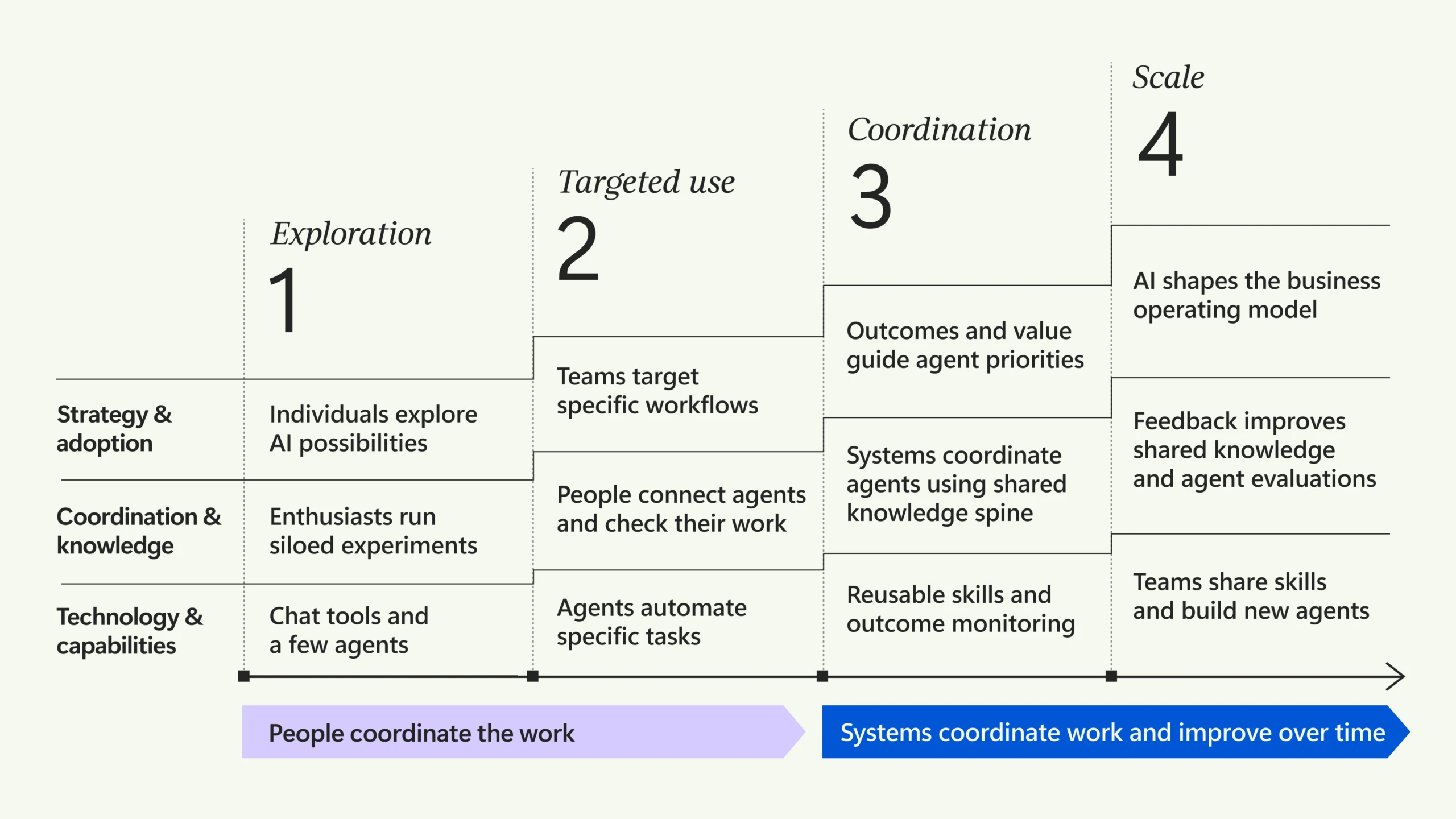
To provide a framework for understanding enterprise transformation, the researchers grouped the companies into four stages based on their scores on the questionnaire.6 Those in stage one exhibit a patchwork of AI pilot projects and often don’t have AI deployments beyond chat. The efforts lack coordination, are not connected to real business workflows, and seem to show minimal business impact.
At stage two, companies use agents to tackle real business. They target specific workflows across a variety of functions but lack systems for management and orchestration. Instead, they create teams and committees to prioritize AI investments, provide checks and balances, and manage scattered efforts. In essence, humans coordinate agents and check their work. Not surprisingly, human orchestration is hard to scale, which can make returns more difficult to realize.
Stage three is the turning point. Companies start using systems, not people, to coordinate agents—some by sharing a common knowledge base, others by closely monitoring agent work—with business outcomes guiding which work agents take on. Researchers heard from some companies that this mostly happens in parts of the business, such as one department or a few workflows, which is a practical place to start.
At stage four, these practices come together. Most have orchestration, governance, and a knowledge spine in place, and many feed lessons from agents’ work back into the shared knowledge and tests they rely on.7 That’s the direction of travel: a single agentic operating model, where systems take on more of the coordination and learning.
Four stages of enterprise transformation
Companies in the study were grouped into four stages of AI maturity. Stage three marks the start of a key breakthrough: shifting coordination of work from people to systems.
Where the returns show up
The team compared financial results from 2022 to 2025 for more than 100 public companies in the study, looking at how companies in the top two quartiles of questionnaire scores fared against those in the bottom quartiles. Companies that scored in the top quartile improved operating margins by over 5 percentage points more than those in the bottom quartile and return on assets by about 2 percentage points more.8 Put simply, the higher a company scored, the more its margins tended to grow. These financial results cover a span of time that precedes most of today’s agent systems. So the study can’t say agents drove those margins, only that the highest-scoring companies were already doing something right. Additional research is planned to test cause and effect.
Why did margins barely move for companies in the bottom two quartiles? The researchers point to an idea economists call the J-curve: when a major new technology arrives, the payoff can dip or lag while companies reorganize work around it, then climb once those changes take hold.9 With agents, the lag may come from deploying them faster than building the systems to coordinate them. Still, if the payoff can lag, how a company manages AI spending along the way matters.
Many firms start by giving employees broad access to AI. About half then set token or spending budgets for teams or tasks. A few go further and tie spend to results, for example by making heavy users justify a higher limit. Using fewer tokens isn’t necessarily the goal. It’s knowing what each good outcome costs. And a major cost can be people reviewing agents’ work—which is where the knowledge spine comes in.
A shared knowledge spine for agents
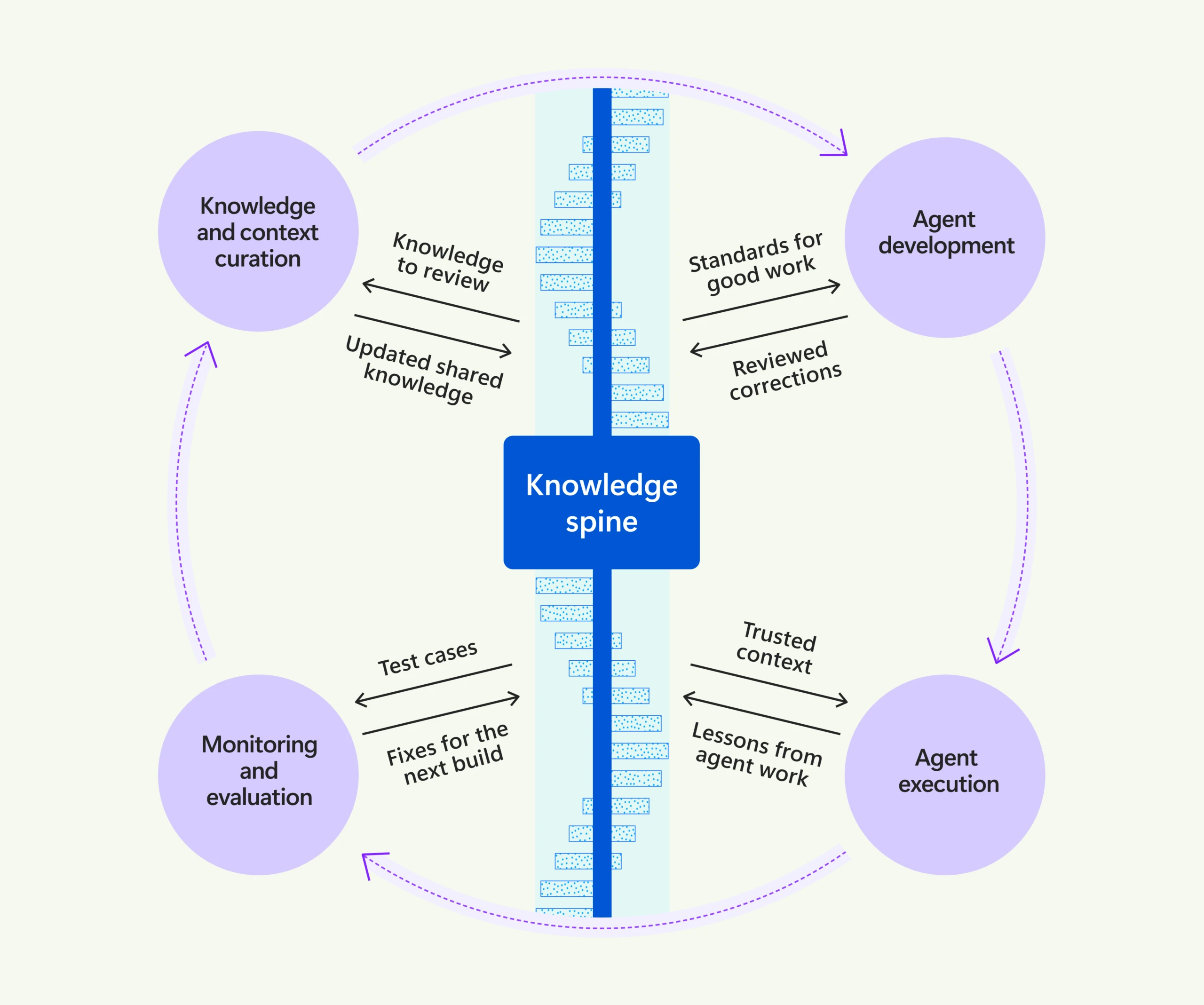
With a knowledge spine, a correction doesn’t stop with the agent that made the mistake—other agents learn from the interaction. A company’s agents draw on the same trusted knowledge of the business, and that knowledge can get better with each correction. The principle is simple, and it’s the thinking behind our enterprise intelligence layer, Microsoft IQ: update shared knowledge in one place and let every agent use it. That frees a company to focus on the part of the knowledge spine only it can produce: the corrections, tests, and lessons from its own work.
The knowledge spine ecosystem
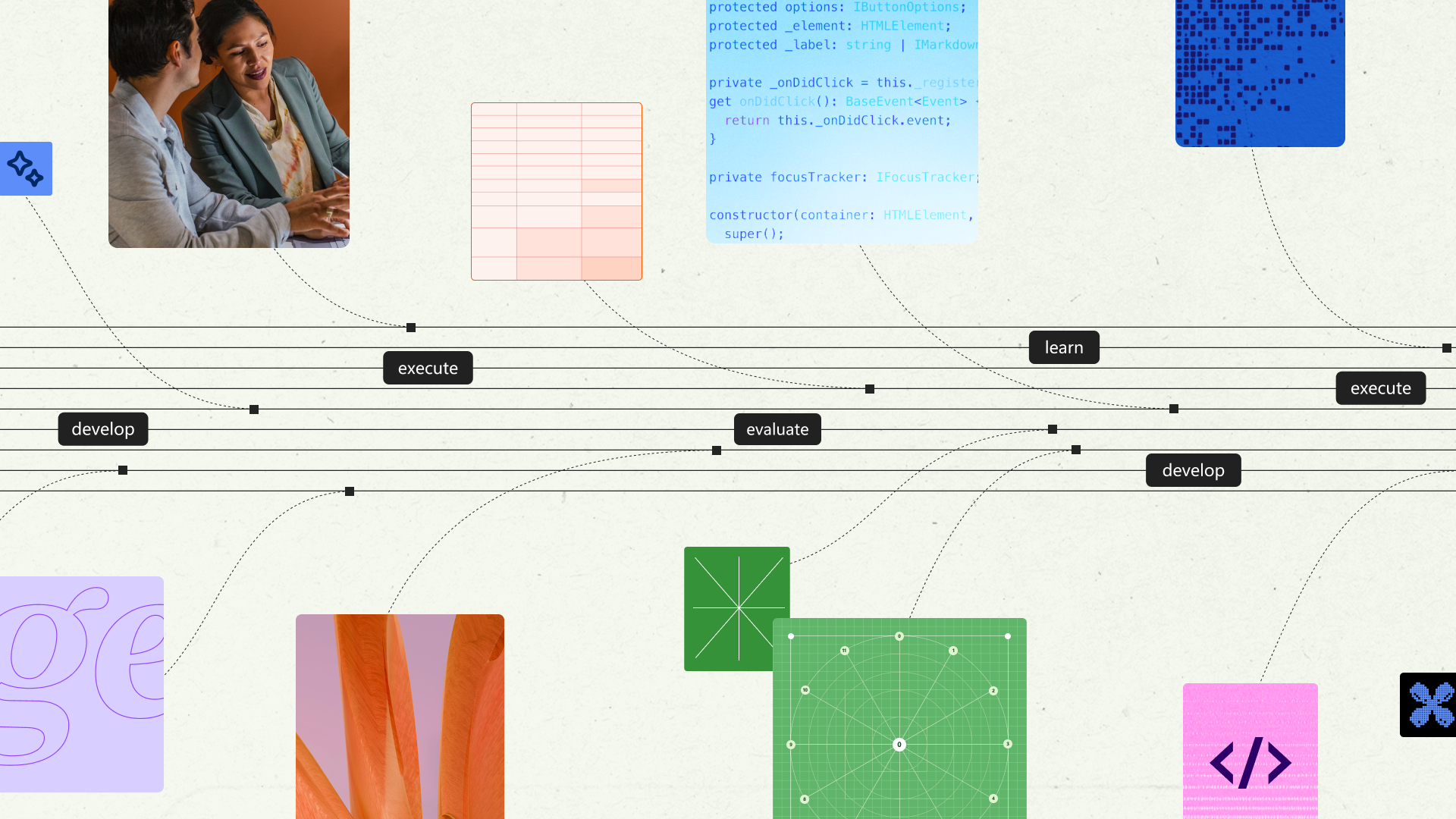
How connected agent activities can turn shared learning into proprietary know-how.
How to build a knowledge spine for agents
The enterprises building a knowledge spine embrace four practices other companies can consider adopting, for one team or the whole organization: First, collect context about business operations from diverse sources—chat applications, systems of record, internal documentation—and store it centrally so that agents can pull from the latest information. Second, treat fixes as information. When someone has to correct an agent’s output, turn that failure into a test case for the next version. Third, combine all that information to shape agent actions. Don’t stop at correcting an answer; change how the agent handles that kind of work. Finally, give the knowledge spine an owner. Someone needs to be accountable for which sources agents should rely on, what happens when those sources conflict, and when outdated information should be replaced.
Under those four practices is a shared principle: observability. Before an agent ships, the company creates a set of test cases with clearly defined expected results, including cases based on past errors. This is your golden dataset—a consistent way to check whether the agent’s work meets your standards. Later-stage firms also capture detailed operational telemetry on each action and attempt an agent makes, which allows them to more easily identify why agents need fixes and how to make them happen.10
When the record shows an agent getting it right, you can choose to widen what that agent may do on its own. When the agent gets something wrong you can pull it back. Agents earn their autonomy based on evidence.
Where to start
Building this system across an entire enterprise is challenging, and few companies will do it all at once. A practical path is to start in one part of the business: build the knowledge spine for a single team or a few connected workflows, prove it works, then extend it. The prize is still the firm-level system, where agents learn from one another across the organization. But you can start small and build toward it.
Three questions can help you and your team see where you stand: when someone corrects an agent, does that lesson reach any other agent? Do you have a shared standard for good work that sharpens whenever something goes wrong? And do you know who owns the knowledge your agents rely on? A “no” to any of these is a good place to begin.
This is the broad shift in enterprise AI: from models to systems, from AI capabilities to AI infrastructure, from isolated intelligence to coordinated intelligence. Models will keep changing. The lessons a company’s agents learn from their own work stay with it—and that’s an advantage to start building now. We see this research as a first step in helping our customers understand what works and how to build it. As more evidence emerges, we’ll continue to share it here. To go deeper on the findings and methodology, read Keystone’s Harvard Business School working paper, “Organizing AI at Enterprise Scale.”
1Sarkar, E., Abudurexiti, D., Beltinger, E., Daubenspeck, J., and Iansiti, M. (2026). “Organizing AI at Enterprise Scale: Agentic Operating Models and Firm Outcomes.” Harvard Business School Working Paper No. 27-038, October 2026. The research was funded in part by Microsoft and Keystone. Microsoft also shared field observations that informed hypotheses explored in the initial interviews; all other aspects of the research were conducted independently of Microsoft.
2Sarkar et al. (2026), Section 5.4 and Figure 5. Financial results for 2022–2025 were compared across questionnaire score groups for public companies in the study. Practices were measured in 2026, after this period, so the results show an association with past performance, not cause and effect.
3Sarkar et al. (2026), Section 5.2 and Table B5. Six of 202 companies (3%) reported all four practices that connect AI operations: an automatically updated agent registry, evaluations triggered by production signals, reuse of past error patterns in testing, and task-specific model selection.
4Sarkar et al. (2026), Section 4.1 and Table A1. Interviews with leaders at 29 organizations, including 18 AI-native startups and 11 established enterprises, informed the questionnaire.
5Sarkar et al. (2026), Section 4.2. Trained facilitators interviewed AI decision-makers at 202 US enterprises with more than 1,000 US employees between June and September 2026: 42 in financial services, 41 in manufacturing, 30 in software, 29 in healthcare and life sciences, 21 in retail, and 39 in other industries. All participants were actively using AI, so the sample doesn’t represent all US companies.
6Sarkar et al. (2026), Sections 5.2 and 6.1 and Figure 6. Statistical analysis identified five groups of companies with similar practices, which the researchers interpret as a proposed four-level maturity framework, described here as four stages, with two configurations at the third level. The levels describe differences among companies at one point in time; the paper treats movement between them as a hypothesis for future testing.
7Sarkar et al. (2026), Tables B2 and B4. Among stage four companies, 86% reported a live orchestration layer, 76% a shared context layer, and 90% a named owner for agent outcomes; 66% grow their evaluation sets with new production failures, and 33% automatically feed lessons from agent operations back into shared context.
8Sarkar et al. (2026), Section 5.4, Figure 5, and Table C3. Financial data from Capital IQ, 2022–2025, covering 113 public companies for return on assets and 97 for operating margin, adjusted for company size and industry. Companies in the top two quartiles of scores improved operating margins by about 5.4 percentage points more than those in the bottom quartiles, and return on assets by about 2.3 points more. By quartile, operating margins changed about +5.8 percentage points in the top quartile versus about +0.4 in the bottom; return on assets changed about +2.3 versus about 0.0.
9Sarkar et al. (2026), Figure 5 and Section 6.2. Adjusted operating margin changes from the lowest to highest quartile of scores were about +0.4, −0.3, +5.1, and +5.8 percentage points. The researchers describe this as a J-shaped pattern but note that statistical tests did not confirm its exact form.
10Sarkar et al. (2026), Table B3. 76% of companies in the top quartile of scores reported searchable records of agent activity, compared with 8% in the bottom quartile.